
The Mirage in the Maldives: A Cautionary Tale
The brochure on the coffee table looked like a portal to another world. It showed a wooden walkway stretching out over water so clear it looked like glass, leading to a thatched-roof bungalow where the only sound was the gentle lapping of the Indian Ocean against the stilts. For Mark and Elena, this wasn’t just a picture; it was the “Goal.” It was the finish line of a year-long marathon of strategic spending, credit card applications, and spreadsheet management. They called it “The Project.”
Mark, a graphic designer with a penchant for optimizing every aspect of his life, had stumbled upon a blog post titled “How I Flew First Class for $50.” The article detailed the world of “travel hacking”—the art of signing up for credit cards to collect massive welcome bonuses, then using those points to book luxury travel for pennies on the dollar. It sounded like magic. It sounded like the perfect way to give Elena, who had been working double shifts at the hospital, the honeymoon they never had.
“It’s simple math, El,” Mark had explained, his eyes wide with the fervor of the newly converted. “We spend money on groceries and gas anyway, right? So we just put that spending on these specific cards. We hit the ‘minimum spend’ requirement—say, $4,000 in three months—and boom, the bank gives us 80,000 points. Those points are worth $1,200 in flights. We do that three or four times, and we’re in the Maldives.”
Elena was skeptical. “But we still have that balance on the Visa from when the car broke down,” she noted, pointing to a $2,500 debt they had been chipping away at for months. “And the interest rate on that is pretty high.”
“That’s the beauty of it,” Mark insisted. “The value of the points is so high—like 5% or 10% return on spending—that it crushes the interest rate. Plus, we’ll get a 0% introductory card to transfer the balance. We’ll hack the system.”
So, “The Project” began.
The first month was exhilarating. A shiny metal card arrived in the mail—heavy, prestigious, clattering satisfyingly onto the table. They shifted all their bills to it. But the minimum spend requirement was $4,000, and their normal budget was only $3,000.
“We need to spend another thousand to unlock the bonus,” Mark said, tapping his calculator. “If we miss it, we get nothing.”
So, they improvised. They bought a new espresso machine (“We’ll save on coffee shop runs,” they justified). They pre-paid six months of car insurance. They went out to a celebratory dinner at a steakhouse. They hit the $4,000 target. The notification popped up on Mark’s phone: Congratulations! You’ve earned 80,000 points. The dopamine hit was visceral, a rush of excitement that felt like winning the lottery.
Encouraged, Mark applied for two more cards. One for hotel points, one for airline miles. The minimum spend requirements stacked up: $4,000 here, $3,000 there. Suddenly, they needed to spend $7,000 in three months just to “win” the game. The logic of “we spend this anyway” vanished. They were now spending to earn.
Then, life happened. The roof developed a leak ($1,200). Elena’s hours were cut slightly. The 0% balance transfer card Mark had planned to get for the old debt? He was rejected because he had opened too many new accounts in a short time.
Six months later, they were in the Maldives. The view was exactly like the brochure. The water was turquoise, the sand was white, and the champagne was cold. Mark posted a photo to Instagram: #TravelHacking #FreeTravel #LivingTheDream.
But that night, as the tropical breeze blew through the bungalow, Mark sat on the edge of the bed, his head in his hands. He had just checked their banking app.
The “free” trip had cost them $400 in taxes and fees, which was fine. But the aggressive spending to hit the bonuses had ballooned their total credit card debt from $2,500 to $14,000. They hadn’t paid off the balances in full because they were always prioritizing the new card’s minimum spend over the old card’s balance.
The interest rates on the rewards cards were punishing—24.99%.
Mark did the math he had avoided for months.
- Total Debt: $14,000
- Interest Rate: ~25%
- Annual Interest Cost: $3,500
They were paying nearly $300 a month just in interest. The flights and hotel they had “hacked” were valued at about $4,000. In just over a year of carrying this debt, they would pay the bank more in interest than the entire value of the trip. And they would still owe the $14,000.
The “free” vacation was actually a loan with a predatory interest rate, disguised as a prize. The stress of the debt washed over the beauty of the lagoon, turning the crystal water into a reminder of what they couldn’t afford. They had played a game against a casino that knew exactly how to rig the odds. And the house had won.
This story is a composite of thousands of similar experiences shared on forums, in financial therapy sessions, and in debt consolidation offices around the world.1 It illustrates the central thesis of this report: When debt is present, travel hacking is not a strategy; it is a trap.
Part I: The Mathematics of the Trap
To understand why travel hacking is dangerous for anyone carrying a balance, we must look past the marketing and at the raw numbers. The credit card industry thrives on a simple imbalance: the difference between what they give you (Rewards) and what they charge you (Interest).
1.1 The Great Imbalance: 2% vs. 22%
The fundamental rule of credit card rewards is the “rebate.” When you spend money, the bank gives you a small percentage back.
- Standard Reward Rate: Most good rewards cards offer between 1% and 2% back in value. If you spend $100, you get $2.3
- Standard Interest Rate (APR): If you do not pay that $100 back immediately, the bank charges you interest. The average Annual Percentage Rate (APR) for rewards cards is significantly higher than for standard cards. In 2025, this average sits around 22% to 24% globally, with some cards reaching nearly 30%.4
This creates a mathematical chasm.
Imagine you buy a $1,000 television on a credit card to earn points.
- The Reward: You earn 2% back. That is $20.
- The Cost: You carry the balance for a year at 22%. You pay $220 in interest.
In this scenario, you have paid the bank $220 to receive a $20 gift card. You are $200 in the hole.
To break even—just to get back to zero—you would need to earn $220 in rewards. At a 2% earning rate, you would need to spend $11,000. But if you carry that $11,000 as debt, the interest grows even faster. It is a race you cannot win. As one financial analysis noted, to offset the interest on a significant debt using only rewards, you would need to spend millions of dollars, which is impossible for the average household.3
1.2 The Mechanics of Interest: A Silent Killer
Many consumers misunderstand how credit card interest works. It is not charged once a year; it is calculated daily and added to your balance every month. This is called “compounding.”
When you are chasing a “Sign-Up Bonus” (SUB), you are often required to spend a large amount, such as $4,000 in three months. If you cannot pay this off immediately, you trigger the interest clock.
- Scenario: You spend $4,000 to get a bonus worth $750. You now have $4,000 in debt.
- Repayment: You pay the minimum payment (usually about 2% of the balance) plus a little extra, say $150 a month.
- Outcome: At 24% interest, it will take you years to pay off that $4,000. By the time you finish, you will have paid nearly $3,000 in interest.
- Net Result: The $750 bonus minus $3,000 in interest equals a net loss of $2,250.
The bank knows this. They design the “minimum spend” requirements specifically to stretch your budget just enough that you might fall behind. Once you carry a balance, the value of the points evaporates instantly. This establishes the golden rule of the industry: Interest always eats rewards..6
1.3 The Data on Interest Rates vs. Reward Rates
To visualize this disparity, let us look at the data across different card types. Notice how as the potential for rewards goes up, the cost of debt (APR) also skyrockets.
| Card Type | Typical Reward Rate | Average APR (Interest Rate) | The “Trap” Gap |
| Low-Interest Card | 0% | 13% – 17% | N/A |
| Cash Back Card | 1.5% – 2% | 20% – 27% | -25% Spread |
| Travel/Airline Card | 1.5% – 2.5% | 22% – 29.99% | -27% Spread |
| Store/Retail Card | 3% – 5% (store only) | 26% – 33% | -28% Spread |
Table 1: Comparison of Reward Potential vs. Interest Costs 5
The data shows that “Travel Rewards Cards” are among the most dangerous financial products for anyone who revolves a balance. They have some of the highest interest rates in the market, often exceeding 29% for penalty rates. The “Trap Gap” represents the massive difference between what you earn and what you pay.
Part II: The Global Landscape of Danger
While the mathematics of “2% vs 22%” is universal, the specific dangers vary depending on where you live. The “Travel Hacking” hobby originated in the United States, but as it spreads globally, it encounters different regulations that make it even riskier for international consumers.
2.1 The United States: The High-Stakes Casino
In the US, banks make money every time you swipe your card through “interchange fees.” Merchants pay about 2-3% of the transaction to the bank. This massive revenue stream allows US banks to offer huge sign-up bonuses (e.g., 100,000 points) and high reward rates.
- The Trap: Because the rewards are so high, the temptation is massive. A consumer sees a 100,000-point offer (worth ~$1,000) and thinks, “I’d be crazy not to take this.” This lures people into opening cards they can’t afford.
- The Debt: The average US household carries thousands in credit card debt. The high rewards act as bait to keep this system running.6
2.2 The United Kingdom and Europe: The “Low Reward, High Risk” Zone
In the UK and the European Union, the government stepped in to protect merchants. They capped interchange fees at roughly 0.3%.11
- The Consequence: Banks in Europe make much less money from swipes. Therefore, they give much less back to the customer. British and European credit cards rarely offer the massive bonuses seen in the US. A “good” card might offer 0.5% or 1% back.
- The Danger for Debtors: This makes the math even worse for UK/EU citizens. If you are earning only 0.5% in rewards but paying 27% or even 40% interest (common on UK sub-prime reward cards), you are being financially decimated. There is no “big bonus” to bail you out. Carrying debt on a rewards card in Europe is pure financial loss with almost zero upside.8
2.3 Australia: The High Fee Hurdle
Australia also limits interchange fees, leading to a system where banks charge the customer directly to make up the difference.
- Annual Fees: Australian rewards cards often come with massive annual fees, sometimes $400 or more.9
- The Calculation: An Australian user must earn enough points to cover the $400 fee plus the interest. If you have debt, this is nearly impossible. You are paying a fee for the privilege of paying interest. Australian financial experts explicitly warn that rewards cards are a “losing game” for anyone who doesn’t pay in full every month.14
2.4 Canada: High Rates, Moderate Rewards
Canada sits between the US and the EU. Interchange fees are higher than in Europe, so rewards are decent, but interest rates are stubbornly high, typically 19.99% to 25.99%.15
- The Trap: Canadian banks aggressively market “low interest” cards (around 12-14%) versus “rewards” cards (20%+). Consumers often choose the rewards card out of optimism (“I’ll pay it off!”), only to get stuck with the higher rate when an emergency hits.17
Global Conclusion: No matter where you live, the banking system is designed so that the “House” (the bank) wins whenever you carry a balance. In the US, they lure you with big bonuses; elsewhere, they extract value through fees and high interest with very little return for you.
Part III: The Psychology of the Swipe
If the math is so clearly bad, why do millions of people still do it? Why do people with $5,000 in debt sign up for a new card to get airline miles? The answer lies in your brain.
Neuroscience and behavioral psychology have revealed that credit cards are not just payment tools; they are psychological triggers that alter how we make decisions.
3.1 The “Pain of Paying”
When you buy something with cash, you physically hand over paper bills. You see them leave your wallet. You feel a sense of loss. Psychologists call this the “Pain of Paying.” It acts as a natural brake on spending. Your brain registers a negative emotion that says, “Stop, this hurts.”.18
Credit cards act as a local anesthetic. They remove the pain. You swipe a piece of plastic (or tap a phone), and nothing leaves your hand. You get the product immediately, but the “loss” (the bill) is pushed weeks into the future.
- The Result: Studies show people are willing to spend up to 100% more on an item when using a credit card compared to cash. You are more likely to buy the expensive steak, the upgraded hotel room, or the designer shoes because the pain signal has been silenced.18
3.2 The Dopamine Loop and “Stepping on the Gas”
It gets worse. Recent studies using fMRI brain scanners have shown that credit cards don’t just reduce pain; they actively stimulate pleasure.
- The Striatum: This is the part of the brain responsible for reward processing. It lights up when you anticipate a reward, flooding your brain with dopamine. It is the same region targeted by addictive drugs and gambling.
- The Discovery: When people shop with credit cards—especially rewards cards—their striatum activates before the purchase. The card itself has become a “conditioned cue” for reward. The brain thinks, “I am not losing money; I am gaining points!”.19
- Stepping on the Gas: Researchers describe this as “stepping on the gas.” The credit card accelerates your desire to spend. For someone in debt, this is disastrous. Your rational brain knows you can’t afford it, but your emotional brain is screaming “Go!” to get the points and the dopamine hit.19
3.3 The Gamification of Debt
Banks hire teams of psychologists and data scientists to make their apps as addictive as possible. This is called Gamification.
- Progress Bars: Apps show you a bar filling up as you get closer to a “Sign-Up Bonus.” This triggers the “Goal Gradient Effect”—we try harder the closer we get to a goal. You might spend money on things you don’t need just to fill the bar.22
- Status Tiers: “Spend $10,000 to reach Platinum Status!” This appeals to our need for social status and exclusivity. People will go into debt just to have a metal card that clinks on the table, signaling (falsely) that they are wealthy.18
- The “Free” Fallacy: We overvalue “free” things. We will pay $500 in interest to get a “free” flight worth $300. The word “free” short-circuits our logical pricing models.
For a person already struggling with debt, these psychological tricks make it nearly impossible to stick to a budget while using a rewards card. The deck is stacked against your willpower.
Part IV: The Dangerous Myths of “Travel Hacking”
To keep you playing the game, the travel hacking community and the banks perpetuate several myths. These sound logical, but they crumble under scrutiny when debt is involved.
Myth 1: “I’m Spending to Save”
The Claim: “I need to buy this new laptop anyway, so I might as well put it on the card to get the points. It’s like getting a discount.”
The Reality: This is known as the “Spending to Save” Fallacy. If you have cash in the bank to pay for the laptop right now, then yes, the points are a rebate. But if you put it on a card and take three months to pay it off, the interest eats the “discount.” Furthermore, the pressure of the “minimum spend” often forces people to buy things they don’t need.
- Horror Story: One Reddit user admitted to prepaying thousands in utility bills and buying gift cards to hit a bonus, only to realize they had drained their actual cash flow and couldn’t pay their rent. They ended up taking a high-interest loan to cover the rent, wiping out the value of the points ten times over.23
Myth 2: “I Can Manage the Minimum Spend with ‘Manufactured Spending’”
The Claim: “I’ll just buy gift cards or money orders to hit the spending requirement, then use them to pay the bill. It’s free points!”
The Reality: This is called Manufactured Spending (MS). It is incredibly risky.
- Risk 1: Banks hate this. If they catch you (and they have algorithms to catch you), they will shut down your accounts and confiscate your points.
- Risk 2: You can get stuck. Imagine buying $3,000 worth of gift cards, only to find you can’t liquidate them back to cash to pay your bill. Now you have a $3,000 credit card bill due in 20 days and a pile of plastic cards you can’t use to pay it. You are now in high-interest debt.23
Myth 3: “I’ll Just Use the Points to Pay the Debt”
The Claim: “If I get into trouble, I’ll just cash out the points to pay off the card.”
The Reality: This is the worst possible use of points.
- Devaluation: Points are usually worth 1 to 2 cents when used for travel. When used for cash back or statement credits, banks often slash the value to 0.5 cents or 0.6 cents.24
- The Math: If you spend $4,000 to get 50,000 points, those points might buy you a $1,000 flight. But if you cash them out, the bank might only give you $250. You spent $4,000 to get $250. That is a terrible return, especially if you are paying interest on the $4,000.26
Part V: The Industry Architecture (How Banks Profit)
To win the game, you must understand your opponent. Banks categorize credit card users into two buckets:
- Transactors (The “Deadbeats”): These people pay their bill in full every month. They pay zero interest. The bank actually loses money on them in the short term, or breaks even via merchant fees. The industry jokingly calls them “deadbeats” because they don’t generate profit from interest. These are the successful travel hackers.
- Revolvers (The Cash Cows): These people carry a balance. They pay interest. This is you if you have debt. The interest payments from Revolvers are what fund the rewards for the Transactors.3
The Hard Truth: When you try to travel hack while in debt, you are not the player; you are the prize. Your interest payments are subsidizing the free champagne and First Class seats for the people who pay in full. You are paying for their vacation.
Banks market rewards cards aggressively to Revolvers because they know the psychology works. They know the promise of points will keep you spending and revolving. One study found that people in the middle-income bracket (who are most likely to carry debt) suffer the most mental health stress from this cycle, yet they are the prime targets for these products.27
Part VI: The Hidden Costs of the Game
Beyond the direct cost of interest, playing the credit card game with debt causes collateral damage to your financial life.
6.1 The Credit Score Impact
“Building credit” is often cited as a reason to get more cards. But for a debtor, it often backfires.
- Utilization Spikes: Your credit score relies heavily on “Utilization”—how much of your limit you use. If you max out a new card to hit a bonus, your utilization spikes, and your score drops.28
- Hard Inquiries: Every application dings your score. If you are desperate for credit, these pile up and look risky to lenders.29
- Rejection: If you have high debt, you might apply for a premium card and get rejected. Now you have a hard inquiry on your report, a lower score, and no new card to show for it.
6.2 Insurance and Life Costs
In many countries (especially the US), your credit score affects your insurance premiums. A lower score caused by high credit card utilization can double your car insurance or homeowner’s insurance rates. That “free” trip could cost you hundreds of dollars a year in higher insurance premiums, a cost you might never connect to your travel hacking habit.6
6.3 The Opportunity Cost
This is the cost of what you could have done with your money.
If you are paying $2,000 a year in credit card interest, that is $2,000 you are not investing.
- Compound Interest (Good Kind): If you invested that $2,000 a year in a boring index fund for 20 years, it could grow to over $90,000.
- The Trade: By chasing points and paying interest, you are effectively trading $90,000 of your future retirement for a few flights today. It is a catastrophic trade-off.3
Part VII: The Exit Strategy (How to Escape)
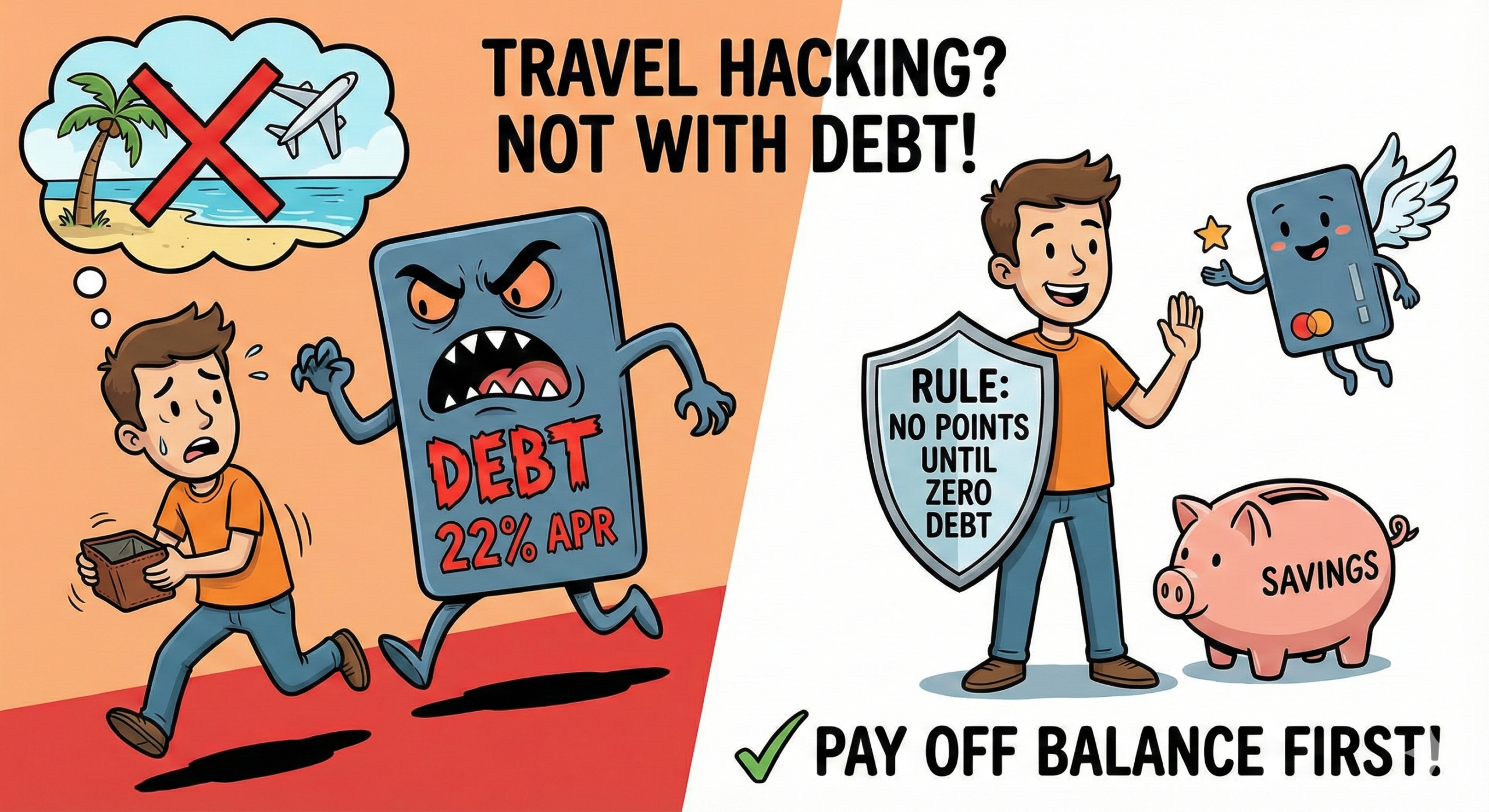
If you are reading this and realizing you are in the trap—holding debt while chasing points—do not panic. But you must stop digging. Here is the rule: No Points Until Zero.
You must resign from the travel hacking game immediately. Here is your roadmap out.
Step 1: Cold Turkey Detox
You cannot outsmart the dopamine loop while still using the cards. You need to break the physical habit.
- Action: Take all credit cards out of your wallet. Delete them from Apple Pay, Google Pay, and Amazon.
- The Ice Method: Literally freeze your cards in a block of ice in your freezer. If you want to buy something, you have to wait for it to melt. This forces a “cooling off” period that re-introduces the pain of paying and kills impulse buys.30
- Switch to Debit/Cash: Research shows that using cash drastically reduces spending. You will feel the “pain” again, and that is good. It will help you save.19
Step 2: Choose Your Weapon (Snowball vs. Avalanche)
You need a strategy to pay off the debt. There are two main methods:
- The Avalanche Method (The Mathematical Choice):
- List all debts.
- Attack the one with the highest interest rate first (e.g., that 24% rewards card).
- Pay minimums on everything else.
- Why: This saves you the most money in interest over time.31
- The Snowball Method (The Psychological Choice):
- List all debts by balance size (smallest to largest), ignoring interest rates.
- Attack the smallest debt first (e.g., that $500 balance).
- Why: When you pay it off, you get a “Win.” You get a dopamine hit—a real one, not a fake one from points. This motivates you to attack the next debt. For many people, this behavioral momentum is more effective than the pure math.32
Step 3: Liquidate if Necessary
If you are drowning, forget the “value” of the points.
- Emergency Option: If you have 100,000 points sitting there and you are paying 25% interest, cash them out for a statement credit. Yes, it’s a “bad value” (0.5 cents per point), but getting out of debt is more important than optimizing a vacation. Use the points to kill the principal.26
Step 4: The Rule of Zero
You are not allowed to play the game again untill:
- All credit card debt is $0.
- You have an emergency fund of 3-6 months of expenses.
- You have a budget that allows you to pay your bill in full every single month on autopay.
Only then can you become a “Transactor” and win the game.
Conclusion: The Golden Rule
Mark and Elena eventually learned their lesson. They stopped chasing the next bonus. They cut up the high-fee cards. They spent two years living frugally, using the “Snowball Method” to pay off the $14,000. It was hard. It wasn’t glamorous. There were no Instagram photos of overwater bungalows.
But the day they made that final payment—the day the balance hit $0.00—they felt a freedom that no airline mile could ever buy.
The world of travel hacking is seductive. It sells a dream of luxury without cost. But the math, the psychology, and the industry itself are rigged against anyone who carries debt. The interest rates are too high, the psychological triggers are too strong, and the margins are too thin.
If you have debt, the most profitable “travel hack” you can ever perform is simply paying it off.
The Golden Rule: No points until the debt is zero.
Works cited
- 4 Lessons from My Credit Card Points and Miles Journey | Morningstar, accessed December 8, 2025, https://www.morningstar.com/personal-finance/4-lessons-my-credit-card-points-miles-journey
- The Psychology of Debt – Homewood Health Centre, accessed December 8, 2025, https://homewoodhealthcentre.com/articles/the-psychology-of-debt/
- Credit Card Hacking for Travel | White Coat Investor, accessed December 8, 2025, https://www.whitecoatinvestor.com/credit-card-hacking-for-travel-407/
- Current Credit Card Interest Rates – Experian, accessed December 8, 2025, https://www.experian.com/blogs/ask-experian/research/current-credit-card-interest-rate/
- Average Credit Card Interest Rate in US Today | LendingTree, accessed December 8, 2025, https://www.lendingtree.com/credit-cards/study/average-credit-card-interest-rate-in-america/
- Miles & Points 101: How Credit Cards Affect Your Credit Score – Daily Drop, accessed December 8, 2025, https://www.dailydrop.com/pages/miles-points-101-how-credit-cards-affect-your-credit-score
- Is getting a credit card for the flight points worth it? : r/travel – Reddit, accessed December 8, 2025, https://www.reddit.com/r/travel/comments/11zrol0/is_getting_a_credit_card_for_the_flight_points/
- What is the average credit card APR in the UK? – Finder, accessed December 8, 2025, https://www.finder.com/uk/credit-cards/average-credit-card-interest-rate-apr-uk
- Low-Rate vs Rewards Credit Cards in Australia – Econnex, accessed December 8, 2025, https://www.econnex.com.au/credit-cards/blogs/low-rate-vs-rewards-credit-cards
- Why Do UK Credit Cards suck compared to the US? : r/HENRYUK – Reddit, accessed December 8, 2025, https://www.reddit.com/r/HENRYUK/comments/1irgkoe/why_do_uk_credit_cards_suck_compared_to_the_us/
- Report on the application of Regulation (EU) 2015/751 on interchange fees for card- based payment transactions – Competition Policy, accessed December 8, 2025, https://competition-policy.ec.europa.eu/system/files/2021-10/IFR_report_card_payment.pdf
- Study on the application of the Interchange Fee Regulation – Copenhagen Economics, accessed December 8, 2025, https://copenhageneconomics.com/publication/study-on-the-application-of-the-interchange-fee-regulation/
- The reality of credit card rewards programs: are they worth it? – MyBudget, accessed December 8, 2025, https://www.mybudget.com.au/blog/credit-cards/credit-card-rewards-programs-are-they-worth-it/
- Are Credit Card Rewards Points Worth It? – HPartners, accessed December 8, 2025, https://hpartners.com.au/are-credit-card-rewards-points-worth-it/
- How does credit card interest rate work – Royal Bank, accessed December 8, 2025, https://www.rbcroyalbank.com/en-ca/my-money-matters/money-academy/credit-and-borrowing/understanding-credit-cards/how-does-credit-card-interest-rate-work/
- Average Credit Card Interest Rate In Canada | KOHO, accessed December 8, 2025, https://www.koho.ca/learn/average-credit-card-interest-rate-in-canada/
- Best Low-Interest Credit Cards In Canada | 2025 – NerdWallet, accessed December 8, 2025, https://www.nerdwallet.com/ca/p/best/credit-cards/best-low-interest-credit-cards
- Swipe, Spend And Regret: The Sneaky Psychology Of Credit Card Spending | Bankrate, accessed December 8, 2025, https://www.bankrate.com/credit-cards/advice/psychology-of-credit-card-spending/
- How credit cards activate the reward center of our brains and drive spending | MIT Sloan, accessed December 8, 2025, https://mitsloan.mit.edu/experts/how-credit-cards-activate-reward-center-our-brains-and-drive-spending
- The Psychology of Spending: Why Your Brain Wants You to Buy More – keepm, accessed December 8, 2025, https://keepm.granitlabs.com/blog/psych-spending
- Neural mechanisms of credit card spending – PMC – NIH, accessed December 8, 2025, https://pmc.ncbi.nlm.nih.gov/articles/PMC7892835/
- BNPL Loyalty Programs Explained: Games, Rewards, and Responsible Use of ‘Buy Now Pay Later’ Plans – Credit Counselling Society, accessed December 8, 2025, https://nomoredebts.org/blog/learn-about-credit/bnpl-loyalty-programs-explained-games-rewards-and-responsible-use-of-buy-now-pay-later-plans
- Confessions of a Churning Addict (with some words of caution) : r/CreditCards – Reddit, accessed December 8, 2025, https://www.reddit.com/r/CreditCards/comments/tsjicz/confessions_of_a_churning_addict_with_some_words/
- Cash Back vs. Travel Rewards: How to Choose – NerdWallet, accessed December 8, 2025, https://www.nerdwallet.com/credit-cards/learn/cash-back-vs-travel-how-to-choose-your-credit-card-rewards
- How to choose your first credit card: Understanding reward points, cashback and category bonuses, accessed December 8, 2025, https://m.economictimes.com/wealth/spend/how-to-choose-your-first-credit-card-understanding-reward-points-cashback-and-category-bonuses/articleshow/125800519.cms
- I’m finally free of CREDIT CARD debt! So… how should I *actually* be using credit cards? – Reddit, accessed December 8, 2025, https://www.reddit.com/r/personalfinance/comments/jwjj4d/im_finally_free_of_credit_card_debt_so_how_should/
- Credit Card Blues: The Middle Class and the Hidden Costs of Easy Credit – PubMed Central, accessed December 8, 2025, https://pmc.ncbi.nlm.nih.gov/articles/PMC4707673/
- How Does Credit Utilization Affect Your Credit Score? – Centier Bank, accessed December 8, 2025, https://www.centier.com/resources/articles/article-details/how-does-credit-utilization-affect-your-credit-score
- Do Credit Inquiries Lower Your FICO Score? – myFICO, accessed December 8, 2025, https://www.myfico.com/credit-education/credit-reports/does-checking-credit-score-lower-it
- 5 Surprisingly Fun Psychology Tricks to Help You Get Out of Debt – Chartway, accessed December 8, 2025, https://www.chartway.com/post/5_surprisingly_fun_psychology_tricks_to_help_you_get_out_of_debt.html?psrc=788
- Strategies to Help You Pay Off Debt | Equifax, accessed December 8, 2025, https://www.equifax.com/personal/education/debt-management/articles/-/learn/paying-off-debt-strategies/
- How to Pay Off Credit Card Debt – Experian, accessed December 8, 2025, https://www.experian.com/blogs/ask-experian/credit-education/how-to-pay-off-credit-card-debt/