
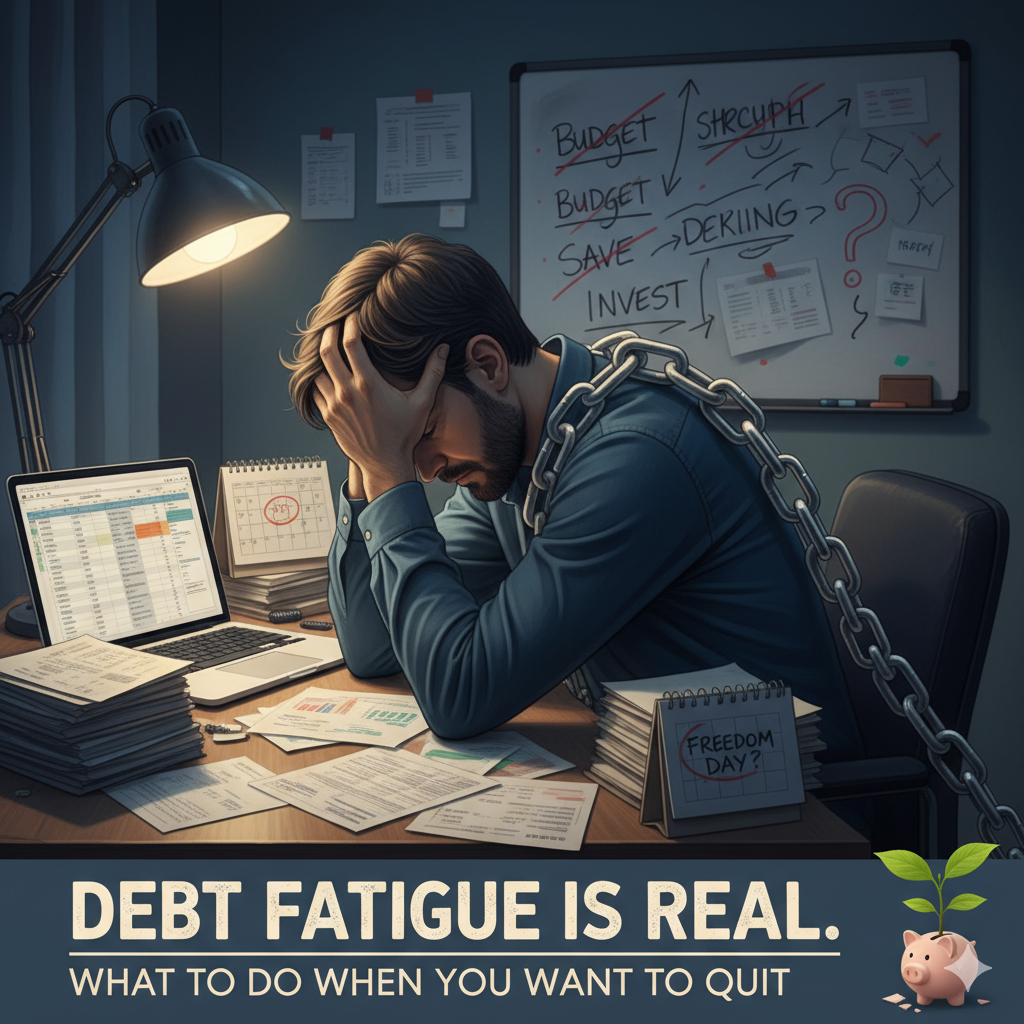
By the 18th month, the silence in Elias’s kitchen was louder than the debt itself.
When Elias first calculated his total debt two years ago—$48,000 spread across credit cards and a student loan—the moment had been dramatic. It was a scene straight out of a movie: the “Inciting Incident.” He had cut up his credit cards with ceremonial scissors. He had downloaded a budgeting app that pinged with a cheerful sound. He felt a surge of adrenaline, a warrior preparing for battle. He was the protagonist of his own redemption story.
But now? Now he was in the “Middle.”
The adrenaline was long gone. The cheerful pings of the app had become annoying reminders of what he couldn’t afford. He had paid off $15,000, a massive achievement, but he still had $33,000 to go. The finish line was too far away to see, and the starting line was too far back to remember.
Elias was experiencing Debt Fatigue. He didn’t need a financial advisor to tell him the math; he knew the math. He needed a psychologist to explain why he suddenly wanted to burn his budget and book a flight to Tokyo.
This isn’t just Elias’s story. It is the invisible geography of the financial journey. Most financial advice focuses on the explosive start or the confetti-filled finish. But the reality of debt is lived in the long, gray winter of the middle. If you are there right now—bored, exhausted, and feeling guilty for being ungrateful—you are not weak. You are fighting biology.
Here is how to survive the slump, validate the boredom, and gamify the most dangerous part of the journey.
Act I: The Diagnosis (Why You Want to Quit)
Elias sat at his table, staring at a spreadsheet that hadn’t changed much in three months. He felt a heavy, apathy-induced fog. He assumed he was just lazy.
In reality, his brain was reacting to the Goal Gradient Hypothesis.
Decades ago, behaviorist Clark Hull watched rats running through mazes. He noticed something peculiar: the rats didn’t run at a steady pace. They ran slowly in the middle and sprinted only when they could see the cheese. Motivation, it turns out, is a function of proximity.
When Elias started, the “novelty” was his cheese. When he finishes, the “freedom” will be his cheese. But right now, at the 35% mark, he is in the “Valley of Death.” He is untethered.
To make matters worse, he is fighting the Small Area Hypothesis. The human brain loves to focus on whichever number is smaller.
- At the start, you look back: “Wow, I paid off $2,000! That’s huge compared to zero!”
- At the end, you look forward: “Only $2,000 left! I’m almost there!”
- But in the middle? The progress behind you looks small, and the mountain ahead looks huge. The brain has no “small area” to trick itself with.
Elias wasn’t failing; he was just in a cognitive dead zone. He realized that relying on willpower—which psychologists call a depletable resource, like a muscle that gets tired—was a losing strategy. He didn’t need to “try harder.” He needed to change the game.
Act II: Gamification (Hacking the Brain)
If the brain won’t run without seeing the cheese, Elias realized he had to paint a picture of the cheese and hang it right in front of his nose. He had to turn his boring spreadsheet into a video game. He needed Gamification.
1. The Visual Strategy: Coloring for Adults
Elias put away his Excel sheet. It was too abstract. Digital numbers on a screen don’t feel real to the primate brain. He went online and found a “Debt Map”—a black-and-white drawing of a winding road that looked like a board game level.
He taped it to his refrigerator. Each square on the road represented $100. That Friday, when he made a $200 payment, he didn’t just click “submit.” He took a red marker and physically colored in two squares.
It sounds childish, but the effect was immediate. He was engaging his motor cortex and his visual cortex. He wasn’t “losing” $200 to a bank; he was “gaining” two red squares. He was conquering territory. This is known as the IKEA Effect: we value things more when we labor over them. His debt was becoming a piece of art.
2. The Haptic Strategy: The Paper Clip Jar
Still, he needed something he could feel. He read about a stockbroker who made $5 million by moving 120 paper clips from one jar to another, one for every sales call.
Elias placed two glass jars on his desk. One was labeled “FREEDOM,” and it was empty. The other was labeled “DEBT,” and it was filled with 330 marbles (each representing $100).
Every time he made a payment, he moved marbles. Clink. Clink. The sound was satisfying. The weight of the marbles moving from one jar to the other provided haptic feedback. It turned the invisible subtraction of money into a tangible addition of progress. On days he felt stuck, he could shake the “Freedom” jar and hear how far he had come.
3. The “Seinfeld” Strategy: Don’t Break the Chain
To handle the daily boredom, Elias adopted Jerry Seinfeld’s productivity hack. The comedian famously used a wall calendar and marked a big red ‘X’ every day he wrote a joke. His only goal: “Don’t break the chain.”.
Elias bought a calendar. His goal wasn’t “pay $1,000.” That was too hard. His goal was “Do one financial thing.”
- Monday: Packed a lunch. (Mark an X).
- Tuesday: Read a finance blog. (Mark an X).
- Wednesday: Checked the Kakeibo journal. (Mark an X).
The streak became the motivator. He didn’t want to see a blank square on the calendar. He shifted his focus from the outcome (which was years away) to the process (which was today).
Act III: The Philosophy of “Kakeibo”
Gamification got Elias moving again, but he was still miserable. He felt deprived. He was turning down dinner invitations and wearing old clothes. He felt like life was on pause.
Then he discovered Kakeibo (pronounced kah-keh-boh), the Japanese “household financial ledger” invented in 1904.
Western budgeting asks: How much money can I save? Kakeibo asks: How much money do I need to spend to live well?
Elias bought a physical notebook. Kakeibo forced him to categorize expenses into four pillars:
- Needs: (Rent, groceries).
- Wants: (Takeout, new games).
- Culture: (Books, museums, films).
- Unexpected: (Medical, repairs).
The “Culture” category changed everything. Before, Elias thought buying a book was a “waste.” Kakeibo validated it as nourishment for the soul. It taught him that debt repayment shouldn’t be a punishment. By mindfully writing down his expenses, he slowed down. He stopped “revenge spending” (buying things just to feel control) and started spending with intent. He realized he could buy a $15 book without guilt if it was categorized as “Culture,” provided he cooked dinner at home to balance it.
Act IV: The Middle Slump and the “VIP Day”
Eight months later, Elias hit the “Wall” again. He was 50% done. The “Small Area Hypothesis” was failing him—the road behind was equal to the road ahead. He felt the urge to quit.
Instead of quitting, he initiated a Micro-Milestone Celebration.
He realized he had been waiting for the “End” to be happy. But the “End” was still a year away. He needed to celebrate the “Middle.” He created a VIP Day. He didn’t spend money. Instead, he told his partner, “I hit 50%.” For that Saturday, Elias was the VIP. He chose the movie. He chose the hiking trail. He took a long bath. He ate the last piece of cake. It was a ritual. It signaled to his subconscious: Paying off debt leads to good things.
He also changed his mathematical strategy. He had been using the “Avalanche Method” (paying high-interest cards first), which is mathematically superior but psychologically slow. He switched to the Snowball Method. He took a small $400 medical bill and paid it off in one go. Boom. Gone. The rush of closing an account—even a small one—gave him the dopamine hit he needed to tackle the big loan again. He traded mathematical efficiency for psychological fuel.
Act V: The Arrival
Two years and three months after he started, Elias moved the final marble.
He transferred the last payment. He waited for the fireworks. He waited for the movie soundtrack. Instead, he just felt… quiet.
He walked into his kitchen. It looked the same. He made coffee. This is the Arrival Fallacy. We expect the finish line to fix everything, to make us permanently happy. But the removal of a negative (debt) is not the same as the addition of a positive.
However, as Elias sat there, he realized something. He wasn’t the same person who had cut up the credit cards. The “Middle” hadn’t just been a waiting room. It had been a training ground.
- He knew how to cook.
- He knew how to differentiate between a “Need” and a “Want.”
- He found joy in coloring squares and moving marbles.
- He had learned patience.
The debt fatigue had been real. The boredom had been excruciating. But by gamifying the struggle, he hadn’t just paid off a number. He had rewired his brain.
The Lesson for the Middle: If you are in the slump right now, stop looking at the summit. It’s too far. Look at the jar on your desk. Look at the calendar on your wall. Color in one square. Move one paper clip. Validate the boredom. It means you are doing the work. The “Middle” is not where the story pauses; it is where the character is built. Keep coloring.