
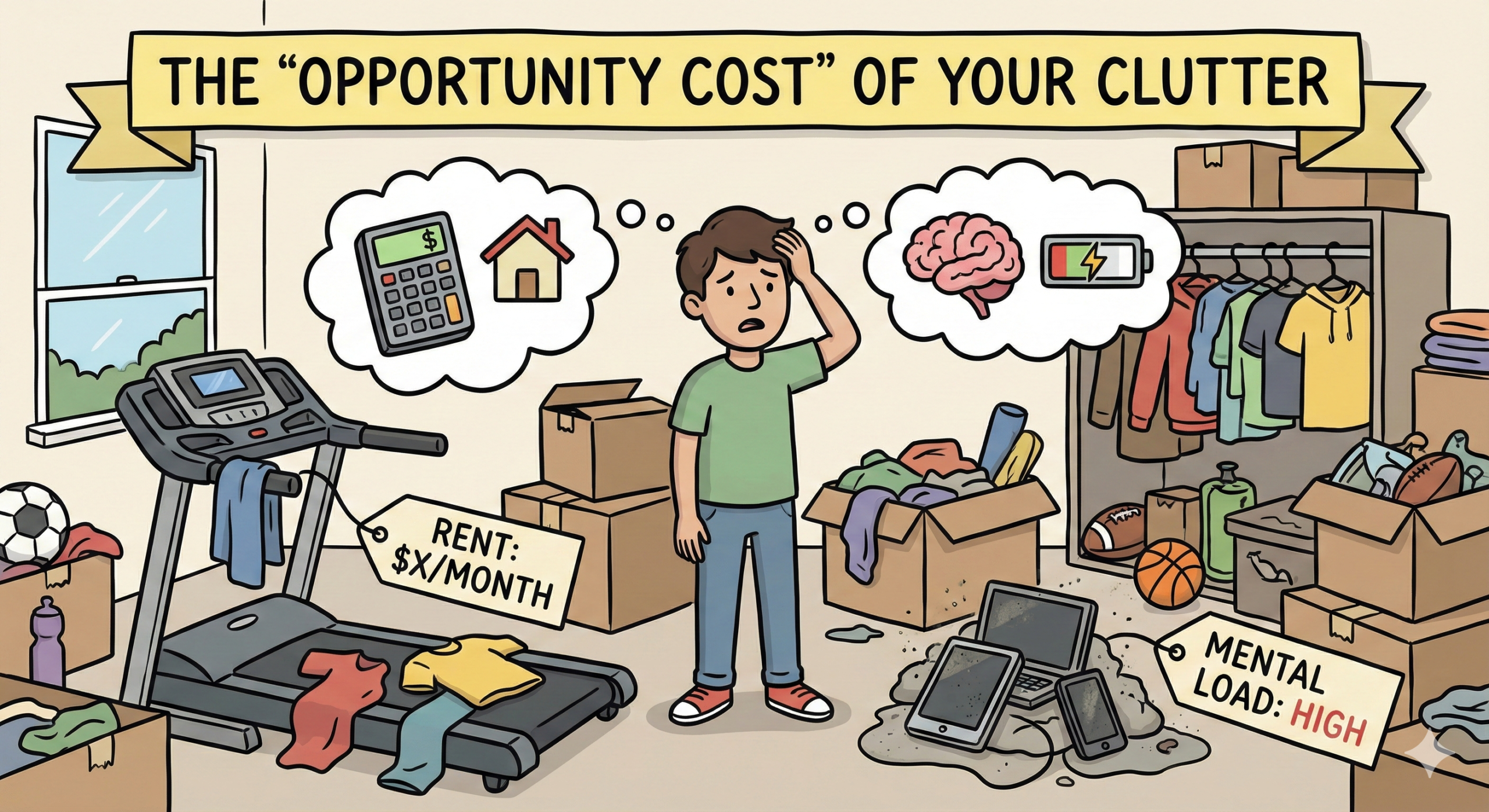
Introduction: The Tenant That Pays No Rent
Elias stood in the center of his living room, a ceramic mug of lukewarm coffee warming his palms, staring at the beast. It was black, sleek, and occupied a prime piece of real estate near the floor-to-ceiling window that overlooked the grey, rain-slicked city skyline. It was a treadmill—the “Ultra-Stride 5000” to be exact. When he had purchased it eighteen months ago, clicking “Buy Now” with a surge of dopamine-fueled optimism, he hadn’t just bought a machine. He had purchased a vision of a future Elias. That version of himself was ten pounds lighter, ran five miles before breakfast, and possessed the cardiovascular endurance of a professional athlete.
The current Elias, however, was tired. He shifted his gaze from the digital display, which was currently draped with a damp towel, to the handlebars, which supported three dress shirts, a pair of stiff jeans, and a wandering phone charger. The running belt, designed for high-impact sprinting, was currently serving as a shelf for a stack of unread magazines and a box of holiday decorations he hadn’t managed to put away since January.
Elias had paid $2,000 for the treadmill. He remembered the sting of the credit card transaction, a pain he had soothed at the time by telling himself it was an “investment in health.” But as he looked around his cramped apartment, the walls seemingly inching closer with every accumulated object, he began to wonder about a different kind of cost. His landlord had just emailed him a notification: his rent was going up again. He was paying a premium to live in the city center, a rate that worked out to roughly $50 per square foot every year.
He did a quick mental calculation, the kind that usually kept him awake at 3:00 AM. The treadmill was large. With the necessary safety clearance behind it—because the manual insisted on six feet of open space to prevent injury—it dominated about 30 square feet of his floor. If he was paying $50 a square foot, that meant the treadmill was “renting” space in his home for $1,500 a year.
He had owned it for 1.5 years.
Purchase price: $2,000.
Rent paid for the machine’s space: $2,250.
Total cost: $4,250.
He had used it seven times.
The realization hit him harder than the caffeine. That meant each run had cost him approximately $607.
Elias took a sip of his coffee, tasting the bitterness. The room felt smaller than usual. It wasn’t just the money. It was the way he had to shimmy sideways to get to the couch. It was the guilt that pricked him every time he looked at the dust gathering on the console. It was the mental energy he spent ignoring it, moving clothes off it, and justifying its existence to his guests who politely stepped around it.
The treadmill wasn’t just an object. It was a squatter. It was a non-paying tenant that ate his money, stole his space, and drained his energy. Elias realized he wasn’t owning his stuff; his stuff was slowly, expensively, owning him.
This is not just Elias’s story. It is the narrative of modern consumption. We are trained to look at the price tag on the shelf, the initial acquisition cost. We agonize over the $5 difference between two toasters. Yet, we rarely calculate the “rent” we pay for every item we bring through our doors. We fail to account for the ongoing maintenance costs, the storage costs, and the psychological taxes levied by our possessions.
This report serves as an exhaustive audit of that cost. By combining global real estate data, behavioral economics, and neuroscience, we will calculate the true “Opportunity Cost” of clutter. We will move beyond the vague notion that “less is more” and prove, with mathematical and scientific precision, that minimalism is not just an aesthetic choice—it is a strategic financial and cognitive imperative.
Chapter 1: The Economic Theory of the Household
1.1 Defining Opportunity Cost in the Living Room
To understand the true cost of the clutter surrounding Elias, we must first step away from the physical items and look at the economic principles governing his life. The most critical of these is Opportunity Cost.
In economics, opportunity cost is defined as the value of the best alternative that you give up when you make a choice.1 It is the difference between the value of the path you chose and the value of the path you did not. It is the road not taken, quantified.
The formula is simple but profound:
Opportunity Cost = Return on Best Option Not Chosen – Return on Option Chosen.1
Let’s apply this to finance first. If you have $10,000 and you choose to use it as a down payment on a car, the cost of that car is not just $10,000. It is also the lost potential of what that money could have done elsewhere. If you had invested that $10,000 in an index fund with a 9.8% annualized growth rate, over a period of years, it could have grown to over $25,000.1 Therefore, the opportunity cost of the car is the $15,000 of passive income you did not earn. You bought a depreciating asset (the car) at the cost of an appreciating asset (the investment).
Now, let us drag this formula into the living room. Space is a finite resource, just like capital. Every square meter of your home has a value attached to it, dictated by the real estate market. When you choose to fill a square meter with a box of old college textbooks, a broken chair, or a treadmill you do not use, you are “spending” that space.
What is the “Best Option Not Chosen” in this scenario?
- Living Space: That square meter could be used for a comfortable reading chair, a yoga mat, or simply open space that makes the room feel larger and more luxurious.
- Downsizing: If you eliminated enough of these “spent” square meters, you could move to a smaller apartment. If you pay $3,000 a month for 1,000 square feet, and 200 square feet are occupied by clutter, you are effectively paying $600 a month to store things you don’t use. That is $7,200 a year—enough for a luxury vacation—spent on warehousing junk.
This is the “Opportunity Factor” of your home.2 Just as companies often neglect innovation projects because they are “starved for resources” by other failing projects, our lives are starved for space and clarity because our resources are tied up in maintaining the status quo of our clutter.2 We accept the “conservative promise” of keeping things “just in case,” leading to a self-fulfilling prophecy of low aspirations and mediocre returns on our living environment.2
1.2 The Real Estate Reality Check
To make this argument concrete, we must look at the actual cost of housing. We often treat our storage space as if it were free. We shove boxes in the attic, the garage, or the spare room without a second thought. But unless you inherited a mortgage-free castle, you are paying for every inch.
The cost of housing in major global cities has skyrocketed, turning floor space into one of the most expensive commodities on earth. If you live in a major economic hub, your floor is likely more valuable than the carpet covering it.
Let’s examine the data for 2024 and 2025 across several major metropolitan areas to see what space actually costs.
Table 1: The Cost of Ownership – Global Real Estate Prices (2024-2025)
| Rank | City | Country | Price per Square Meter (Purchase) | Source |
| 1 | Hong Kong | China | ~$25,300 | 3 |
| 2 | Zurich | Switzerland | ~$24,800 | 3 |
| 3 | London | UK | ~$19,700 | 3 |
| 4 | New York | USA | ~$16,100 | 3 |
| 5 | Shanghai | China | ~$14,800 | 3 |
| 6 | Beijing | China | ~$14,700 | 3 |
| 7 | Taipei | Taiwan | ~$14,400 | 3 |
| 8 | Paris | France | ~$13,700 | 3 |
Insight: In Hong Kong, a single square meter costs over $25,000. A standard treadmill takes up roughly 3 square meters including safety clearance.4 Therefore, the “land value” sitting under that treadmill is approximately $75,000. If that treadmill is just a glorified clothes rack, you are essentially parking a used piece of gym equipment on a pile of cash large enough to buy a luxury car.
This is not just a problem for buyers. Renters face an even more immediate “cash-out-of-pocket” loss. Every month, the rent check clears, and a portion of that money goes directly to housing items that provide zero utility.
Table 2: The Monthly “Rent” of Space – Global Rental Markets (2024)
| City | Average Monthly Rent (Approx.) | Trend (YoY) | Notes on Cost | Source |
| New York (Manhattan) | ~$4,500 (Median) | +2.1% to +6% | High demand kept prices near records despite economic shifts. | 5 |
| London (Central) | £2,600 – £3,100 | Rising | Central zones command massive premiums (£39+ per sq. ft. annually). | 8 |
| Tokyo (23 Wards) | ¥4,200 – ¥5,000 per sqm | +3.4% to +5.2% | Rents rose for the 7th consecutive year. | 10 |
| Sydney | ~$3,700 AUD (Inner City) | Rising | Vacancy rates dropped to ~1.2%, pushing rents up. | 12 |
| Mumbai (Prime) | ₹80,000 – ₹130,000 | +5.1% | Significant surges in prime areas like Worli and Lower Parel. | 14 |
Implication: In Manhattan, rents hit a median of $4,530 in late 2024.5 If an average apartment is 700 square feet, that’s roughly $6.50 per square foot per month, or $78 per square foot per year.
Elias’s 30-square-foot treadmill setup is costing him:
$78 x 30 sq ft = $2,340 per year.
This is the “hidden trade-off”.16 When Elias looks at his bank account and wonders why he can’t save for a vacation, the answer is sitting in his living room. He is spending his vacation money on rent for a machine he doesn’t use.
1.3 The Global Rent Index: A Comparative Analysis
The burden of clutter is not distributed equally. The geography of where you live dictates the severity of the opportunity cost.
The Asian Paradox:
In cities like Tokyo and Hong Kong, the cost of space is existential. With average rents in Tokyo rising for seven straight years to reach over ¥4,300 per square meter 11, the pressure to declutter is not just a lifestyle trend; it is a financial survival strategy. The “ma”—the Japanese concept of negative space—is culturally revered, but in 2024, it is economically enforced. A 50-square-meter apartment simply cannot house “aspirational” items. This explains why the minimalist movement (led by figures like Marie Kondo) gained such traction here; it provides a philosophical framework for an economic necessity.
The Western “Space Trap”:
Conversely, the United States offers a different trap. While New York is expensive, much of the U.S. has relatively affordable space compared to income. The U.S. ranks high in affordability for home ownership relative to salary.17 This abundance of space—large suburban homes with basements, garages, and attics—lowers the perceived opportunity cost of keeping things.
This leads to Parkinson’s Law of Clutter: “Possessions expand to fill the space available.”
Because the garage is “free” space (mentally), it gets filled. But this accumulation eventually breaches the home’s capacity, leading to the booming self-storage industry, which effectively re-monetizes this free space at a premium.
The Emerging Market Squeeze:
In cities like Mumbai, we see a clash of forces. The economy is growing, and with it, the “IKEA Effect” and the desire for consumer goods.18 However, housing infrastructure is lagging. Rents in Mumbai’s prime districts jumped over 5% in a single quarter of 2024.14 The middle class is caught in a pincer movement: they have the income to buy things, but the cost of space is rising so fast they cannot afford to house them. This is creating a new, acute form of clutter stress in developing economies.
Chapter 2: The Cognitive Balance Sheet
2.1 The Neuroscience of “Stuff”
If the financial cost of clutter is the “rent” we pay with our wallets, the cognitive cost is the “tax” we pay with our minds. Elias doesn’t just lose money on his treadmill; he loses focus. Every time he walks past it, his brain has to register it, identify it, and make a micro-decision to ignore it.
We often assume our vision is like a camera—passive and infinite. But neuroscience shows that our attention is a limited resource with a strict budget.
A landmark study from the Princeton University Neuroscience Institute illuminates exactly what happens in Elias’s brain when he looks at his cluttered living room. The researchers used functional magnetic resonance imaging (fMRI) to monitor brain activity in cluttered environments.19
The Findings:
- Competitive Interaction: The study found that multiple stimuli present in the visual field at the same time compete for neural representation.20 The brain is not a bottomless bucket; it is a narrow pipe. When you fill your visual field with a treadmill, piles of mail, scattered toys, and crowded shelves, these objects jam the pipe.
- Suppression Cost: To focus on a single task—like reading a book or having a conversation—Elias’s brain must actively suppress the neural response to the treadmill.21 This suppression is an active metabolic process. It burns energy.
- The Result: The researchers concluded, “Visual clutter competes with our brain’s ability to pay attention and tires out our cognitive functions over time”.19
This means that a cluttered home literally makes you dumber. It reduces your working memory, slows your processing speed, and drains your mental battery faster than a tidy environment.22 Elias feels tired not because he ran on the treadmill, but because his brain has been “running” to ignore it all day.
2.2 Cortisol and the Cost of Chaos
The mental drain of clutter eventually manifests as physical stress. The bridge between the mind and the body is Cortisol, the primary stress hormone.
In 2012, researchers at UCLA’s Center on Everyday Lives of Families (CELF) conducted an ethnoarchaeological study of 32 dual-income families in Los Angeles.24 They didn’t just ask people how they felt; they measured their saliva to track hormone levels throughout the day.
The results revealed a startling gender divide in the “cost” of clutter:
- The “Wife” Tax: The study found a direct link between the amount of physical clutter in the home and the cortisol levels of the wives. Women who used words like “cluttered,” “messy,” or “chaotic” to describe their homes had flatter diurnal cortisol slopes.25 Normally, cortisol should drop in the evening to allow for relaxation and sleep. For these women, the stress hormone stayed elevated, signaling a state of chronic low-grade “fight or flight.”
- The “Husband” Immunity: Interestingly, the husbands in the study did not show the same cortisol spike in response to the mess.26
Why the difference? The researchers suggest a sociological explanation. Despite modern advances, women often still feel a disproportionate societal responsibility for the state of the home.26 For Elias, the treadmill might be an annoyance. For his partner, it might be a visceral symbol of failure, a visual “to-do” list that never gets checked off, triggering a chemical stress response that damages long-term health.
Thus, the opportunity cost of clutter includes physical well-being. The “rent” is paid in higher blood pressure, poorer sleep, and increased anxiety.
2.3 Decision Fatigue: The Invisible Tax
There is another layer to the cognitive cost: the sheer volume of choices. It is estimated that the average adult makes roughly 35,000 decisions every single day.27
Most of these are not life-changing choices like “Should I marry this person?” or “Should I quit my job?” They are micro-decisions:
- “Which mug should I use?”
- “Where should I put these keys?”
- “Should I wash these jeans or wear them one more time?”
- “Do I keep this receipt or throw it away?”
Clutter multiplies these micro-decisions exponentially.
When Elias walks into his messy apartment, he is bombarded:
- The treadmill: “Should I move the clothes off it?” (Decision 1)
- The stack of mail: “Is this important?” (Decision 2)
- The remote control hidden under a magazine: “Where is it?” (Decision 3)
This leads to a phenomenon known as Decision Fatigue.29 As we make more decisions, the quality of our judgment deteriorates. Our willpower is a finite fuel tank. By the time Elias sits down to work or talk to his family, his tank is empty. He becomes irritable, impulsive, and less capable of handling complex problems.
This is why successful minimalists like Mark Zuckerberg or Steve Jobs famously adopted a “uniform,” wearing the same outfit every day.30 By eliminating the decision of “what to wear,” they saved their cognitive fuel for running their companies. Minimalism applies this logic to the entire environment. By owning fewer things, you reduce the number of objects that demand your attention, care, and decision-making energy. You stop managing inventory and start living.
Chapter 3: The Psychology of Holding On
If clutter costs us so much—thousands of dollars in rent, massive amounts of stress, and cognitive exhaustion—why do we keep it? Why can’t Elias just sell the treadmill?
The answer lies in the deep wiring of the human brain. We are evolutionarily designed to hoard resources, and behavioral economists have identified specific cognitive biases that trap us in a cycle of accumulation.
3.1 The Endowment Effect: Why We Overvalue
The first trap is the Endowment Effect. This is the psychological finding that we value items more simply because we own them.18
In classic experiments, researchers gave participants a coffee mug and asked how much they would sell it for. The average answer was around $7.00.
Another group was not given a mug but was asked how much they would pay to buy one. The average answer was around $3.00.
The mug was identical. The only difference was ownership. Once the mug was “theirs,” its perceived value more than doubled.
For Elias, the treadmill is not just a used machine worth $400 on the secondhand market. It is his machine. He remembers the day he bought it. He remembers the specific plans he had. This emotional attachment inflates the price in his head, making him unwilling to sell it for its true market value. He would rather keep it (paying $1,500/year in space rent) than suffer the perceived “loss” of selling it for less than he thinks it is worth.32
Neuroscience supports this: fMRI scans show that the prospect of selling personal possessions can activate the insula, a brain region associated with physical pain and disgust.32 Decluttering literally hurts.
3.2 The Sunk Cost Fallacy: Chasing Good Money with Bad
The second, and perhaps most dangerous, trap is the Sunk Cost Fallacy. This is the tendency to continue an endeavor once an investment in money, effort, or time has been made.33
Elias stares at the treadmill and thinks, “I spent $2,000 on this. If I get rid of it, I’ve wasted $2,000.”
This is a lie.
The $2,000 is already gone. It left his account 18 months ago. It is a “sunk” cost—it cannot be recovered.
The rational decision should be based only on the future: “Will this treadmill provide me with value from this day forward?”
If the answer is no, then keeping it is actually compounding the loss. He is spending fresh money (rent) and fresh energy (stress) to honor a past mistake.34
As the organizational expert Marie Kondo notes, “Sunk costs are not relevant to decision-making in the present or future”.35 The value of an item is in its utility or the joy it sparks now. If it does neither, its purpose is fulfilled—even if that purpose was just to teach you that you hate running on treadmills.36
3.3 Aspirational Clutter: The Ghost of Future Self
The treadmill represents a specific, painful type of possession: Aspirational Clutter.
These are the things we buy for the person we wish we were, rather than the person we actually are.37
- The Treadmill: For the Fantasy Elias who runs marathons.
- The Bread Maker: For the Fantasy Elias who bakes fresh sourdough every Sunday (Real Elias buys sliced bread).
- The Mandarin Textbooks: For the Fantasy Elias who is fluent in three languages (Real Elias watches Netflix).
- The Craft Supplies: For the Fantasy Elias who is an artist (Real Elias is too tired to paint).38
We hold onto these items because getting rid of them feels like admitting defeat. Selling the treadmill feels like killing the Fantasy Elias. It forces us to confront the reality of our habits and our identity.
However, this confrontation is necessary. As the decluttering pros at The Decluttering Co note, “You can decide to be the kind of person who throws on any pair of shoes and heads out for adventure,” rather than the person who stares at a machine.36
Letting go of aspirational clutter is not a loss; it is a liberation. It clears the path for you to invest in who you actually are. If you love walking in the park, sell the treadmill and buy a great pair of hiking boots. That is an investment in your reality, not your fantasy.
Chapter 4: The Storage Economy
4.1 The Rise of the External Closet
When the Endowment Effect and Aspirational Clutter collide with the physical limits of our homes, we don’t usually choose to own less. We choose to pay for more space.
This behavior has birthed a behemoth: the Self-Storage Industry.
In 2024, the global self-storage market was valued at a staggering $60.1 billion.39 It is projected to grow to nearly $90 billion by 2033.39
This industry is built on a simple business model: monetizing human indecision.
In the United States, there is now more than 5.4 square feet of self-storage space for every man, woman, and child.
In the United Kingdom, the market is exploding, with Londoners paying premium rates to store items they cannot fit in their flats.8
4.2 The Mathematics of Self-Storage
Let’s look at the math of storage, which is often even worse than the math of the treadmill.
A 50-square-foot storage unit in Central London costs approximately £64 per week.8
That is roughly £3,138 ($4,000 USD) per year.
Imagine Elias decides to move his treadmill and a few boxes of “aspirational” books to a storage unit to clear his living room.
- Value of items stored: ~$600 (resale value).
- Cost of storage: $4,000/year.
In less than two months, he has paid more in rent than the items are worth.
If he keeps them there for five years (a common duration for long-term storage), he will have paid $20,000 to warehouse $600 worth of junk.
This is the ultimate triumph of the Sunk Cost Fallacy. We pay thousands to avoid the pain of throwing away pennies.
The industry knows this. Introductory rates (“First Month for £1!”) are designed to get your stuff in the door. Once it is there, the inertia sets in. The psychological effort required to go to the unit, sort the boxes, and make decisions is so high that people simply keep paying the monthly bill, often for decades.8
Chapter 5: Global Perspectives on Space
The “clutter equation” changes depending on where you are on the map. The trade-off between space and stuff is a universal human struggle, but the economic variables differ wildly.
5.1 The Asian Metropolis: Efficiency as Survival
In Tokyo, the relationship with objects is fundamentally different.
- Cost: Average rents in the 23 wards have risen to record highs, with family-sized units costing huge sums.11
- Space: The average dwelling size is significantly smaller than in the West.
- Impact: There is no “spare room.” There is no basement. The “opportunity cost” is immediate. If you buy a large item, something else must go.
This environment has fostered a culture of extreme curation. The success of Japanese organizing consultants like Marie Kondo is not accidental; it is a product of an environment where holding onto “sunk costs” is physically impossible. The “ma” (space) is more valuable than the object. In Tokyo, minimalism is not a style; it is a survival skill.
5.2 The Western Suburb: The Paradox of Abundance
In the United States and Australia, we see the opposite extreme.
- Affordability: The U.S. has high income-to-housing-price ratios in many areas, meaning space is relatively “cheap”.17
- The Trap: This leads to the “Garage Paradox.” Because space feels abundant, the filter for bringing items into the home is weak. We buy bulk goods, multiple sets of linens, and seasonal decor because “we have the room.”
- Consequence: The clutter fills the house until it spills over. The U.S. is the primary driver of the self-storage boom because the sheer volume of acquisition outpaces even the largest suburban homes.40
5.3 Emerging Markets: The Clash of Growth and Space
In Mumbai and Shanghai, a new dynamic is emerging.
- Rising Costs: Rents in Mumbai are surging (up 5-10% in some quarters), with landlords demanding higher premiums.14
- Rising Aspirations: Simultaneously, the middle class is exploding, fueling a consumption boom.
- The Conflict: People are buying “Western” levels of consumer goods but living in “Asian” density housing. This creates acute stress. Families are navigating how to fit modern appliances, fast fashion wardrobes, and tech gadgets into traditional apartments, leading to a rapid rise in demand for organization solutions and smart storage.41
Chapter 6: Strategic Divestment
We have established the problem. The treadmill is a money pit. The clutter is a stress factory. The storage unit is a financial black hole.
So, what is the solution?
We must shift from being “consumers” to being “strategic investors” in our own lives. We need a divestment strategy.
6.1 The ROI of Decluttering
If we view the home as a business, decluttering is a restructuring process that unlocks massive value.
1. The Space Dividend:
Elias sells the treadmill.
- Loss: He “loses” the machine.
- Gain: He reclaims 30 square feet of prime living room space.
- Value: At $50/sq ft, he has unlocked $1,500/year in real estate value. He can now place a reading chair there, creating a “sanctuary” for relaxation. This space now generates “joy” and “rest” dividends every single day.
2. The Time Dividend:
Fewer items mean less management.
- Scenario: A minimalist wardrobe (Project 333 or similar).
- Gain: Elias saves 10 minutes every morning deciding what to wear. He saves 30 minutes a week on laundry and organizing.
- Value: That is roughly 60 hours a year—more than a full work week of vacation time—reclaimed simply by owning less cloth.
3. The Focus Dividend:
A clear environment reduces the “visual noise” that tires the brain.21
- Gain: Lower cortisol levels. Improved focus. Higher quality decision-making.
- Value: While harder to quantify, the ability to work without distraction and relax without guilt is arguably the most valuable return of all.
6.2 Tactics for Liquidation
How do we overcome the Endowment Effect and Sunk Cost Fallacy? We need rules that bypass our emotional biases.
Rule 1: The “Rent” Calculator
For every large item, do the math. Measure its footprint. Multiply by your rent per square foot. Ask: “Is this item paying me $X in value?” If not, evict it.
Rule 2: The “One-Year” Statute of Limitations
If you haven’t used it in a year, you don’t own it; you are archiving it. The “sunk cost” is gone. Donate it or sell it.
- Tip: For sentimental items, take a photo. You keep the memory (the trigger) but release the space-eating object.42
Rule 3: The “20/20” Rule
For “just in case” items (extra cables, generic tools), use the Minimalist’s rule: If you can replace it for less than $20 and in less than 20 minutes, get rid of it. This eliminates the need to hoard low-value items.43
Rule 4: The “Container” Limit
Don’t buy more bins. Let the container dictate the volume. If the bookshelf is full, you must remove a book to buy a book. This imposes a “physical budget” on your stuff.
Conclusion: The New Bottom Line
Elias sat on his couch. The spot by the window was empty.
He had listed the Ultra-Stride 5000 on a local marketplace. A young student came and hauled it away for $350.
Technically, Elias had “lost” $1,650 on the deal. The old Elias would have agonized over that number.
But the new Elias, armed with his “Opportunity Cost” spreadsheet, saw it differently.
- He had stopped the bleeding of $1,500/year in rent.
- He had eliminated the daily “suppression cost” of ignoring the machine.
- He had reclaimed the view of the city skyline.
He took the $350 and bought a really good pair of running shoes and a membership to the park district gym. He also bought a small, comfortable armchair for the window nook.
As he sat there, watching the rain fall over the city, he realized something profound.
Albert Einstein once joked, “If a cluttered desk is a sign of a cluttered mind, of what, then, is an empty desk a sign?”.19
For years, people took this as a defense of mess. But looking at his empty, peaceful corner, Elias knew the answer.
An empty desk—and an empty corner—is a sign of a mind prepared to work. It is a sign of potential. It is a sign of freedom.
The strategic argument for minimalism is not about deprivation. It is about allocation. It is about ruthlessly cutting the overhead of your life so you can invest heavily in the things that actually yield a return—your time, your health, and your peace of mind.
Your treadmill is paying you nothing. It’s time to stop paying its rent.
Appendix: Global Data Reference Table
To assist in your own “Clutter Audit,” use the following reference data to estimate the cost of your space.
Table 3: Estimated Annual “Rent” Cost of Common Clutter Items (2024)
| Item | Avg. Size (incl. clearance) | Annual Cost (NYC/London) | Annual Cost (Tokyo/Sydney) | Annual Cost (Mumbai) |
| Treadmill | ~30 sq. ft. / 3 sq. m | ~$2,100 | ~$1,200 | ~$450 |
| Queen Bed (Guest) | ~35 sq. ft. / 3.3 sq. m | ~$2,450 | ~$1,320 | ~$500 |
| Standard Bookshelf | ~5 sq. ft. / 0.5 sq. m | ~$350 | ~$200 | ~$75 |
| Storage Box (Large) | ~4 sq. ft. / 0.4 sq. m | ~$280 | ~$160 | ~$60 |
| Pile of Clothes | ~3 sq. ft. / 0.3 sq. m | ~$210 | ~$120 | ~$45 |
Note: Calculations based on median rental prices per square foot in prime city centers provided in market reports.5 Actual costs will vary by neighborhood.
Works cited
- How To Calculate Opportunity Cost: The Hidden Cost Of Every Decision – Wealthfit, accessed November 28, 2025, https://wealthfit.com/articles/how-to-calculate-opportunity-cost/
- Innovation Opportunity Factor calculator – SmartOrg, accessed November 28, 2025, https://smartorg.com/innovation-opportunity-factor-calculator/
- Chart: Home and Rent Price Changes in Global Cities (2015-2025) – Visual Capitalist, accessed November 28, 2025, https://www.visualcapitalist.com/charted-home-and-rent-price-changes-in-global-cities-2015-2025/
- How Much Space Do You Need For a Treadmill, accessed November 28, 2025, https://www.treadmilldoctor.com/blog/how-much-space-does-a-treadmill-use
- Living in NYC Just Got More Expensive as Average Rent Prices Jump 5.6% – Realtor.com, accessed November 28, 2025, https://www.realtor.com/news/trends/new-york-city-december-2024-rental-report/
- NYC sees median rents rise for the third month in a row – Brick Underground, accessed November 28, 2025, https://www.brickunderground.com/rent/nyc-manhattan-brooklyn-queens-rental-market-report-december-2024
- Manhattan median rent spiked 6 percent to $4,500 in April – Brick Underground, accessed November 28, 2025, https://www.brickunderground.com/rent/nyc-manhattan-brooklyn-queens-rental-market-report-april-2025
- Storage Costs in London Revealed: What You’ll Actually Pay in 2025, accessed November 28, 2025, https://removalsandstoragex.com/blog/storage-costs-in-london/
- Average rent in London: April 2024 – Zoopla, accessed November 28, 2025, https://www.zoopla.co.uk/discover/property-news/average-rent-london/
- Tokyo Residential Leasing Q1/2024 – Savills, accessed November 28, 2025, https://www.savills.com/research_articles/255800/215504-1
- Tokyo condo rents rise for 7th year in 2024 at slower rate than 2023 – Patience Realty, accessed November 28, 2025, https://www.patiencerealty.com/post/tokyo-condo-rents-rise-for-7th-year-in-2024-at-slower-rate-than-2023
- Cost of living in Sydney – updated for 2025 – Muval, accessed November 28, 2025, https://www.muval.com.au/blog/cost-of-living-in-sydney
- Sydney’s Rental Market Trends and Forecasts – Property Update, accessed November 28, 2025, https://propertyupdate.com.au/sydneys-rental-market-trends-and-forecasts/
- Rents surge across 13 major cities; Mumbai remains priciest – Construction Week India, accessed November 28, 2025, https://www.constructionweekonline.in/business/rents-surge-across-13-major-cities-mumbai-remains-priciest
- Mumbai property rates in 2024: Check residential property price, rent in Mumbai, Thane, other areas of MMR in Q3 – The Economic Times, accessed November 28, 2025, https://m.economictimes.com/wealth/real-estate/mumbai-property-rates-in-2024-check-residential-property-price-rent-in-mumbai-thane-other-areas-of-mmr-in-q3/articleshow/114623048.cms
- 4 Types of Clutter Challenges + How to Tackle Them – Simply + Fiercely, accessed November 28, 2025, https://www.simplyfiercely.com/types-of-clutter/
- The global cost of homes in 2025: Comparing the real mortgage interest rates and home prices around the world – BestBrokers.com, accessed November 28, 2025, https://www.bestbrokers.com/forex-brokers/the-global-cost-of-homes-in-2024-comparing-the-real-mortgage-interest-rates-and-home-prices-around-the-world/
- Neural correlates of overvaluation and the effort to save possessions in a novel decision task: An exploratory fMRI study – PubMed Central, accessed November 28, 2025, https://pmc.ncbi.nlm.nih.gov/articles/PMC9911144/
- Psychology: Your Attention, Please | Princeton Alumni Weekly, accessed November 28, 2025, https://paw.princeton.edu/article/psychology-your-attention-please
- Interactions of top-down and bottom-up mechanisms in human visual cortex – PubMed – NIH, accessed November 28, 2025, https://pubmed.ncbi.nlm.nih.gov/21228167/
- How Does Clutter Affect Cognitive Function? – Lifestyle → Sustainability Directory, accessed November 28, 2025, https://lifestyle.sustainability-directory.com/question/how-does-clutter-affect-cognitive-function/
- How Clutter Affects Our Mental Health – Nurture Your Nature Psychotherapy, accessed November 28, 2025, https://nurtureyournaturepc.com/latest-news/how-clutter-affects-our-mental-health/
- The Psychology of Clutter: How a Disorganized Home Impacts Mental Clarity, accessed November 28, 2025, https://lifebyleadership.com/blog/the-psychology-of-clutter-how-a-disorganized-home-impacts-mental-clarity/
- Why Clutter Affects Men and Women Differently (And What to do About it), accessed November 28, 2025, https://richinwhatmatters.com/2020/06/13/why-clutter-affects-men-and-women-differently-and-what-to-do-about-it/
- The Clutter Culture – Newsroom | UCLA, accessed November 28, 2025, https://newsroom.ucla.edu/magazine/center-everyday-lives-families-suburban-america
- Home Tours Correlate 2010 by the Society for Personality With Daily Patterns of Mood and Cortisol – UCLA CELF, accessed November 28, 2025, https://www.celf.ucla.edu/2010_conference_articles/Saxbe_Repetti_2010b.pdf
- Decision Fatigue: A Conceptual Analysis – PMC, accessed November 28, 2025, https://pmc.ncbi.nlm.nih.gov/articles/PMC6119549/
- How many decisions are you making today? – HOOPP, accessed November 28, 2025, https://hoopp.com/news-and-insights/member-news/article-details/how-many-decisions-are-you-making-today
- How Minimalism Can Improve Your Mental Health – Becoming Minimalist, accessed November 28, 2025, https://www.becomingminimalist.com/how-minimalism-can-improve-your-mental-health/
- How Minimalism Helps You Overcome Decision Fatigue | by Douaa El Khaer – Medium, accessed November 28, 2025, https://medium.com/change-your-mind/how-minimalism-helps-you-overcome-decision-fatigue-b815cad702af
- An Exploration of Economic Reasoning in Hoarding Disorder Patients – PMC – NIH, accessed November 28, 2025, https://pmc.ncbi.nlm.nih.gov/articles/PMC3210419/
- Podcast ep 53: The Endowment Effect and hoarding – How this cognitive bias makes you feel the need to keep everything – That Hoarder, accessed November 28, 2025, https://www.overcomecompulsivehoarding.co.uk/podcast-ep-53-the-endowment-effect-and-hoarding/
- The Sunk Cost Fallacy – The Decision Lab, accessed November 28, 2025, https://thedecisionlab.com/biases/the-sunk-cost-fallacy
- The Psychology of Decluttering: Why It’s So Hard to Ditch Stuff – Hustle Escape, accessed November 28, 2025, https://www.hustleescape.com/psychology-of-decluttering/
- accessed November 28, 2025, https://medium.com/@semiretireplan/marie-kondo-endowment-effect-and-sunk-costs-69fc0e732a46#:~:text=So%2C%20I%20know%20that%20my,in%20the%20present%20or%20future.
- Decluttering and making decisions. Stay or go? 7 criteria for what to keep., accessed November 28, 2025, https://thedeclutteringco.com.au/decluttering-and-making-decisions/
- Psychology Now, accessed November 28, 2025, http://103.203.175.90:81/fdScript/RootOfEBooks/E%20Book%20collection%20-%202025%20-%20H/ENGG%20TECHINCAL%20MAGAZINES/Psychology_Now_Volume_2_5th_Revised_Edition_February_2025.pdf
- Paper Doll Explains Aspirational vs. Inspirational Clutter | Best Results Organizing, accessed November 28, 2025, https://juliebestry.com/2024/03/25/paper-doll-explains-aspirational-vs-inspirational-clutter/
- Self Storage Market Size, Share & Report Analysis 2033 – IMARC Group, accessed November 28, 2025, https://www.imarcgroup.com/self-storage-market
- Self-Storage Market Size to Hit USD 107.36 Billion by 2034 – Precedence Research, accessed November 28, 2025, https://www.precedenceresearch.com/self-storage-market
- mumbai-residential-market-watch-year-end-2024.pdf – Savills, accessed November 28, 2025, https://pdf.savills.asia/asia-pacific-research/india-research/mumbai-residential-market-watch-year-end-2024.pdf
- It’s All Too Much Quotes by Peter Walsh – Goodreads, accessed November 28, 2025, https://www.goodreads.com/work/quotes/789368-it-s-all-too-much-an-easy-plan-for-living-a-richer-life-with-less-stuff
- Minimalism: Understanding Its Deeper Psychological Impact – Beyond Healing Counseling, accessed November 28, 2025, https://beyondhealingcounseling.com/minimalism-understanding-its-deepr-psychological-impact/