
It began with a dressing gown.
In 1765, the French philosopher Denis Diderot—famous for co-founding the Encyclopédie—acquired a beautiful new scarlet robe. It was elegant, luxurious, and utterly perfect. It was also a disaster.
As Diderot sat in his study, wearing his magnificent new garment, he noticed that his surroundings looked shabby by comparison. His straw chair was suddenly too rustic; his desk too ragged; his wall prints too common. Driven by a sudden, inexplicable urge for “coherence,” Diderot began to upgrade everything. He bought a damask chair, a new writing desk, and expensive prints.
By the time he was finished, his room was a masterpiece of interior design, but Diderot was deeply in debt and miserable. He famously wrote, “I was absolute master of my old dressing gown, but I have become a slave to my new one.”1
Two and a half centuries later, we are all Diderot. But unlike the philosopher, who had to visit tailors and artisans to ruin his finances, we can do it from our couches in seconds. In the age of the “one-click” buy, the distance between a sudden desire and a completed purchase has collapsed to zero. To reclaim our financial freedom, we need a tool that restores that distance. We need the 30-Day Rule.
The Frictionless Trap
Imagine you are scrolling through Instagram at 11:00 PM. You see an ad for a high-tech coffee maker. You don’t need a coffee maker—yours works fine—but this one is matte black, sleek, and promises “barista-quality” foam.
In the old world, buying this machine would have required friction. You would have to find your keys, drive to a store, find the aisle, and wait in line. That physical effort gave your brain time to cool down. Today, that friction has been engineered out of existence. “Buy Now, Pay Later” (BNPL) services split the cost into invisible slivers, bypassing the psychological “pain of paying,” while one-click checkouts remove the need to even type in your address.
This frictionless environment exploits a glitch in your biology. When you see that coffee maker, your brain’s reward center releases dopamine. Contrary to popular belief, dopamine isn’t about pleasure; it’s about seeking. It screams, “Get this now!” shutting down your prefrontal cortex—the logical part of your brain that cares about your rent or your savings goals.3
The impulse is a wave. It rises fast, peaks in intensity, and creates a sense of urgent physiological arousal. But here is the secret retailers don’t want you to know: the wave crashes in about 20 minutes.5
If you buy within that 20-minute window, you are acting under the influence of a chemical high. If you wait, the fog lifts. The 30-Day Rule is simply a mechanism to force you to wait for the fog to clear.
The Circuit Breaker: How the Rule Works
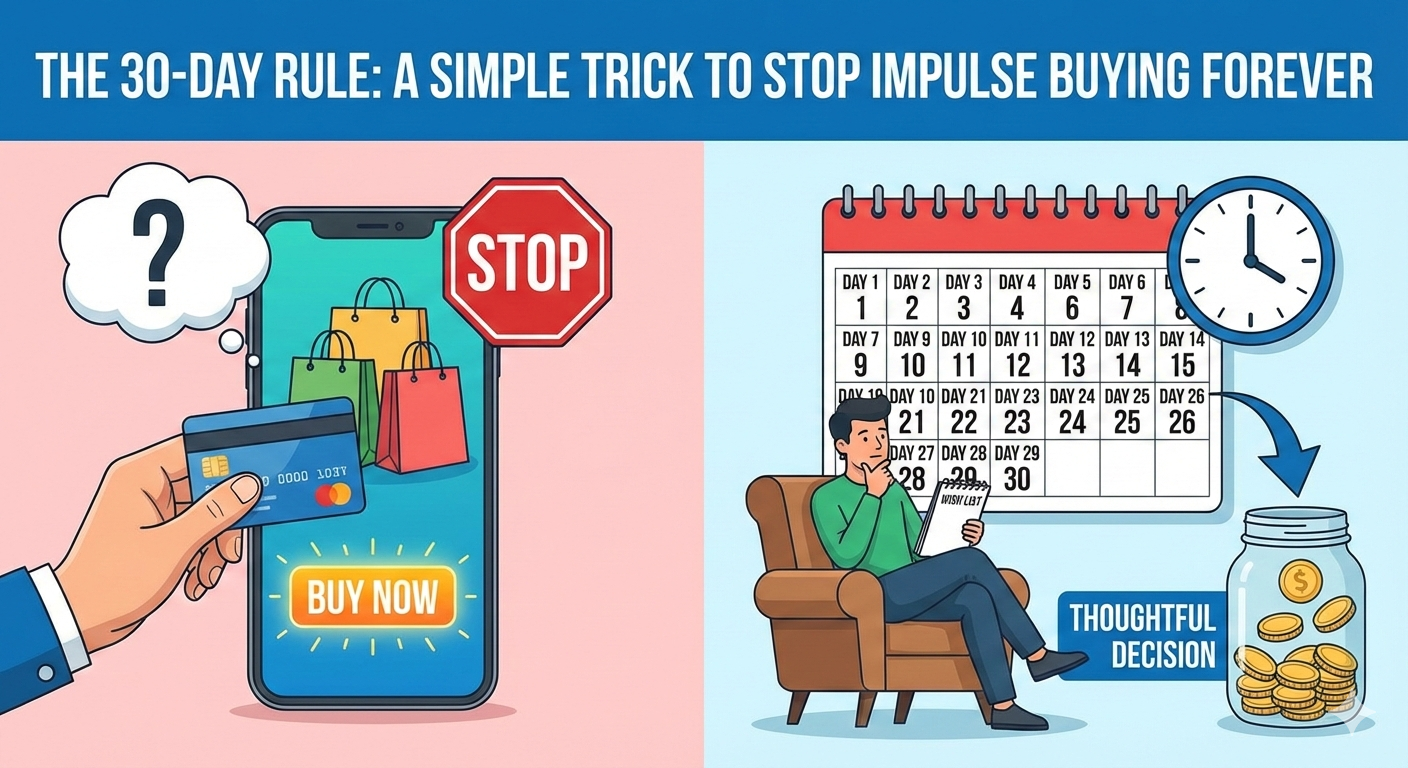
The 30-Day Rule is a “commitment device”—a rule you set for yourself when you are calm to bind your hands when you are tempted. The protocol is deceptively simple:
- The Pause: When you feel the urge to buy something non-essential (a Want, not a Need), you stop. You do not add it to your cart. You do not click “Buy Now.”7
- The List: You open a note on your phone or a physical journal and write down the item’s name, the price, the store, and—most importantly—today’s date.9
- The Wait: You promise yourself that you are allowed to buy this item, but only after 30 days have passed.
- The Verdict: After the 30 days are up, you look at the list. If you still want it, and you have the money, you buy it.
Spoiler alert: You usually won’t want it.
By imposing a mandatory “cooling-off period,” you are manually re-inserting the friction that technology removed. You are giving your “cool” rational brain a chance to catch up with your “hot” emotional brain.11
Tales from the Front Lines
This isn’t just theory. It’s a strategy that has saved real people from financial ruin and psychological distress.
The One Who Hit Rock Bottom
Consider the story of Cait Flanders. In her late twenties, Cait seemed successful, but she was secretly drowning in $30,000 of consumer debt. She was caught in the cycle of “earn more, buy more,” using shopping as a way to numb her emotions and distract herself from unhappiness.
One day, realizing she had maxed out her credit cards and had only $100 to her name, she initiated a radical version of the rule: a year-long shopping ban. She allowed herself only groceries and absolute essentials.
The first few months were agonizing. Without the dopamine hit of buying new things, Cait was forced to confront the difficult emotions she had been suppressing. But as the months passed, something shifted. She realized that “browsing” was the trigger. By cutting off the input, she cut off the urge. By the end of her experiment, she had saved $17,000, paid off her debt, and reshaped her entire life.13
The “Fantasy Self”
Then there is Hannah Louise Poston, a beauty YouTuber who realized her spending was driven by a ghost. She wasn’t buying clothes for the life she actually lived; she was buying them for her “Fantasy Self”—a version of Hannah who was more organized, more elegant, and lived a different life.
During her “No-Buy Year,” Hannah learned a profound lesson about the 30-Day Rule. She discovered that the desire to buy didn’t just vanish; it simply “waited.” She had to learn to sit with the discomfort of wanting something and not getting it. She called this “Urge Surfing”—riding the wave of desire until it crashed, rather than trying to drown it with a purchase.16
Hannah realized that buying a silk dress wouldn’t make her the kind of person who goes to galas; it would just make her a person with a silk dress and less money.17
Modernizing the Rule
For many of us, waiting 30 days for a small purchase feels like overkill. You can adapt the rule to fit your life using a “Tiered System”:
- Under $50? Wait 24 Hours. Give it one night’s sleep. Usually, the “shoppers’ high” fades by morning.18
- $50 – $100? Wait 72 Hours. Take the weekend to think about it.20
- Over $100? Wait 30 Days. Major purchases require major consideration.18
If you lack the willpower to stop yourself, let technology be the bad guy. Browser extensions like “Icebox” can replace the “Buy” button on sites like Amazon with a “Put it on Ice” button, automatically enforcing a waiting period before you can check out.21
The Happy Ending
The goal of the 30-Day Rule isn’t to stop you from having nice things. It is to ensure that the things you have are things you truly value.
When Diderot looked around his perfectly curated, expensive room, he missed his old, ragged dressing gown. He missed the freedom of not caring. By applying the 30-Day Rule, you protect yourself from the Diderot Effect. You stop the spiral before it starts.
The next time you feel that sudden, electric urge to click “Buy,” remember Diderot. Take a breath. Write it down. Wait. You might find that the greatest luxury money can buy isn’t the item in your cart—it’s the peace of mind that comes from knowing you don’t need it.
Works cited
- Psychologists Reveal What’s Really Behind Your Constant Urge to Redecorate, accessed November 20, 2025, https://www.housebeautiful.com/uk/decorate/a65378357/diderot-effect-impulse-buying-home-decor/
- Impulse buying behavior during livestreaming: Moderating effects of scarcity persuasion and price perception – NIH, accessed November 20, 2025, https://pmc.ncbi.nlm.nih.gov/articles/PMC10979273/
- The State of Impulse Buying (Statistics & Trends 2025) – Invesp, accessed November 20, 2025, https://www.invespcro.com/blog/impulse-buying/
- What Life Looks Like After a 2-Year Shopping Ban – Food52, accessed November 20, 2025, https://food52.com/story/22128-the-year-of-less-cait-flanders-life-after-a-shopping-ban
- Urge Surfing: A Mindful Approach To Managing Cravings And Impulses – Ashburn Psychological and. Psychiatric Services, accessed November 20, 2025, https://www.ashburnpsych.com/urge-surfing-a-mindful-approach-to-managing-cravings-and-impulses/
- A comprehensive study on factors influencing online impulse buying behavior: Evidence from Shopee video platform – NIH, accessed November 20, 2025, https://pmc.ncbi.nlm.nih.gov/articles/PMC11336989/
- What is the 30 day rule – Current, accessed November 20, 2025, https://current.com/blog/what-is-the-30-day-rule/
- Book recommendation: The Year of Less by Cait Flanders : r/declutter – Reddit, accessed November 20, 2025, https://www.reddit.com/r/declutter/comments/emvlws/book_recommendation_the_year_of_less_by_cait/
- Master Your Spending with the 30-Day Purchase Plan, accessed November 20, 2025, https://www.firstcomcu.org/post/master_your_spending_with_the_30day_purchase_plan.html
- From Browsing to Buying: Determinants of Impulse Buying Behavior in Mobile Commerce, accessed November 20, 2025, https://www.mdpi.com/0718-1876/20/4/266
- How Can a “Cooling-off” Period Be Used to Manage Impulse Buying?, accessed November 20, 2025, https://lifestyle.sustainability-directory.com/learn/how-can-a-cooling-off-period-be-used-to-manage-impulse-buying/
- How Does the 30-Day Rule Prevent Impulse Purchases? → Learn, accessed November 20, 2025, https://lifestyle.sustainability-directory.com/learn/how-does-the-30-day-rule-prevent-impulse-purchases/
- ‘My house filled with stuff while my bank account drained’: how I stopped impulse buying, accessed November 20, 2025, https://www.theguardian.com/thefilter/2025/feb/27/how-to-stop-impulse-buying
- The Year of Less | Summary, Quotes, FAQ, Audio – SoBrief, accessed November 20, 2025, https://sobrief.com/books/the-year-of-less
- I Lived On 51% Of My Income — Saving, Shopping Ban – Refinery29, accessed November 20, 2025, https://www.refinery29.com/en-us/cait-flanders-year-of-less-excerpt
- What Is the Psychological Mechanism behind Impulse Buying? → Learn, accessed November 20, 2025, https://lifestyle.sustainability-directory.com/learn/what-is-the-psychological-mechanism-behind-impulse-buying/
- The Psychology Behind Impulse Buying: How Pricing Strategies Affect Shopping Habits | by Colin MB Cooper | Medium, accessed November 20, 2025, https://medium.com/@colin-cooper/the-psychology-behind-impulse-buying-how-pricing-strategies-affect-shopping-habits-4fe4c547e9c3
- The One Shopping Rule You Must Always Follow Before Big Purchases — Even If It’s Begrudgingly | Nasdaq, accessed November 20, 2025, https://www.nasdaq.com/articles/one-shopping-rule-you-must-always-follow-big-purchases-even-if-its-begrudgingly
- How the ’72-Hour Rule’ can help you stay out of debt – KTVB, accessed November 20, 2025, https://www.ktvb.com/article/money/magnify-money/how-the-72-hour-rule-can-help-you-stay-out-of-debt/277-440526859
- My Foolproof Method To Stop Impulse Spending – Frugalwoods, accessed November 20, 2025, https://frugalwoods.com/2017/01/09/my-foolproof-method-to-stop-impulse-spending/
- The Effect of Materialism on Impulsive Buying: The Mediating Role of the Diderot Effect, accessed November 20, 2025, https://pmc.ncbi.nlm.nih.gov/articles/PMC12561318/
- This Chrome extension stops impulse purchases by forcing you to think about them, accessed November 20, 2025, https://thenextweb.com/news/chrome-extension-stops-impulse-purchases-forcing-think