
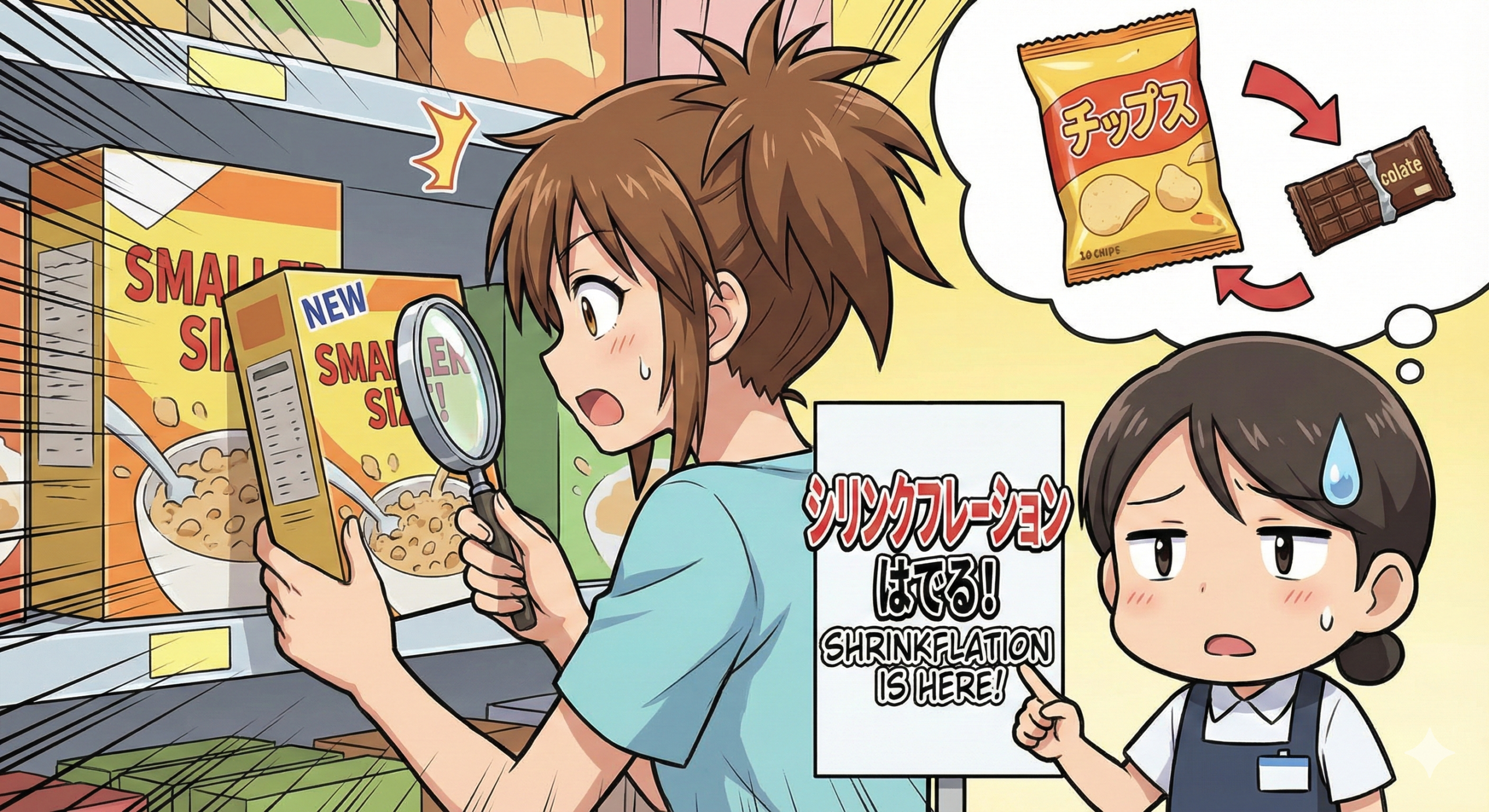
I. The Case of the Vanishing Chips
It began on a Tuesday, the sort of nondescript weekday that usually blurs into the rhythm of routine. Sarah stood in aisle four of her local supermarket, the fluorescent lights humming overhead with a sterile, flickering persistence that felt like a headache waiting to happen. In her hand, she held a bag of her favorite potato chips—”Salty Crunch,” the bold red bag she had been buying for movie nights since she was a teenager. It felt familiar, crinkly, and bright, a tactile anchor to happier, simpler times. But as she lifted it from the shelf, her hand shot up a fraction of an inch too fast, the muscle memory of her arm calibrated for a weight that was no longer there. It was as if she had braced herself to lift a brick and had instead picked up a feather.
She frowned, a subtle knitting of brows that went unnoticed by the other shoppers rushing past. She turned the bag over in her hands, the foil catching the light. It looked the same. The logo was the same bold, aggressive font that promised intense flavor. The price tag on the shelf still read $4.50, the same price she had paid last month, and the month before that, and the month before that. But when she gave the bag a little shake, the contents rattled around like loose change in a washing machine. She pressed her fingers against the front, feeling for the chips inside. Her fingers met only air—a pressurized void—until they reached the bottom third of the bag. It was mostly nitrogen, that “protective atmosphere” companies claim is essential for freshness, but today it felt less like protection and more like a magic trick where the magician makes your money disappear into thin air.
Sarah was not an economist. She did not spend her mornings reading the Financial Times or tracking the fluctuating price of crude oil futures or the yield on ten-year treasury bonds. She was a graphic designer who just wanted a snack. But standing there, staring at the “Family Size” label that suddenly seemed like a cruel, ironic joke, she felt a prickle of annoyance that quickly deepened into suspicion. She checked the weight printed in the corner, tiny numbers she usually ignored, the fine print of the grocery contract. 275 grams.
“Wait,” she whispered to herself, her voice barely audible over the store’s Muzak. “Wasn’t this 300 grams last time?”
She pulled out her phone, scrolling back through her digital history. She was the kind of person who documented the mundane—her cat, her dinner, funny license plates. Three months ago, she had sent a picture of her snack haul to her sister. She found the image and zoomed in on the red bag in the photo. There it was, clear as day, pixelated but undeniable: 300g.
The price was the same. The bag was roughly the same size. But 25 grams of chips—about a handful, perhaps ten decent-sized crisps—had vanished.
As she continued shopping, the pattern emerged everywhere, a silent epidemic of reduction. The toilet paper rolls looked a little looser on the cardboard tube, the sheets wound with a casual slackness rather than the tight precision of before. The chocolate bar she grabbed at the checkout felt thinner, brittle, as if it had gone on a diet. The bottle of orange juice had a deep indentation on the bottom, a “punt” so profound it ate up space where juice used to be. Sarah wasn’t just imagining it. Her grocery cart was full of ghosts—the phantom food she was paying for but not receiving.
She wasn’t alone in this realization. Across the ocean in Tokyo, a student named Kenji was staring at a package of Kit Kats, realizing there was one less bar inside than his childhood memories insisted upon.1 In London, a mother named Elena was looking at a bottle of mouthwash that seemed to have physically shrunk, even though the price had jumped up a pound.2 In Mumbai, a street vendor was skillfully putting fewer onions in the vada pav because he couldn’t afford to keep the price steady otherwise.3
This wasn’t a glitch. It wasn’t an accident. It was a global phenomenon, a silent strategy cooked up in boardrooms thousands of miles away. Sarah paid for her groceries, feeling a strange mix of confusion and betrayal. She had just been introduced to the invisible hand of the market, and it had just picked her pocket.
This is the story of Shrinkflation. It is the story of how the world’s biggest companies are playing a high-stakes game of “Honey, I Shrunk the Groceries,” betting billions that you are too busy, too tired, or too distracted to notice. But today, we are going to notice. We are going to look past the bright logos and the “New and Improved!” stickers to see what is really happening to our money. We will travel from the candy aisles of Germany to the street markets of Nigeria, uncovering the tricks of the trade. And most importantly, we will learn how to fight back using the one tool they can’t shrink: simple math.
II. The Anatomy of Hidden Inflation
Defining the Phenomenon
In the formal lexicon of economics, shrinkflation is the practice of reducing the size, quantity, or weight of a product while maintaining or even increasing its sticker price.4 The term is a portmanteau of “shrink” (to get smaller) and “inflation” (the general rise in prices), coined by the economist Pippa Malmgren.7 It acts as a stealth mechanism for price hikes. When inflation occurs transparently, consumers see the price of milk rise from $3.00 to $3.50. The pain is immediate and visible at the register. The shopper grumbles, perhaps reconsiders the purchase, or switches to a cheaper brand.
Shrinkflation, however, is designed to anesthetize this pain. The price remains anchored at $3.00, soothing the consumer’s price sensitivity. But the carton that once held 1 liter now holds 900 milliliters. The consumer pays the same amount for less product, meaning the effective price per unit of milk has risen, yet the psychological trigger of a “price hike” is avoided.7 This is “hidden inflation,” a strategy predicated on the assumption that consumers are observant of prices but negligent of net weights.7
While the practice is generally legal—provided the net weight listed on the package is accurate—it treads a fine ethical line. Consumer advocates argue it is deceptive, relying on habit and inattention to pass costs onto the consumer without their explicit consent.5
The Economic Engine: Why Now?
To understand why your grocery basket is shrinking, one must look upstream to the factory floor and the global supply chain. The production of goods is subject to a complex matrix of costs, nearly all of which have surged in recent years.
1. The Volatility of Raw Materials
The most direct driver is the cost of ingredients. For a chocolate manufacturer, the price of cocoa is existential. Recent years have seen cocoa prices triple due to adverse weather conditions in West Africa, specifically in Ivory Coast and Ghana, which produce the bulk of the world’s supply.5 Faced with a 300% increase in the cost of their primary ingredient, a manufacturer has three choices: absorb the cost and accept lower profits, raise the price and risk alienating customers, or use less cocoa by shrinking the bar. Most choose the latter.7 This dynamic applies across the board: wheat for pasta, vegetable oil for frying chips, and pulp for paper products have all seen significant price volatility.
2. The Logistics of Movement
Transporting a box of cereal from a manufacturing hub in Michigan to a supermarket shelf in Florida involves significant expense. Fuel prices, driver wages, and vehicle maintenance all contribute to logistics costs. Shrinkflation offers a logistic advantage: smaller packages mean more units can fit on a pallet, and more pallets can fit in a truck. A 10% reduction in package size might allow a company to ship 10% more product for the same fuel cost, a massive efficiency gain that incentivizes downsizing.13
3. The Packaging Equation
Often, the packaging costs as much as the product inside. Aluminum for cans, plastic for wrappers, and cardboard for boxes are commodities with fluctuating prices. By shrinking a package, a company uses less material. Over the course of millions of units, saving a fraction of a gram of plastic translates to millions of dollars in savings.
4. Labor and Overhead
As the cost of living rises, workers demand higher wages. Energy costs for running factories have also spiked globally. Shrinkflation allows companies to recover these rising overheads without the “sticker shock” of a higher retail price.13
5. The Profit Imperative: Greedflation?
While companies cite inflation as the primary driver, financial data suggests another motive: profit expansion. A detailed analysis of major Fast-Moving Consumer Goods (FMCG) groups shows that for many, operating margins have not just survived inflation—they have thrived on it.
| Company | Operating Margin Growth (2021-2024) | Price Increases (2021-2024) |
| Beiersdorf | +47.8% | N/A |
| PepsiCo | +27.2% | +34% |
| Mondelez | +24.6% | +30.9% |
| Unilever | +16.0% | +20.4% |
| Henkel | +13.1% | +30.6% |
| Nestlé | +7.0% | +17.7% |
Data Source: IntoTheMinds 14
The table above reveals a stark reality. Companies like Beiersdorf and PepsiCo saw double-digit increases in their profitability during the very period they were shrinking products. This has led to accusations of “Greedflation”—the idea that companies are using the cover of general inflation to raise prices (or shrink products) far beyond what is necessary to cover their costs, effectively padding their margins at the consumer’s expense.5
The Psychological Battlefield
Why is this tactic so effective? It exploits specific cognitive biases hardwired into the human brain.
The “Just Noticeable Difference” (Weber’s Law)
Psychophysics, the branch of psychology that deals with the relationships between physical stimuli and mental phenomena, offers a concept called the Just Noticeable Difference (JND). This is the minimum amount by which stimulus intensity must be changed in order to produce a noticeable variation in sensory experience.6 Corporations are masters of Weber’s Law. They know that if they reduce a 100g bar by 5g, the change is below the JND for most people holding the bar. It feels the same. If they reduced it by 20g, the brain’s error detection circuits—specifically the amygdala and ventral striatum—would light up, signaling that something is “off”.11 The goal is to stay comfortably within the zone of imperceptibility.
Loss Aversion
Behavioral economists Daniel Kahneman and Amos Tversky identified “Loss Aversion,” the principle that the pain of losing is psychologically about twice as powerful as the pleasure of gaining. A price increase feels like a direct financial loss. A size reduction, however, is abstract. We do not “lose” money; we just gain slightly less product. The brain categorizes this as a much smaller negative event, or overlooks it entirely.15 This is sometimes called the “Silver Lining Effect,” where consumers subconsciously prefer getting less to paying more, because the price point is the “anchor” of the transaction.15
III. Europe: The Legislative Frontline
Europe has become the epicenter of the backlash against shrinkflation, with governments and consumer groups taking aggressive steps to name and shame offenders.
France: The Shame Signs
In France, the cultural importance of food and consumer protection has led to a fierce response. The supermarket chain Carrefour, attempting to position itself as the consumer’s ally, initiated a campaign of “shaming” suppliers. They placed orange signs on shelves next to products like Lipton Ice Tea, explicitly stating that the bottle size had decreased while the price had risen. This forced a national conversation, leading the French government to pass legislation in July 2024. The new law mandates that retailers must inform consumers if a product has been reduced in size without a corresponding price drop. The signs must remain up for two months, a “scarlet letter” for shrinkflated goods.4
Germany: The “Cheat Pack”
In Germany, consumer protection is driven by powerful advocacy groups. The Hamburg Consumer Advice Center actively monitors products and awards the dubious title of “Deceptive Package of the Month” (Mogelpackung des Monats). A notable example was Aldi’s Gut Bio Fennel Tea. The price appeared to drop from €1.49 to €1.19, which seemed like a bargain. However, the box contained only 20 tea bags instead of the previous 25, and the weight of each individual bag had also been reduced. The net result was a 50% price increase per gram of tea, hidden behind a lower sticker price.18
The United Kingdom: A Crisis of Cost
The UK, grappling with a cost-of-living crisis, has seen rampant shrinkflation across staples.
- Mouthwash: A bottle of Listerine or similar mouthwash might shrink from 500ml to 400ml, vanishing 20% of the product overnight.
- Cleaning Products: Jif Power & Shine bathroom cleaner saw a dramatic reduction from 700ml to 500ml. Simultaneously, the price rose from £2.50 to £4.00. This double whammy meant the price per 100ml increased by over 122%.9
- Chocolate: Nestlé’s Quality Street tubs, a Christmas tradition, have been steadily losing weight, dropping from 600g to 550g recently, while the price at retailers like Morrisons rose from £6 to £7.2
- Biscuits: McVities has been a frequent offender. Their “Forest Fruit” biscuits dropped from 218g to 174g, and their iconic Digestives went from 400g to 355g, all while prices remained static.9
Hungary and Romania
Eastern Europe is also regulating. Hungary introduced rules effective February 2024 requiring retailers to flag downsized products. Romania and Italy are following suit with similar legislation, creating a patchwork of anti-shrinkflation laws across the continent.4
IV. North America: The Corporate Strategy
In the United States and Canada, the approach is less about government regulation and more about corporate strategy and consumer “choice.”
The “Family Size” Illusion
American supermarkets are dominated by “Family Size,” “Party Size,” and “Mega Size” labeling. These terms are marketing fluff, not legal definitions. A “Family Size” box of Cocoa Puffs in 2024 might be smaller than a “Regular” box from 2010.
- General Mills: The company shrank “Family Size” boxes of cereals like Cocoa Puffs by 6%.
- Nabisco: Wheat Thins “Family Size” boxes shrank by 12%.20
- Gatorade: PepsiCo replaced the standard 32oz bottle with a 28oz bottle. The new bottle was designed to be curvier and easier to hold, a “feature” that conveniently masked the 12% reduction in volume. The price remained the same.20
The Chip Aisle Conspiracy
Frito-Lay (a division of PepsiCo) is frequently cited in shrinkflation reports.
- Doritos: Bags have seen a reduction of roughly 5% in weight.
- Tostitos and Ruffles: PepsiCo executives have openly discussed managing “price points.” When the cost of variety packs became too high, they shifted strategy, sometimes reducing the count or changing the mix.20
- Barilla Pasta: A controversy erupted when consumers noticed a discrepancy between US and Canadian packaging. Barilla Rigatoni was sold in 454g (1 lb) boxes in the US, but 410g boxes in Canada. The company claimed this was for market differentiation, but for consumers, it looked like a 10% cut.14
Skimpflation in Services
The US also sees a rise in “Skimpflation,” where the quality of service degrades. Hotels no longer offer daily housekeeping. Airlines replace meals with snacks. It is a reduction in the “product” of service without a reduction in the room rate or ticket price.21
V. Asia: The Culture Shock
Asia presents a diverse landscape, from the deflation-fighting policies of Japan to the street-level adaptations in India.
Japan: Breaking the Taboo
For decades, Japan struggled with deflation—prices rarely rose, and raising them was considered a corporate taboo. Now, faced with global inflation and a weak yen, Japanese companies are in a bind. They cannot easily raise prices without angering consumers who are used to stability. Shrinkflation has become the preferred coping mechanism.
- Kit Kat: The journey of the Japanese Kit Kat is a case study in shrinkflation. Packages went from 13 mini-bars to 12. Then, for a brief period, they went back to 13, but the price was hiked significantly. Recently, they dropped to 11 bars. The constant fluctuation makes it dizzying for consumers to track value.1
- Citizen Action: The frustration is so palpable that a Japanese consumer, Masayuki Iwasa, created a website called Neage.jp (meaning “price increase”). It acts as a wiki for shrinkflation, where users upload evidence of shrinking products. It tracks thousands of items, from hamster food to biscuits, providing a digital paper trail of the shrinking economy.22
South Korea: The Fine Print
South Korea has taken a hard line. A new rule mandates that companies must display a notice for three months if they downsize a product. Failure to do so results in a fine of 5 million Won ($3,700) for a first offense, and 10 million Won ($7,400) for a second. This puts the onus of transparency squarely on the manufacturer.16
India: The Sachet Economy and Street Food
In India, the market is extremely price-sensitive. A large portion of the population buys “sachets”—single-serve packets of shampoo, detergent, or biscuits—priced at magic price points like ₹5 or ₹10.
- The Magic Price Point: Companies cannot change the ₹5 price point because a coin is a distinct psychological and practical unit. Instead, they ruthlessly cut weight. A ₹5 pack of biscuits that used to weigh 80g might now weigh 55g. The packet size stays roughly the same, but the biscuits inside are smaller or fewer.23
- Skimpflation: Travelers and locals alike have noted a degradation in quality. Airline snacks that were once roasted almonds are now cheaper rice crackers. “Analogue paneer” (made with vegetable oil) is swapping out real dairy paneer in restaurants to keep costs down.25
- Street Food: In Pune, vendors of the popular vada pav snack face a dilemma. Rising oil and potato prices mean they must either raise prices or shrink the vada. Many chose to make the potato patty smaller or use smaller buns, maintaining the street price that commuters expect.3
VI. The Global South: Survival Economics
In emerging markets, shrinkflation is not just an annoyance; it is a threat to food security and basic living standards.
Nigeria: The Struggle for Value
Nigeria has faced severe inflation, impacting the cost of staples like rice, beans, and oil. The “sachet economy” is dominant here.
- The Cola Wars: Historically, brands like Pepsi and Coca-Cola used volume to compete. The entrance of “Bigi” and “Big Cola” disrupted the market with larger bottles for lower prices. However, inflation forced even these challengers to reconsider their sizing.
- Miksi Milk: In Kenya (representative of East African trends), a 500g sachet of milk powder was reduced to 450g. This 10% reduction is significant for families who rely on powdered milk for nutrition. The price remained unchanged, effectively raising the cost of nutrition by 11%.26
- Bouillon Cubes: In Ghana, Onga seasoning cubes dropped from 12g to 11g. In a market where every gram counts for flavor and caloric intake, these micro-reductions accumulate.26
South Africa: The shrinking Basket
- Cereal: The “Mighty Grain” cereal reduction mentioned earlier is also felt here.
- Hot Cross Buns: A staple for Easter, Community Co’s buns shrank from 480g to 450g while simultaneously increasing in price—a “double whammy” of shrinkflation and inflation.27
- Toilet Paper: Manufacturers have reduced the number of sheets, a subtle change that forces households to buy more frequently.28
South America: Inflation Veterans
Brazil and Argentina are veterans of high inflation environments.
- Argentina: Under President Javier Milei, the country is undergoing massive economic adjustments. Beef consumption has dropped to 13-year lows as prices soar. Consumers are buying smaller cuts of meat, or switching to cheaper proteins, effectively shrinking their own consumption baskets out of necessity.29
- Brazil: To combat deceptive downsizing, Brazil implemented a law requiring manufacturers to place a prominent declaration on the front of the package for 180 days (6 months) detailing the old weight, the new weight, and the absolute and percentage reduction. This “shaming” regulation is one of the strictest in the world.16
VII. The Taxonomy of Deception: How They Fool You
Companies employ a sophisticated arsenal of packaging tricks to disguise these reductions. The goal is to alter the physical reality of the product without altering the consumer’s perception of it.
1. The “Air Fill” (Functional Slack Fill)
This is the most pervasive tactic. A consumer picks up a large bag of chips, and it feels substantial. Opening it reveals that the chips occupy only the bottom third. Companies argue this “slack fill” is nitrogen gas necessary to protect the delicate chips during shipping.30 While partially true, consumer advocates note that the ratio of air to product seems to be shifting in favor of air. It creates a visual illusion of volume that does not exist.
2. The Indentation (The Dimple or Punt)
A jar of peanut butter or pasta sauce may look cylindrical from the outside. However, turning it over reveals a deep concave indentation in the base, known as a “punt.” In wine bottles, this provides structural integrity. In plastic peanut butter jars, it serves only to displace volume. A jar with a deep punt can hold 10-15% less product than a flat-bottomed jar of the same height and width.31
3. The “New Look” Redesign
When a product is downsized, companies rarely keep the old box, which would leave noticeable empty space. Instead, they launch a “New, Sleek Design!”
- The Skinny Box: A cereal box might be kept at the same height and width (the “face” that looks out from the shelf) but the depth is reduced. From the front, it looks identical. Only by turning it sideways does the consumer see it has lost 20% of its volume.
- The Curvy Bottle: As seen with Gatorade, a straight bottle is replaced by a curvy, “ergonomic” one. The curves nip in the waist of the bottle, reducing volume while marketing it as a grip feature.32
4. The Count Reduction
This occurs in multi-packs. A box of cheese slices that used to contain 12 slices now contains 10. The box size remains unchanged, but the slices are spaced differently or the plastic dividers are thicker. Unless the consumer memorized the previous count, the change goes unnoticed.18
5. The Recipe Shift (Skimpflation)
If the physical size cannot be reduced, the internal composition is altered.
- Water Content: Liquid soap or soups may have their water content increased. The volume is the same, but the active ingredients are diluted.
- Fat Content: Ice cream is “whipped” more to include more air bubbles (overrun). The tub is full, but the weight of the ice cream inside drops.
- Ingredient Swaps: Expensive ingredients like cocoa butter, olive oil, or dairy are replaced with cheaper alternatives like palm oil, sunflower oil, or vegetable starches. A “chocolatey chip” cookie may no longer contain legal chocolate.33
VIII. Fighting Back: The Power of “Price Per Unit”
In this landscape of shifting weights and vanishing chips, the consumer is not helpless. There is a counter-measure, a “superpower” available in almost every supermarket: Unit Pricing.
The Great Equalizer
The “Price” is what you pay at the register (e.g., $4.00). The “Price Per Unit” tells you the cost for a standard amount of that product (e.g., $0.25 per ounce, or $1.00 per 100 grams).8 This metric cuts through the noise of packaging design, marketing claims, and “Family Size” labels. It standardizes value.
Decoding the Shelf Tag
Scenario: You are buying laundry detergent.
- Bottle A: $12.00. It is a large, brightly colored bottle with a “New Ergonomic Grip!” It claims “30% More Cleaning Power!”
- Bottle B: $11.50. It looks slightly smaller and is a generic store brand.
Instinct suggests Bottle B is cheaper. Marketing suggests Bottle A is better. The Unit Price reveals the truth.
- Bottle A: The tag reads “$0.25 per load.”
- Bottle B: The tag reads “$0.18 per load.”
Despite the flashier packaging and claims, Bottle A is 38% more expensive for the actual service it provides (cleaning clothes).
The DIY Calculation
In smaller stores or developing markets where unit pricing is not mandated on tags, consumers can calculate it using a smartphone.8
The Formula:
$$\text{Price Per Unit} = \frac{\text{Total Price}}{\text{Total Weight or Count}}$$
Example 1: The Cereal Check
- Old Box: $4.50 for 500g.
- Calculation: $4.50 / 500 = 0.009$ ($0.90 per 100g).
- New “Shrinkflated” Box: $4.50 for 450g.
- Calculation: $4.50 / 450 = 0.01$ ($1.00 per 100g).
- Result: A pure price increase of 11%.
Example 2: The Toilet Paper Test
- Pack Price: $10.00.
- Total Sheets: 1,000 sheets (found on the back in fine print).
- Calculation: $10.00 / 1,000 = 0.01$ per sheet.
- Comparison: If a competitor offers 1,200 sheets for $11.00 ($0.009 per sheet), the more expensive pack is actually the better value.
A Strategy Guide for the Modern Shopper
- Ignore the Front, Read the Bottom: The “Net Weight” printed at the bottom of the package is the only honest thing on the box.
- Audit Your Staples: You don’t need to calculate this for everything. Pick your top 10 items (coffee, cereal, toilet paper, detergent, pet food) and memorize their “good” unit price.
- Brand Disloyalty: If your favorite brand shrinks, switch. Loyalty is expensive in an inflationary environment. Store brands (private label) are often produced in the same factories as name brands but are less prone to marketing-driven shrinkflation.
- Buy in Bulk with Caution: Bulk usually offers a lower unit price, but not always. Grocery stores know consumers assume “bigger is cheaper.” Sometimes, two medium jars of peanut butter are cheaper per ounce than one “Mega” jar. Always do the math.
- Use Technology: In Japan, consumers use Neage.jp. In other countries, apps and Reddit communities like r/shrinkflation serve as early warning systems.
IX. Conclusion: The Future of the Grocery Basket
Will shrinkflation recede? History suggests it is a ratchet mechanism—it moves easily in one direction but rarely reverses. When cocoa prices eventually fall, it is unlikely that Mondelez will announce, “Great news! The chocolate bar is 10g heavier for free!” Instead, they will likely maintain the smaller size and enjoy the recovered margin.7
However, the era of opacity is ending. The rise of “shame” legislation in Europe, strict labeling laws in Brazil and South Korea, and the digital vigilance of consumers in Japan and the US creates a new pressure. Companies can no longer assume their adjustments will go unnoticed.
The supermarket has changed. It is no longer just a place of provision; it is a landscape of subtle negotiation and calculation. Sarah, standing in aisle four with her lighter bag of chips, represents the new consumer: skeptical, informed, and armed with a calculator. The chips may be fewer, but the awareness is growing. In the battle for value, the most powerful weapon is simply paying attention.
Key Terminology
| Concept | Definition | Example |
| Shrinkflation | Reducing product size while keeping the price static. | A 200g chip bag becoming 175g for $4.00. |
| Skimpflation | Reducing quality of ingredients/service at same price. | Using palm oil instead of butter; hotels cutting housekeeping. |
| Unit Price | The cost per standard unit of measurement. | $0.25 per ounce; $1.20 per 100g. |
| Loss Aversion | Psychological preference to avoid losses over acquiring gains. | Preferring a smaller product to a higher price tag. |
| JND (Weber’s Law) | The threshold of change noticeable to human senses. | A 5g reduction in a 100g bar goes unnoticed. |
| Slack Fill | Empty space in packaging, ostensibly for protection. | A chip bag that is 50% air. |
Works cited
- Japan’s Kit Kats Are Shrinking! Nestle Japan Announces Price Increases and Reduced Sizes for 133 Products, accessed November 23, 2025, https://hyperjapan.co.uk/food-drink/japans-kit-kats-are-shrinking-nestle-japan-announces-price-increases-and-reduced-sizes-for-133-products/
- Shrinkflation hits everyday staples, piling more pressure on households – The Guardian, accessed November 23, 2025, https://www.theguardian.com/business/2025/oct/28/shrinkflation-hits-everyday-staples-piling-more-pressure-on-households
- Pune on my plate: ‘Lose customers or lose profits’, inflation leaves street food vendors in the lurch – The Indian Express, accessed November 23, 2025, https://indianexpress.com/article/cities/pune/pune-on-my-plate-lose-customers-or-lose-profits-inflation-leaves-street-food-vendors-in-the-lurch-9810585/
- International Shrinkflation Guide | DLA Piper, accessed November 23, 2025, https://www.dlapiper.com/en/insights/topics/international-shrinkflation-guide
- Shrinkflation Uncovered: Myths, Realities, and Consumer Impact – – Food Distribution Guy, accessed November 23, 2025, https://fooddistributionguy.com/shrinkflation-uncovered-myths-realities-and-consumer-impact/
- Shrinkflation – Wikipedia, accessed November 23, 2025, https://en.wikipedia.org/wiki/Shrinkflation
- Understanding Shrinkflation: Causes, Examples, and How to Identify It – Investopedia, accessed November 23, 2025, https://www.investopedia.com/terms/s/shrinkflation.asp
- Pinchin’ Pennie$ in the Kitchen: 6 Tips to Save Money With Unit Pricing | NDSU Agriculture, accessed November 23, 2025, https://www.ndsu.edu/agriculture/extension/publications/pinchin-pennie-kitchen-6-tips-save-money-unit-pricing
- 10 products hit by shrinkflation in 2024 | CHOICE, accessed November 23, 2025, https://www.choice.com.au/shopping/packaging-labelling-and-advertising/packaging/articles/shrinkflation-investigation
- Shrinkflation: How inflation is downsizing some of your favourite foods, accessed November 23, 2025, https://www.weforum.org/stories/2022/03/how-companies-are-hiding-inflation-without-charging-you-more/
- This is your brain on shrinkflation -, accessed November 23, 2025, https://thomasramsoy.com/index.php/2024/10/28/this-is-your-brain-on-shrinkflation/
- Understand Shrinkflation and Effective Marketing Strategies for your Brand – Mintel, accessed November 23, 2025, https://www.mintel.com/insights/retail/understand-shrinkflation-effective-marketing-strategies/
- The Impact of Shrinkflation on Warehousing | Datex Blog, accessed November 23, 2025, https://datexcorp.com/impact-of-shrinkflation-on-warehousing/
- Shrinkflation: still a magic recipe in 2025 – Intotheminds, accessed November 23, 2025, https://www.intotheminds.com/blog/en/shrinkflation/
- new smaller size! Why getting less with shrinkflation is preferable to paying more – Macquarie University, accessed November 23, 2025, https://research-management.mq.edu.au/ws/portalfiles/portal/198145651/198144145.pdf
- Where To Find Shrinkflation Penalties – Econlife, accessed November 23, 2025, https://econlife.com/2024/05/shrinkflation-penalties/
- Shrinkflation – the fight against deceptive packaging and consumer deception | B+P Creality, accessed November 23, 2025, https://www.bpc.works/en/news/shrinkflation-the-fight-against-deceptive-packaging-and-consumer-deception/
- Shrinkflation: When Price Increases are Hidden Behind the Packaging – FACHPACK, accessed November 23, 2025, https://www.fachpack.de/en/fachpack-360/2023-2/article/shrinkflation-hidden-price-increases-behind-packaging
- Shrinkflation – DLA Piper, accessed November 23, 2025, https://www.dlapiper.com/en-us/insights/blogs/consumer-food-and-retail-insights/2024/shrinkflation
- Tostitos and Ruffles Will Add More Chips to Bags, Fighting ‘Shrinkflation’ – Vice Magazine, accessed November 23, 2025, https://www.vice.com/en/article/tostitos-ruffles-shrinkflation/
- Shrinkflation, Downsizing, and the Destruction of Trust | Psychology Today, accessed November 23, 2025, https://www.psychologytoday.com/us/blog/small-town-usa/202409/shrinkflation-downsizing-and-the-destruction-of-trust
- Japanese Consumers Combat Shrinkflation With Online Tracker – Sharecafe, accessed November 23, 2025, https://www.sharecafe.com.au/2025/09/09/japanese-consumers-combat-shrinkflation-with-online-tracker/
- Small packs in demand as FMCG companies hike prices – The Times of India, accessed November 23, 2025, https://timesofindia.indiatimes.com/business/india-business/small-packs-in-demand-as-fmcg-companies-hike-prices/articleshow/117004882.cms
- Small Packs amid Big Bills: Indians Reshape Shopping Habits as Inflation Hits Budget, accessed November 23, 2025, https://agronfoodprocessing.com/small-packs-amid-big-bills-indians-reshape-shopping-habits-as-inflation-hits-budget/
- Skimpflation is robbing you daily: Welcome to the great squeeze on India’s middle class, accessed November 23, 2025, https://www.businesstoday.in/personal-finance/investment/story/skimpflation-is-robbing-you-daily-welcome-to-the-great-squeeze-on-indias-middle-class-503100-2025-11-21
- Shrinkflation in Africa: the smaller, the better (profits) – Sagaci Research, accessed November 23, 2025, https://sagaciresearch.com/shrinkflation-in-africa-the-smaller-the-better-profits/
- Shrinkflation: The ten latest grocery items to have shrunk in 2024 according to Choice, accessed November 23, 2025, https://thenightly.com.au/lifestyle/shrinkflation-the-ten-latest-grocery-items-to-have-shrunk-in-2024-according-to-choice-c-14015763
- Shrinkflation: Smaller Products, Booming Prices, accessed November 23, 2025, https://crushmag-online.com/shrinkflation-smaller-products-booming-prices/
- Argentina consumers still feeling inflation pinch | The Pig Site, accessed November 23, 2025, https://www.thepigsite.com/news/2024/11/argentina-consumers-still-feeling-inflation-pinch
- Shrinkflation: Sharing Size went from 10.10 oz to 9.40 oz : r/economy – Reddit, accessed November 23, 2025, https://www.reddit.com/r/economy/comments/13o6xhc/shrinkflation_sharing_size_went_from_1010_oz_to/
- How we’re getting ripped off by hidden inflation – YouTube, accessed November 23, 2025, https://www.youtube.com/watch?v=H2Z-FQtezCc
- Turning Shrinkflation Into a Shopper Win: How Packaging & Messaging Guide Choice – Behaviorally, accessed November 23, 2025, https://www.behaviorally.com/blog/turning-shrinkflation-into-a-shopper-win-how-packaging-messaging-guide-choice
- ‘Shrinking in size, but not in price’ – Everything you need to know about ‘shrinkflation’, accessed November 23, 2025, https://www.weforum.org/stories/2024/05/shrinkflation-inflation-cost-of-living/
- How to Compare Unit Prices – CookingHub, accessed November 23, 2025, https://www.cookinghub.com/budget-cooking/budget-tips/how-to-compare-unit-prices/
- Unit pricing | Real Life, Good Food, accessed November 23, 2025, https://reallifegoodfood.umn.edu/shop-smart/unit-pricing
- The Unstoppable Rise of Shrinkflation – The Food Institute, accessed November 23, 2025, https://foodinstitute.com/focus/the-unstoppable-rise-of-shrinkflation/