
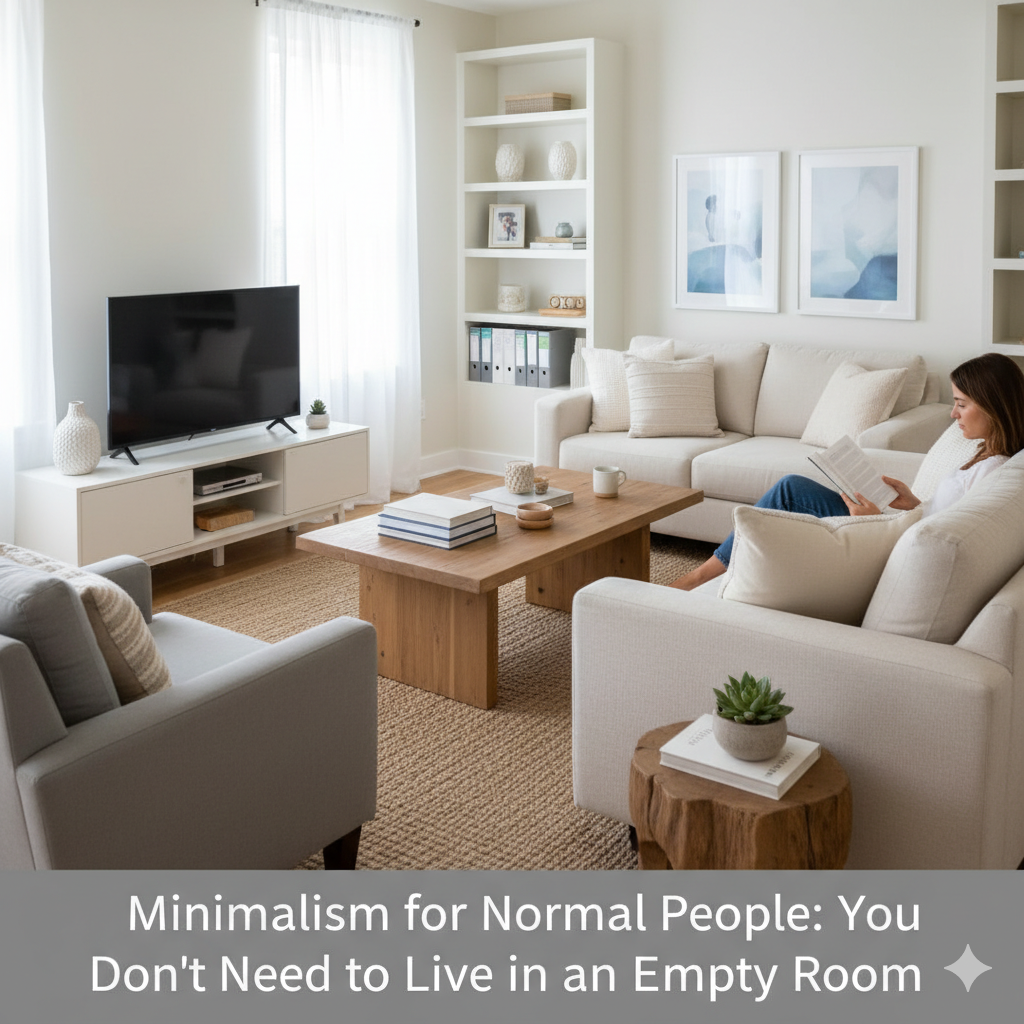
Chapter 1: The Ghost in the Garage
The realization didn’t hit Sarah in a bank or a financial advisor’s office. It hit her on a humid Tuesday afternoon in her parents’ garage, holding a box of Tupperware from 1994.
Sarah, a 42-year-old project manager with two kids and a mortgage she felt in her bones, was staring at the physical legacy of her parents’ 52-year marriage. Her father had passed away six months prior, and her mother had moved into assisted living. Sarah was left with the house. Or, more accurately, she was left with the contents of the house.
“It’s all good stuff,” her mother had told her, eyes misty. “We saved it for you. It has value.”
Standing in the sweltering heat, Sarah did the math. She had been cleaning this house for six weekends straight. She had rented a dumpster for $600. She had taken four days off work (unpaid leave). And she was barely halfway through the basement. She looked at the Tupperware—yellowed, slightly sticky, missing half the lids—and then at the stacks of National Geographic magazines, the three broken vacuum cleaners “kept for parts,” and the dining set that no longer fit modern aesthetics.
This wasn’t wealth. It was a debt.
Her parents had paid to buy this stuff. Then they paid to heat and cool the rooms that held it. They paid property taxes on the square footage it occupied. And now, Sarah was paying with her time and mental sanity to get rid of it.
“I realized in that moment that I wasn’t looking at ‘assets,’” Sarah told us later. “I was looking at ‘frozen money.’ My parents had spent decades converting their cash—their freedom—into inventory that I was now paying to throw away.”
This is the trap of the modern household. We are sold a version of the “Good Life” that looks like accumulation. But there is a quiet, growing movement of people like Sarah who are waking up to a different truth. They aren’t interested in the stark, white-walled aesthetic of trendy minimalism, where you own one spoon and sit on the floor. That’s minimalism for people who don’t have kids or hobbies.
Sarah wanted Financial Minimalism. She didn’t want an empty room; she just wanted to stop paying rent for her junk.
This is the story of how “stuff” became the greatest silent killer of modern wealth, and how normal people—people with kids, busy jobs, and sentimental hearts—can use the economics of subtraction to buy back their lives.
Chapter 2: The Architecture of Excess
To understand Sarah’s garage, we have to look at the house itself. If you walked through an American neighborhood in 1973, the average new home was about 1,660 square feet. Today, that number has ballooned to over 2,500 square feet.
Here is the paradox: while our houses have nearly tripled in size over the last 50 years, the families living inside them have gotten smaller. We have more space per person than any civilization in history.
So why does it feel like we have no room?
“The gas expands to fill the container,” explains Dr. James H., a behavioral economist who studies consumer spending. “We didn’t build bigger houses to fit the stuff we had. We bought more stuff because we built bigger houses.”
This phenomenon has created a bizarre architectural trend. Drive through any modern subdivision, and you will see three-car garages. Yet, according to the U.S. Department of Energy, 25% of people with two-car garages cannot park a single car inside them. Another 32% can only fit one.
Think about the financial absurdity of this.
Let’s say you buy a house for $400,000. If the garage represents 15% of the home’s square footage, you paid $60,000 for that space. If that space is filled with old sports equipment, broken holiday decorations, and boxes you haven’t opened since the Obama administration, you are effectively paying a $60,000 mortgage for a storage locker. Meanwhile, your $30,000 car—a machine that rapidly depreciates when exposed to sun and hail—sits in the driveway, rotting.
This is the first principle of Financial Minimalism: Every square foot of your home has a price tag.
If your mortgage and utilities cost you $2,500 a month for a 2,500-square-foot house, you are paying $1.00 per square foot, per month. That guest room you use twice a year? That’s a $150-a-month subscription fee. That basement filled with “projects you’ll get to someday”? That’s $300 a month.
When Sarah looked at her own house through this lens, the math was terrifying. “I have a dining room we use maybe at Thanksgiving,” she said. “It’s full of china we never touch. I calculated that room costs me $2,000 a year in mortgage interest and taxes. That’s $2,000 I’m paying to house plates.”
Chapter 3: The Storage Industrial Complex
If the garage is the first line of defense against clutter, the self-storage unit is the surrender.
Let’s meet Mark and Jen. They are a composite of the millions of Americans who fuel a $44 billion industry. When Mark and Jen moved from a house to a condo, they couldn’t bear to part with their “good furniture.” It included a sectional sofa, a heavy oak desk, and roughly twenty boxes of books and kitchen gadgets.
“We’ll just rent a unit for a few months while we sort it out,” Mark said.
That was five years ago.
The unit costs $145 a month. It is a standard 10×10 concrete box. Over five years, Mark and Jen have paid $8,700 in rent.
Here is the kicker: The resale value of the items in the unit is less than $1,200.
They have paid nearly $9,000 to protect $1,000 worth of assets. This is a negative return on investment of nearly 800%. If Mark managed his retirement portfolio this way, he would be destitute. But because it is “just stuff,” the financial bleed goes unnoticed.
The self-storage industry knows this. They bank on the Sunk Cost Fallacy. This is the psychological quirk where we refuse to cut our losses because we’ve already invested so much. Mark feels he can’t throw the sofa away now—he’s paid $8,000 to keep it! To throw it away would be to admit that the money was wasted. So, he pays another $145 next month to delay the pain.
This industry is now so large that there is 7.3 square feet of self-storage space for every man, woman, and child in America. We have built a shadow housing market, not for people, but for our excess inventory.
Financial Minimalism asks a brutal question: If your house burned down today, would you replace this item? If the answer is no, you are paying to store a ghost.
Chapter 4: The Hidden Ledger of Insurance and Depreciation
The cost of owning “stuff” isn’t just about space. It’s about risk.
Most homeowners insurance policies have a coverage limit for “Personal Property” (Coverage C), usually set at 50% to 70% of the dwelling coverage. If your house is insured for $400,000, your policy automatically charges you to cover $200,000 worth of stuff.
But what if you don’t have $200,000 worth of stuff?
“I audited my possessions,” Sarah said. “I went room by room. Even if I bought everything brand new—the clothes, the electronics, the furniture—I maybe have $50,000 worth of things.”
She was paying premiums to insure a lifestyle she didn’t have. While not all insurers allow you to lower this limit easily, many do, or they allow you to shift to a policy that matches your actual inventory. By reducing her personal property coverage to match her actual needs, Sarah saved $180 a year.
But the bigger financial lie we tell ourselves is about Depreciation.
We look at a dining table we bought for $1,500 in 2010 and think, “This is a valuable asset.” We treat it like a savings bond. But furniture is not a bond. It is closer to a banana—it starts rotting the moment you buy it.
Insurance adjusters use “depreciation schedules” to determine the actual cash value of items.
- Upholstered Furniture: Loses 10-20% of its value every year.
- Electronics: Lose 20-30% per year.
- Clothing: Loses 50% the moment you cut the tags off.
After five to seven years, most of the “assets” clogging our homes are financially worthless. We are warehousing zero-value inventory.
When Sarah tried to sell her parents’ “valuable” dining set—solid cherry wood, pristine condition—she listed it for $1,000. No bites. She dropped it to $500. Silence. Finally, she begged a second-hand dealer to take it.
“I’ll give you $50 if you help me load it,” the dealer said. “Nobody wants brown furniture anymore, lady. It’s heavy, it doesn’t fit in modern apartments, and young people buy IKEA.”
That was the moment the myth of “heirloom value” shattered for Sarah. She realized that by holding onto things for “resale value,” she was fighting a losing battle against a market that had moved on.
Chapter 5: The Psychology of “More” (The Diderot Effect)
Why do we do this? Why do rational people, who clip coupons to save 50 cents on pasta, spend thousands storing junk?
It isn’t stupidity. It’s biology. We are fighting against a psychological phenomenon known as the Diderot Effect.
Denis Diderot was a French philosopher in the 1700s. He lived a humble life until someone gifted him a beautiful scarlet dressing gown. The gown was magnificent. Too magnificent. When he wore it, he noticed his old desk looked shabby. So he replaced the desk. Then the rug looked cheap, so he bought a Damascus rug. Then the chair, the paintings, the mirror.
Soon, Diderot was in debt, sitting in a luxurious room that felt alien to him. “I was the absolute master of my old dressing gown,” he wrote. “I have become the slave of my new one.”
We see this in the modern home every day.
You buy a new smartphone.
Suddenly, your old headphones won’t connect, so you buy AirPods.
Then you need a wireless charging pad.
Then you need a protective case.
Then you need a subscription to Apple Music to justify the high-quality audio.
One purchase triggers a chain reaction of consumption.
Financial Minimalism acts as a circuit breaker for the Diderot Effect. It embraces incoherence. A financial minimalist is okay with the old rug next to the new desk. They are okay with the “good enough” item. They recognize that the “spiral of upgrades” is a marketing funnel designed to drain liquidity.
Chapter 6: The Cognitive Tax
There is a cost to clutter that doesn’t show up on a bank statement, but it bankrupts us all the same: The Cognitive Tax.
Neuroscience researchers at Princeton University found that physical clutter in your environment competes for your attention. It restricts your brain’s ability to focus and process information.
When you sit down to work at a messy desk, or try to relax in a living room covered in toys, your brain is running a background process: Scan the mess. Categorize the mess. Ignore the mess. This drains your battery.
For women, the data is even more alarming. A study by UCLA’s Center on Everyday Lives and Families (CELF) tracked cortisol (stress hormone) levels in families. They found a direct link: The density of household objects in a home spiked cortisol levels in women.
The “mess” was physically stressing them out.
Sarah felt this. “I would come home from work, tired, and see the pile of mail on the counter and the shoes in the hall, and I would just shut down,” she said. “We stopped inviting friends over because the ‘cleaning cost’—the three hours of panic-cleaning required to make the house presentable—was too high.”
This is a loss of Social Wealth. When your stuff prevents you from connecting with people, you are poorer.
The Financial Minimalist views their home as a machine for living, not a museum for things. If the machine is clogged, it cannot produce happiness.
Chapter 7: The Kid Paradox
“But I have kids!”
This is the number one objection to minimalism. And it is valid. Kids are engines of entropy. They come with gear, they grow out of clothes every three months, and they seem to generate plastic toys out of thin air.
But this is where Financial Minimalism shines brightest. It shifts the focus from “depriving the child” to “curating the childhood.”
The Toy Rotation Strategy
The average American child receives $6,500 worth of toys over their childhood, yet they play with a fraction of them. The floor of a typical playroom is a graveyard of abandoned interest.
Financial minimalists use “Toy Rotation.”
- Take 75% of the toys and put them in opaque bins in a closet.
- Leave 25% out on the shelves.
- Every three weeks, swap them.
When the “old” toys come out of the closet, the child reacts as if they are brand new. You have artificially created novelty without spending a dime. You save money, the house stays cleaner, and the child actually plays deeper because they aren’t overstimulated by 200 options.
The Capsule Wardrobe
Instead of buying 40 cheap t-shirts that stain and shrink, the financial minimalist parent buys 10 high-quality items that all match.
Blue pants, grey shorts, striped shirts. Everything matches everything.
The morning fight about “what to wear” vanishes because there are no bad combinations. The laundry volume drops. And because you are buying less, you can afford higher quality fabrics that survive the playground.
The Art of Archives
Then there is the artwork. The endless stream of drawings, paintings, and glued macaroni that comes home from school.
Sarah used to keep it all in a guilt-ridden box. Now, she uses a service (like Artkive) or just a scanner. She digitizes the art, prints it into a single, hardcover coffee table book at the end of the year, and recycles the originals.
The child gets a beautiful book celebrating their work. Sarah gets her closet back. The cost of the book ($30) is far less than the cost of storing boxes for 20 years.
Chapter 8: The Liquidity Event (The Exit Strategy)
So, how do we get out? How do we transition from the “Normal Person” accumulating junk to the Financial Minimalist building wealth?
It starts with a shift in how we view Liquidity.
Stuff is illiquid. You cannot pay for groceries with a used treadmill. You cannot pay for college with a collection of Hummel figurines.
Cash is liquid. Investments are liquid.
The Downsizing Unlock
The ultimate move for the empty nester—or even the rightsizing family—is to trade square footage for freedom.
Consider the “Retirement Equation.”
If you sell the 3,000-square-foot family home for $600,000 and move to a 1,500-square-foot condo for $350,000, you unlock $250,000 in tax-free equity (in many jurisdictions).
Invested at a modest 5% return, that $250,000 generates $12,500 a year in passive income.
That covers your utilities, your insurance, and your groceries.
You have traded two empty bedrooms and a formal dining room for food for the rest of your life.
The Rental Economy
For the things you can’t sell, stop buying them.
Do you need to own a power washer? You use it once a year for 4 hours.
A good power washer costs $300. To rent one costs $40.
You would have to own it for 7.5 years to break even—and that’s assuming it doesn’t break, require oil changes, or take up valuable garage space.
The Financial Minimalist rents the tool, does the job, returns the tool, and keeps the $260 difference compounding in an index fund.
Chapter 9: Conclusion — The Unburdened Life
Six months after that day in the garage, Sarah finished the job. The house was sold. The proceeds were invested.
But the biggest change happened in her own home. She went room by room with a new ruthlessness. She sold the treadmill she didn’t use. She donated the clothes that didn’t fit. She cancelled the storage unit Mark and Jen were still paying for in our hypothetical scenario.
“I didn’t end up with an empty white room,” Sarah says. “My house still looks like a home. There are throw pillows. There are books. But every single thing in this house is currently working for me. Nothing is freeloading.”
She opens her banking app.
“I used to spend $300 a month on ‘household miscellaneous’—just stuff from Target I thought we needed. I put that money into a travel fund now. We’re going to Japan next spring.”
This is the promise of Financial Minimalism. It isn’t about deprivation. It isn’t about suffering. It is about realizing that we have been duped into trading the most precious resource we have—our life energy—for plastic and wood.
When you clear the clutter, you don’t just find your floorboards. You find your money. You find your time. And most importantly, you find the headspace to decide what you actually want your life to be about.
The empty room isn’t the goal. The unburdened life is.
Sources:
- 1 U.S. Department of Energy Data on Garage Usage & Housing Trends
- 2 Self Storage Association (SSA) Industry Report 2024
- 3 UCLA Center on Everyday Lives and Families (CELF): “Life at Home in the Twenty-First Century”
- 4 Princeton University Neuroscience Institute: “Interactions of Top-Down and Bottom-Up Mechanisms in Human Visual Cortex”
- 5 Insurance Information Institute: Depreciation Schedules for Personal Property
Works cited
- 21 Surprising Statistics That Reveal How Much Stuff We Actually Own – Becoming Minimalist, accessed November 19, 2025, https://www.becomingminimalist.com/clutter-stats/
- Aesthetic Minimalism vs Lifestyle Minimalism | by The Minimal Jess – Medium, accessed November 19, 2025, https://medium.com/@theminimaljess/aesthetic-minimalism-vs-lifestyle-minimalism-4498d2cb85cb
- Minimalism Is Just Another Boring Product Wealthy People Can Buy – The Financial Diet, accessed November 19, 2025, https://thefinancialdiet.com/minimalism-just-another-boring-product-wealthy-people-can-buy/
- Functional Minimalism vs Aesthetic Minimalism – Reddit, accessed November 19, 2025, https://www.reddit.com/r/minimalism/comments/1ueygp/functional_minimalism_vs_aesthetic_minimalism/
- Goodbye materialism: exploring antecedents of minimalism and its impact on millennials well-being – PMC – NIH, accessed November 19, 2025, https://pmc.ncbi.nlm.nih.gov/articles/PMC10249935/