
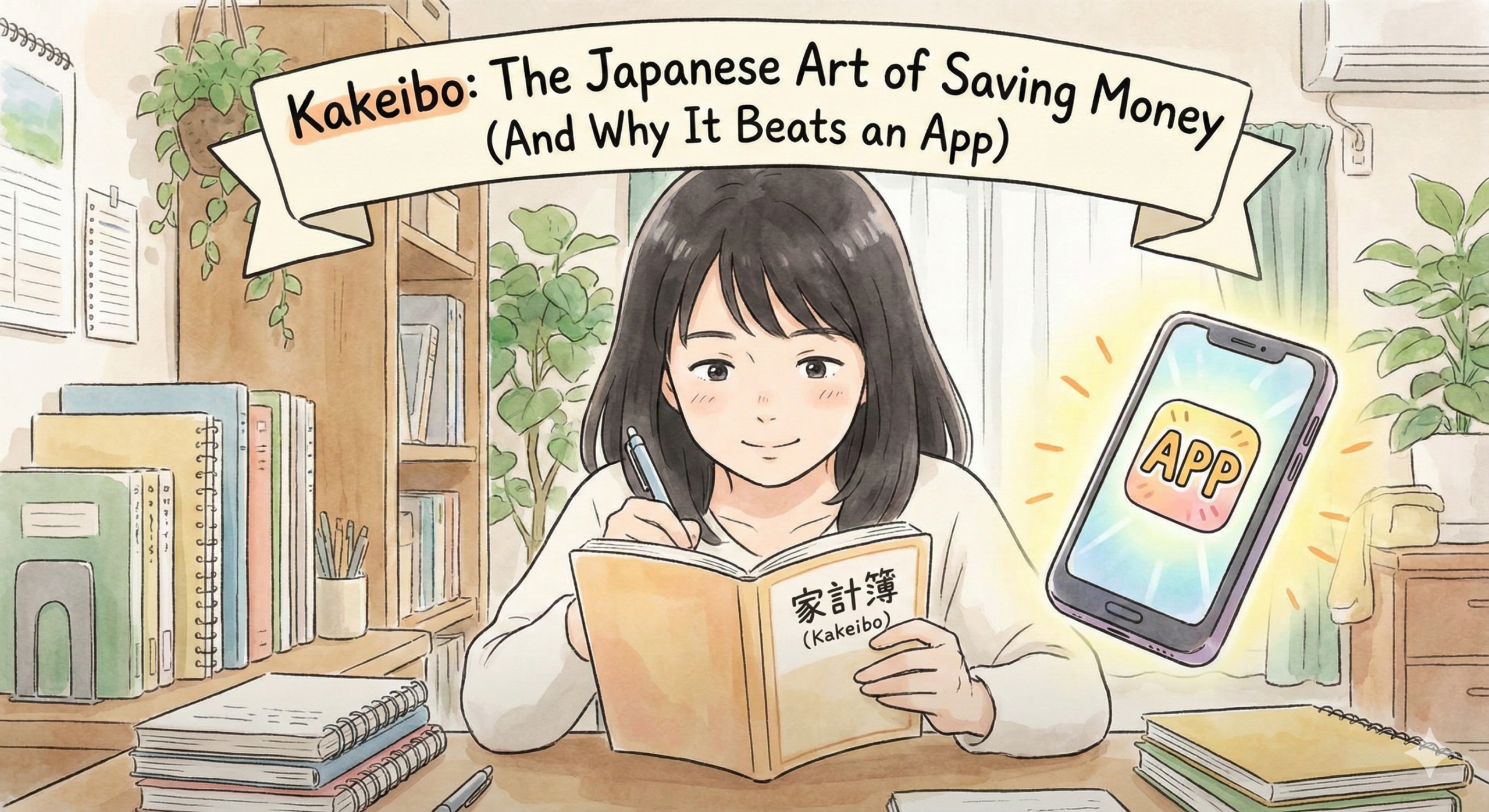
Executive Summary
In the contemporary financial landscape, characterized by frictionless digital transactions, algorithmic nudges, and the gamification of spending, the relationship between the individual and their resources has become increasingly abstract. While financial technology (FinTech) promises control through automation, the paradox of the modern era is that financial anxiety remains at historic highs, particularly among younger generations navigating an inflationary environment. This report investigates Kakeibo (pronounced kah-keh-boh), a manual budgeting method originating in 1904 Japan, positing that its analog nature offers distinct cognitive and psychological advantages over digital alternatives.
By synthesizing historical analysis, neuroscientific research on handwriting versus typing, and behavioral economics regarding “pain of paying” and emotional regulation, this article argues that Kakeibo is not merely a ledger system but a cognitive tool for behavior modification. The analysis reveals that the tactile engagement of pen and paper stimulates the Reticular Activating System (RAS) and enhances memory encoding, countering the “mindless” consumption encouraged by the digital attention economy. Furthermore, the article explores the distinct categorization philosophy of Kakeibo—specifically the “Culture” category—as a mechanism for value-based spending, contrasting it with the deprivation-based models common in Western budgeting.
Part I: The Cognitive Dissonance of Digital Finance
1.1 The Paradox of Automation
The notification arrived at 11:03 PM on a Tuesday. It was a soft, digital chime, designed by user experience (UX) psychologists to be pleasant, yet for Kenji, a 28-year-old graphic designer in Tokyo, it triggered a familiar knot of anxiety. The screen of his smartphone lit up, casting a pale blue glow across the darkened bedroom. It was his banking app, delivering a “Weekly Insight” summary. A colorful, animated pie chart appeared, slicing his life into jagged wedges of neon green and alarming red. He had overspent on “Leisure” by 14%. Again.
Kenji swiped the notification away, but the physiological response—the cortisol spike—lingered. He possessed three different budgeting apps, installed with the best of intentions. They were marvels of modern technology, automatically syncing with his credit cards, categorizing his coffee purchases via merchant codes, and sending him “nudges” when he approached his limit. Yet, despite the gigabytes of data and the algorithmic precision, he felt entirely out of control. The apps were passive observers; they told him what he had already done, functioning like a scoreboard at a game he was perpetually losing. The spending felt frictionless—a tap of a watch, a scan of a face—and the money vanished into the ether, recorded only by these silent digital accountants.1
This scenario illustrates the fundamental tension between modern convenience and cognitive awareness. The digitization of money has removed the “friction” of the transaction. In behavioral economics, friction is the effort required to complete an action. When money was physical—gold, silver, or paper—there was a tactile exchange. The spender physically felt the depletion of their resources. In the era of “one-click” ordering and biometric payments, this friction has been engineered out of the system to maximize consumption.3 The result is a state of financial dissociation, where the consumer is intellectually aware of their budget but behaviorally disconnected from the act of spending.
1.2 The Analog Counter-Revolution
Across the city, in a much smaller, older apartment in the Yanaka district, an elderly woman named Hana sat at her kitchen table. There were no screens glowing here. Instead, under the warm light of a desk lamp, she opened a physical book. It was not a novel, but a ledger—a Kakeibo. The paper was thick, creamy, and smelled faintly of cedar and ink.
Hana picked up her pen. Earlier that day, she had bought a bouquet of lilies and a new book of poetry. In a digital app, these might have been lumped under “Shopping,” “Misc,” or perhaps “Entertainment.” But Hana paused. She thought about the lilies. She thought about the poetry. She did not write them under “Wants.” She wrote them carefully in the column marked Culture.5
This act—the physical movement of the hand, the moment of pause, the deliberate categorization—changed the nature of the transaction. It was not money lost; it was an investment in her soul. She looked at the illustration at the bottom of the page: a cartoon pig (the saver) wrestling a cartoon wolf (the spender). She smiled. Today, the pig had won.1 She calculated her balance by hand, doing the subtraction in the margins. She knew exactly how much money she had to survive the week, down to the last Yen. She closed the book, feeling a sense of completion and peace that Kenji, with all his automated alerts and predictive algorithms, had never known.
The story of Kenji and Hana frames the central thesis of this report: that the solution to modern financial stress is not more technology, but less. The resurgence of Kakeibo represents a shift toward “slow finance,” prioritizing mindfulness and intentionality over speed and convenience.
Part II: Historical Genesis and Sociological Context
2.1 The Meiji Era and the Education Gap
To understand why a paper notebook is making a resurgence in a hyper-digital world, one must look back to Tokyo in 1904, a pivotal moment in Japanese history. Japan was in the midst of the Meiji Restoration, a period of rapid modernization and industrialization that transformed the nation from a feudal society into a global power. However, this modernization was uneven, particularly regarding gender roles.8
The prevailing cultural ideal for women during this period was Ryosai Kenbo, or “Good Wife, Wise Mother.” The Meiji government codified a male-centered authoritarian family system, where the role of women was restricted to child-rearing and domestic servitude, while men were educated to become leaders of society and heads of households.8 The education gap was profound; while public schooling was expanding, opportunities for women to acquire skills relevant to economic independence or professional advancement were severely limited.
In this restrictive landscape lived a woman named Motoko Hani (1873-1957). Hani was not merely a housewife; she was a radical intellectual and Japan’s first female journalist. She recognized that the “Good Wife, Wise Mother” ideology, while limiting, also placed the woman at the center of the domestic sphere.1 Hani sought to weaponize this position. If the home was the woman’s domain, then the management of that domain—specifically its economics—should be a professional, intellectual pursuit, not merely a chore.
2.2 The Philosophy of Fujin no Tomo
Motoko Hani believed that financial stability was the bedrock of happiness and, more importantly, that controlling the household finances was a path to female empowerment.1 She argued that a woman who mastered the family budget was not a submissive dependent, but a partner and a “Chief Financial Officer” of the domestic economy. She viewed the household not just as a place of rest, but as an organization that required governance.9
In 1903, she founded the magazine Katei no Tomo (Family’s Friend), later renamed Fujin no Tomo (Woman’s Friend) in 1908. It was in these pages, in 1904, that she introduced the Kakeibo system.2 The term literally translates to “household finance ledger.”
Hani’s philosophy was rooted in the democratization of accounting. At the time, complex bookkeeping was the domain of merchants and businesses. Hani simplified these principles for the home, removing the need for an abacus or advanced mathematical training. Her system required only a pen, a notebook, and a willingness to be honest with oneself. She famously stated, “Memory can be fuzzy, but the books are accurate”.1 This aphorism underscores the system’s primary function: to strip away the anxiety of ambiguity by making the invisible mechanics of the household economy visible.
2.3 The Middle-Class Identity and the “Ledger”
The introduction of Kakeibo coincided with the rise of Japan’s urban middle class. As families moved from agrarian lifestyles to salaried employment in cities, the nature of income changed. It became regular but fixed. The Kakeibo became a status symbol of this new “modern” life.9
Hani encouraged families to be active contributors to a community-building project. Readers of her magazine would submit their budget data, creating an early form of crowdsourced financial data. Anonymous families were featured in columns discussing family budgeting (kakei) and family governance (kasei).9 These columns depicted expenses such as magazine subscriptions, servant salaries, and social fees, defining the boundaries of the new middle-class lifestyle.
The Kakeibo was thus more than a savings tool; it was a mechanism for social definition. It allowed women to demonstrate their competence and “wisdom” as mothers and wives by showcasing their ability to manage the 50 to 150 yen monthly salaries of their husbands.9 It transformed the private act of spending into a disciplined, almost moral, public virtue.
Part III: The Neuroscience of Analog: Why The Brain Prefers Paper
In an era of Artificial Intelligence and automated banking, it seems counterintuitive to claim that a pen and paper are superior tools for behavior modification. However, a growing body of neuroscience suggests that for the specific task of learning and memory retention, analog tools engage the brain in ways that digital interfaces cannot.
3.1 The Encoding Hypothesis and the Reticular Activating System
The fundamental difference between Kakeibo and an app lies in the “Encoding Hypothesis.” This theory posits that the depth of processing affects the strength of the memory trace.
When a user enters data into an app—or worse, when the app auto-imports data—the cognitive engagement is passive. Typing on a keyboard or tapping a screen involves minimal motor complexity. The movements are standardized; the key for “5” feels identical to the key for “9”.10
In contrast, handwriting is a complex sensorimotor task. Shaping the number “5” requires a specific sequence of strokes, pressure control, and spatial planning. This engages the Reticular Activating System (RAS), the part of the brain stem responsible for filtering information and governing attention.1 The RAS acts as a gatekeeper; by focusing physically on the formation of the characters, the brain signals that this information is important.
3.2 Neural Connectivity: The EEG Evidence
Research using high-density electroencephalography (EEG), such as the studies conducted by Professor Audrey van der Meer at the Norwegian University of Science and Technology, provides empirical support for this distinction. These studies involve placing nets of 256 sensors on participants’ heads to measure brain electrical activity.11
The results consistently show that handwriting activates a broader network of brain regions compared to typing. Specifically, handwriting increases connectivity between the parietal and central brain regions, generating theta wave patterns associated with memory formation and the encoding of new information.11
- The Motor Cortex: Adjusts movement precision and timing for letter formation.
- The Cerebellum: Coordinates the fine motor skills required to manipulate the pen.10
- The Visual Cortex: Processes the spatial organization of the page.
When Kenji receives a notification that he spent $50, his brain processes it visually but with low neural connectivity. When Hana writes “$50” in her ledger, the multisensory integration of vision, motor control, and proprioception (the feeling of the pen on paper) creates a “richer” memory trace.10 This makes the expenditure more “real” to the brain.
3.3 The “Pain of Paying” and Friction
Behavioral economist Dan Ariely coined the term “Pain of Paying” to describe the negative emotion experienced when parting with money. This pain is a psychological brake on spending. The intensity of this pain is determined by two factors: the saliency of the payment (how noticeable it is) and the timing (how close it is to consumption).
Digital payments are designed to reduce the pain of paying to near zero. Credit cards decouple the consumption from the payment by 30 days. Contactless payments remove the physical act of handing over currency. This “frictionless” environment causes consumers to underestimate their spending, often by significant margins.4
Kakeibo reintroduces friction. The requirement to manually record every transaction acts as a “speed bump” in the consumption cycle. The user must confront the cost not when the bill arrives at the end of the month, but during the process of recording. This delay and effort force the brain to re-evaluate the necessity of the purchase. As the research suggests, the “physical placing of cash in envelopes” or the writing of the number makes the user “less likely to spend it on other things, like drinks with friends”.14
3.4 The Dopamine Trap of Fintech UX
Modern financial apps are designed by user experience (UX) experts to be addictive. They utilize the same psychological triggers as social media platforms.
- Variable Rewards: “Confetti” animations when a bill is paid.
- Push Notifications: Constant reminders to engage with the app.
- Gamification: Progress bars and badges for saving.
While these features make banking “fun,” they keep the user in a dopamine loop.15 The user checks the app to alleviate anxiety (a negative trigger) or to see a reward (a positive trigger). This reinforces the habit of checking the app, but not necessarily the habit of controlling the money.
Kakeibo breaks this dopamine loop. A notebook does not ping. It does not offer variable rewards. It offers only the cold, hard truth of the numbers. By removing the digital interface, the user removes the external stimuli designed to manipulate behavior, allowing for internal regulation to take over.16
Part IV: The Kakeibo Methodology: A Deep Technical Analysis
The Kakeibo system is built on a framework of reflection. It rejects the idea that a budget is a rigid cage or a punishment. Instead, it views the budget as a map for navigating one’s values. The system operates on a monthly cycle, defined by four specific questions and four distinct categories of spending.
4.1 The Four Fundamental Questions
Before the month begins, and at the end of the cycle, the practitioner must sit with their ledger and answer four prompts. These are not data entry fields; they are prompts for meditation, originally formulated by Hani Motoko and popularized globally by authors like Fumiko Chiba.2
| Question | Purpose | Psychological Mechanism |
| 1. How much money do you have? | Establishes the fixed reality of income. | Forces the user to confront the “scarcity” of resources immediately. It is not an estimate; it is the net income after fixed costs. |
| 2. How much would you like to save? | Sets the intention (Goal Setting). | Shifts saving from a “residual” activity (saving what is left) to a “priority” activity (saving first). This aligns with the “Pay Yourself First” principle.19 |
| 3. How much are you spending? | The active tracking phase. | Creates the feedback loop. The user records expenses in real-time (or daily), maintaining awareness of the “burn rate” of their funds.5 |
| 4. How can you improve? | The reflection phase. | Moves from passive recording to active learning. It transforms “failure” (overspending) into data for future optimization.19 |
4.2 The Four Pillars of Spending
Perhaps the most distinct feature of Kakeibo is how it categorizes life. Modern apps often have dozens of auto-generated categories: “Uber,” “Starbucks,” “Groceries,” “Utilities,” “Clothing,” “Entertainment,” “Pets,” “Subscriptions.” This granularity can be overwhelming and lead to “decision fatigue”.3
Kakeibo simplifies life into four “pillars”.5 This simplification is intentional; it forces the user to categorize based on function and value, rather than just the merchant name.
Category 1: Needs (Survival)
These are the non-negotiables. Rent, mortgage, basic groceries, medication, insurance, transportation to work.
- Psychological Note: This establishes the “baseline” cost of existence. If this category exceeds 50-60% of income, the user knows the problem is structural (income vs. cost of living), not behavioral.
Category 2: Wants (Leisure)
Discretionary spending for pleasure, convenience, or status. Dining out, fashion, expensive coffee, video games, hobbies that are purely recreational.
- Psychological Note: This is where the “Expenses Wolf” usually lives. It identifies areas of potential reduction. However, Kakeibo does not ban these; it simply labels them truthfully as “Wants” rather than “Needs.”
Category 3: Culture (The Differentiator)
This is the most unique and philosophical aspect of Kakeibo. It includes books, museums, cinema, art supplies, newspapers, and educational courses.6
- Analysis: In Western budgeting (e.g., the 50/30/20 rule), a book and a video game might both fall under “Entertainment” or “Wants.” In Kakeibo, they are viewed differently. “Wants” often represent passive consumption or fleeting pleasure. “Culture” represents an investment in the self—enrichment of the mind and soul.
- Impact: By creating a specific category for this, Kakeibo gives the user permission to spend money on personal growth without guilt. It recognizes that a life without culture is bleak, even if the bank account is full. It encourages the user to ask: “Is this purchase a distraction (Want), or is it an enrichment (Culture)?”.6
Category 4: Unexpected (Extras)
Unplanned costs. Medical emergencies, car repairs, sudden gifts, funeral contributions.
- Psychological Note: This prepares the mind for the reality that life is chaotic. By budgeting for the unexpected, the user reduces the anxiety of the unknown. It turns a “financial disaster” into a “planned inconvenience”.5
4.3 Visual Metaphors: The Pig and The Wolf
Visual metaphors are a powerful tool in the Kakeibo tradition. Original Kakeibo books often feature illustrations of a “Savings Pig” and an “Expenses Wolf”.7
- The Wolf represents the consumption that eats away at resources. It is not necessarily “evil,” but it is hungry and aggressive.
- The Pig represents the security of the future. It grows slowly and needs protection.
The user visualizes their daily choices as feeding one animal or the other. Did you feed the Wolf today by buying clothes you don’t need? Or did you feed the Pig by cooking dinner at home? This analog gamification helps maintain motivation without the need for digital badges.1 At the end of the month, the user subtracts the Wolf’s total from the Pig’s total to see who “won” the battle.
Part V: The Psychology of Consumption and Emotional Regulation
Kakeibo is not just a math problem; it is a psychological intervention. It functions similarly to Cognitive Behavioral Therapy (CBT) by forcing the user to examine the thoughts and feelings that precede a behavior (spending).
5.1 Emotional Spending Triggers
Research indicates that a significant portion of spending is driven by emotional regulation rather than functional need. The SSAC Scale (Spending as Social and Affective Coping) measures the degree to which people spend money to cope with negative affect.25 Common triggers include:
- Stress: “Retail therapy” to soothe anxiety.26
- Loneliness: Spending to feel connected or valued by salespeople.
- Boredom: Browsing online stores for stimulation (dopamine seeking).
- Insecurity: Buying status items to bolster self-worth or “protect one’s image”.27
Kakeibo addresses this by asking the user to reflect on the feeling behind the purchase. During the monthly review, questions like “How did I feel before spending this money, and how do I feel now?” 5 allow the user to identify these patterns. For example, a user might notice they always overspend on “Wants” on Fridays. Upon reflection, they realize this is a reaction to workplace stress. The ledger reveals the correlation between emotion and financial loss.
5.2 Mindfulness: Shoshin and Wabi-Sabi
The practice of Kakeibo is deeply intertwined with Zen Buddhist concepts that permeate Japanese culture.
- Shoshin (Beginner’s Mind): This concept refers to having an open, eager attitude and a lack of preconceptions.28 In Kakeibo, this means approaching the budget each month without judgment of the past. Even if the previous month was a disaster, the new page is blank. It prevents the “what the hell effect”—where a dieter or budgeter creates a small failure and then abandons the entire plan out of shame.
- Wabi-Sabi (Imperfection): This is the appreciation of the imperfect and transient.20 Kakeibo does not demand a “perfect” budget. It accepts that there will be “Unexpected” expenses and days where the Wolf wins. The goal is not perfection, but awareness. Accepting financial imperfections reduces the shame that often leads to avoidance behaviors (like not checking bank balances).
Part VI: The Modern Financial Crisis: Gen Z, BNPL, and Invisible Debt
The relevance of Kakeibo has exploded in the 2020s, largely because the financial landscape for younger generations (Millennials and Gen Z) has become increasingly hostile, opaque, and deceptive.
6.1 The Gen Z Economic Reality
Global research indicates that Gen Z and Millennials are facing a unique constellation of financial struggles.
- Inflation and Cost of Living: High costs of housing and essentials have made traditional milestones (home ownership) feel out of reach.29
- Income Instability: Many rely on gig economy work or face stagnant wages relative to inflation.31
- Anxiety: A significant percentage of young adults report feeling “financial dysmorphia”—a distorted view of their finances driven by social media comparison.29
In this environment of scarcity and anxiety, the financial industry has created products that mask the reality of debt, making it easier to spend money one does not have.
6.2 The Trap of “Buy Now, Pay Later” (BNPL)
Services like Klarna, Afterpay, and Affirm have popularized the “Buy Now, Pay Later” model. This allows consumers to split purchases into small installments (e.g., “4 payments of $50”).
- Psychological Mechanism: This exploits “temporal discounting.” The pain of paying $200 is high. The pain of paying $50 is low. The consumer focuses on the immediate low cost rather than the total liability.33
- Debt Stacking: A consumer might have five or six active BNPL plans. Because each one is small, they do not feel “in debt.” However, the aggregate monthly outflow can be devastating. Research shows Gen Z borrowers have higher delinquency rates on these products compared to older generations.34
- Legal Risks: Many users do not realize these are loans that can impact credit scores (FICO is beginning to incorporate them) or lead to legal disputes.35
Kakeibo as the Antidote:
Kakeibo destroys the illusion of BNPL.
- Full Value Recording: When a Kakeibo user buys a $200 jacket using BNPL, the strict philosophy of the ledger demands they record the full value of the item ($200) in the “Wants” column immediately. The resource is consumed the moment the decision is made.
- Visualizing the Wolf: The “Expense Wolf” does not care that the payment is split; the user has committed the funds. By writing down “$200,” the user confronts the true cost, neutralizing the marketing trick of the installment plan.35
6.3 Subscription Fatigue and the “Death by a Thousand Cuts”
The subscription economy has shifted spending from active decisions to passive recurring charges. The average consumer now juggles numerous subscriptions (Netflix, Spotify, Gym, Software, Meal Kits), often underestimating their total cost by huge margins.36
- The “Set and Forget” Danger: Companies rely on inertia. Once a card is linked, the consumer forgets the monthly drain.
- The Kakeibo Fix: In Kakeibo, you must re-write your fixed expenses every single month at the start of the cycle.1 You must write “Netflix – $15,” “Spotify – $10,” “Hulu – $12.”
- The Redundancy Reveal: Writing these down in a list makes the redundancy obvious in a way that an autopay statement does not. Seeing three video streaming services written sequentially often triggers the realization: “Why am I paying for all of these?”.37 This manual transcription acts as a monthly audit of one’s lifestyle.
Part VII: Comparative Analysis: Algorithms vs. Awareness
Why would someone choose a manual method over sophisticated software like YNAB (You Need A Budget), Mint (now Credit Karma), or Excel?
7.1 The Learning Curve and Accessibility
- Apps (YNAB/Mint): These often have steep learning curves. Users must link bank accounts, troubleshoot sync errors, and learn proprietary interface logic. YNAB, while effective (using zero-based budgeting), requires a subscription and significant digital setup.38
- Kakeibo: The learning curve is non-existent. If you can write and subtract, you can do Kakeibo. It is accessible to everyone, regardless of tech-savviness or income level. It requires no subscription fees.40
7.2 The “Spectator” Effect vs. Agency
- Apps: The primary selling point of apps is automation. “We track it for you!” But automation is the enemy of awareness. When the app tracks it for you, you stop tracking it yourself. You become a spectator of your finances.41 Users often check the app only after the damage is done.
- Kakeibo: The manual entry is the value. It prevents the user from ignoring their reality. You cannot “swipe away” a page in a notebook the way you swipe away a notification. The user is the active agent, not the passive recipient of data.42
7.3 Privacy and Security
- Apps: Free budgeting apps often monetize user data. They analyze spending habits to serve targeted advertisements or sell aggregated data to financial institutions.43 They also require storing bank credentials in the cloud, presenting a (theoretical) security risk.
- Kakeibo: 100% private. No data breaches, no targeted ads, no selling of financial history. The ledger exists only in the physical world.44
| Feature | Budgeting Apps (Mint, YNAB) | Kakeibo (Analog) |
| Data Entry | Automated / Imported | Manual / Handwritten |
| Psychological Impact | Passive Awareness | Active Reinforcement (RAS Activation) |
| Cost | Subscription or Ad-Supported | Cost of a notebook |
| Privacy | Low (Data often sold/shared) | High (Physical copy only) |
| Focus | Analytics and History | Intention and Mindfulness |
| Primary Risk | Disengagement / Notification Fatigue | Giving up on manual entry |
Part VIII: Implementing Kakeibo – A Practical Guide
Adopting Kakeibo does not require buying an expensive imported Japanese journal, though many are available.45 Any notebook will suffice. The process follows a strict monthly rhythm.
Step 1: The Setup (Beginning of the Month)
On the first day of the month, the user sits down with their journal.
- Calculate Fixed Income: Write down exactly how much money will enter the bank account.
- Subtract Fixed Expenses: Deduct rent, bills, and subscriptions that cannot be cancelled.
- Set the Savings Goal: Decide on an amount to save before anything else. This money is considered “spent” on the future self.19
- Determine the Budget: The remaining number is the budget for the month. This is the money available for the four categories.
Step 2: The Daily Log
Every evening, or perhaps every few days, the user records their spending.
- Receipt Management: Many Kakeibo practitioners keep receipts in their wallet during the day and transcribe them at night.
- Categorization: As each item is written, it is placed into one of the four columns: Needs, Wants, Culture, or Unexpected.
- The Narrative: Some users add brief notes about their emotional state. “Bought expensive coffee (Want) – felt stressed at work.” This connects the emotion to the spending.5
Step 3: The “Cash Stuffing” Hybrid
Many modern users combine Kakeibo with the “cash envelope” system. Once the budget is determined (Step 1), the user withdraws the cash for “Wants” and “Culture” and places them in physical envelopes.
- Mechanism: When the envelope is empty, the spending stops.
- Synergy: This adds a second layer of tactile feedback to the Kakeibo writing process.14
Step 4: The Monthly Review (End of Month)
At the month’s end, the user tallies the totals for each category. Then, they answer the final reflection question: How can I improve?
- Did “Wants” exceed “Needs”?
- Did “Culture” disappear entirely? (A sign of a life with no joy).
- Did “Unexpected” costs derail the budget? (A sign that the emergency fund needs to be prioritized).
This reflection is written out in sentences, not just numbers. It is a diary entry about money.5
Part IX: Conclusion – The Art of Living Well
The ultimate goal of Kakeibo is not simply to save money. If the goal were just accumulation, a spreadsheet would suffice. The goal of Kakeibo is financial mindfulness. It is about aligning one’s spending with one’s values.
Hani Motoko understood in 1904 what behavioral economists are just discovering today: that money is emotional. We spend when we are sad, we spend when we are happy, and we spend to project an image to others. An app cannot understand these emotions. It sees only numbers. It cannot distinguish between a book of poetry that heals the soul (Culture) and a video game bought out of boredom (Want).
A Kakeibo journal sees the handwriting. It sees the hesitation before writing down a regretful purchase. It sees the joy of writing down a “Culture” expense that brought genuine happiness. By forcing us to slow down, pick up a pen, and confront our choices through the neuro-circuitry of our own hands, Kakeibo restores agency to the consumer.
In a world of infinite digital noise, the quiet discipline of the ledger offers a way out of the chaos. It turns the “Expenses Wolf” into a manageable pet, and ensures that the “Savings Pig”—and the future it represents—grows fat and happy. It proves that in the psychology of money, the slow way is often the only way.
Works cited
- Kakeibo: A Life-Changing Method for Saving Money – Treehugger, accessed November 23, 2025, https://www.treehugger.com/kakeibo-or-life-changing-method-getting-personal-finances-order-4858518
- Looking For A Kakeibo App? – Centsible, accessed November 23, 2025, https://centsible.app/blog/looking-for-a-kakeibo-app/
- The psychology behind online shopping habits and what drives us to click ‘buy now’, accessed November 23, 2025, https://www.ioniapay.com/insights/the-psychology-behind-online-shopping-habits-and-what-drives-us-to-click-buy-now
- Spendception: The Psychological Impact of Digital Payments on Consumer Purchase Behavior and Impulse Buying – PMC – PubMed Central, accessed November 23, 2025, https://pmc.ncbi.nlm.nih.gov/articles/PMC11939284/
- Kakeibo – PocketSmith, accessed November 23, 2025, https://www.pocketsmith.com/methodologies/kakeibo/
- Kakeibo: The Japanese Budgeting Method Explained – MoneyLion, accessed November 23, 2025, https://www.moneylion.com/learn/kakeibo-japanese-budgeting-method/
- This Japanese Budgeting System Could Be the Key to Saving Big Bucks – Wise Bread, accessed November 23, 2025, https://www.wisebread.com/this-japanese-budgeting-system-could-be-the-key-to-saving-big-bucks
- Kakeibo: Become mindful of your budget. – MERIKKUMA, accessed November 23, 2025, https://merikkuma.com/2018/09/28/kakeibo-become-mindful-of-your-budget/
- CHILDREN: AS TREASURES – Childhood and the Middle Class in Early Twentieth Century Japan – Brill, accessed November 23, 2025, https://brill.com/downloadpdf/display/title/57843.pdf
- The Neuroscience Behind Writing: Handwriting vs. Typing—Who Wins the Battle? – PMC, accessed November 23, 2025, https://pmc.ncbi.nlm.nih.gov/articles/PMC11943480/
- Writing by hand may increase brain connectivity more than typing on a keyboard – Frontiers, accessed November 23, 2025, https://www.frontiersin.org/news/2024/01/26/writing-by-hand-increase-brain-connectivity-typing
- Handwriting Shows Unexpected Benefits Over Typing – Psychiatrist.com, accessed November 23, 2025, https://www.psychiatrist.com/news/handwriting-shows-unexpected-benefits-over-typing/
- The Neuroscience Behind Writing: Handwriting vs. Typing-Who Wins the Battle? – PubMed, accessed November 23, 2025, https://pubmed.ncbi.nlm.nih.gov/40141690/
- What Is Kakeibo? Japanese Budget Method To Save Money – Refinery29, accessed November 23, 2025, https://www.refinery29.com/en-us/kakeibo-japanese-money-saving-method-breaking
- The Psychology of Spending: Hidden Triggers Making You Overshop in 2025 – Medium, accessed November 23, 2025, https://medium.com/@janakyyiyer/the-psychology-of-spending-hidden-triggers-making-you-overshop-in-2025-1aef0f919adb
- The Hidden Cost of Emotional Spending (& How to Take Control) – by Ramit Sethi, accessed November 23, 2025, https://www.iwillteachyoutoberich.com/emotional-spending/
- Kakeibo: The Japanese way to manage money through mindfulness – Big Think, accessed November 23, 2025, https://bigthink.com/smart-skills/kakeibo-money/
- Kakeibo – A Japanese Budgeting Method – Quirk Money, accessed November 23, 2025, https://www.quirk.money/post/what-is-kakeibo
- Kakeibo – the Japanese budgeting method explained – Rest Less, accessed November 23, 2025, https://restless.co.uk/money/everyday-finance/kakeibo-the-japanese-budgeting-method-explained/
- Kakeibo: The Japanese art of budgeting and saving money | Chase UK, accessed November 23, 2025, https://www.chase.co.uk/gb/en/hub/kakeibo-saving/
- I TRIED KAKEIBO FOR A MONTH: THE JAPANESE METHOD OF BUDGETING – Medium, accessed November 23, 2025, https://medium.com/@skygarai404/i-tried-kakeibo-for-a-month-the-japanese-method-of-budgeting-ba08ab7ff915
- Kakeibo | PDF – Scribd, accessed November 23, 2025, https://www.scribd.com/document/838350710/Kakeibo
- 4 simple and clean lessons from the kakeibo, the Japanese art of smart spending, accessed November 23, 2025, https://www.thejournal.ie/kakeibo-4695349-Jun2019/
- Kakeibo, the art of saving – Wealthy Parrot, accessed November 23, 2025, https://www.wealthyparrot.com/kakeibo-the-art-of-saving/
- Spending as Social and Affective Coping (SSAC): Measure Development and Initial Validation – American Psychological Association, accessed November 23, 2025, https://www.apa.org/education/ce/spending-social-affective-coping.pdf
- Emotional spending: what is it and how to manage it? – MAPFRE, accessed November 23, 2025, https://www.mapfre.com/en/insights/economy/emotional-spending/
- 8 Emotional Triggers That Cause People To Spend – The Dollar Stretcher, accessed November 23, 2025, https://thedollarstretcher.com/money-problems/emotional-spending-triggers/
- ค้นพบความหมายชีวิตด้วย Ikigai แบบคนญี่ปุ่น, accessed November 23, 2025, https://www.lemon8-app.com/@fahchue/7296011293440459265?region=us
- Confronted with Higher Living Costs, 72% of Young Adults Take Action to Improve their Financial Health, finds BofA Better Money Habits Study | Press Releases | Newsroom | Bank of America, accessed November 23, 2025, https://newsroom.bankofamerica.com/content/newsroom/press-releases/2025/07/confronted-with-higher-living-costs–72–of-young-adults-take-ac.html
- Financial literacy across generations: How Gen Z, millennials, and boomers handle money, accessed November 23, 2025, https://www.gwi.com/blog/financial-literacy-by-generations
- Millennials’ and Gen Z’s Money Management During COVID-19: Challenges and Opportunities – Global Financial Literacy Excellence Center (GFLEC), accessed November 23, 2025, https://gflec.org/wp-content/uploads/2022/10/Millennials-and-Gen-Zs-Money-Management-During-COVID-19-Challenges-and-Opportunities_November_FINAL.pdf
- How the cost of living crisis affects young people around the world | World Economic Forum, accessed November 23, 2025, https://www.weforum.org/stories/2023/08/cost-of-living-crisis-affects-young-people/
- ‘You Can Justify Everything’: I Became Addicted to ‘Buy Now, Pay Later’ – Vice Magazine, accessed November 23, 2025, https://www.vice.com/en/article/you-can-justify-everything-i-became-addicted-to-buy-now-pay-later/
- Gen Z Consumers Are Using Credit More, and Differently, than Their Millennial Counterparts at the Beginning of their Credit Journeys – TransUnion Newsroom, accessed November 23, 2025, https://newsroom.transunion.com/gen-z-using-credit-differently/
- New LegalShield Research Warns of ‘Buy Now Pay Later’ Credit Crunch: 3 in 4 Americans Use It, Half Miss Payments, accessed November 23, 2025, https://www.legalshield.com/press-releases/new-legalshield-research-warns-of-buy-now-pay-later-credit-crunch-3-in-4-americans-use-it-half-miss-payments
- Subscription fatigue: The next trend? – International Finance, accessed November 23, 2025, https://internationalfinance.com/magazine/economy-magazine/subscription-fatigue-the-next-trend/
- Reshaping Product Launches in a World of Subscription Fatigue. | Kadence, accessed November 23, 2025, https://kadence.com/en-us/knowledge/reshaping-product-launches-in-a-world-of-subscription-fatigue/
- Budget tracker applications – long time Mint lover : r/retirement – Reddit, accessed November 23, 2025, https://www.reddit.com/r/retirement/comments/1oxx90u/budget_tracker_applications_long_time_mint_lover/
- Blog – Top 10 Budgeting Apps for Students to Future-Proof Your Finances – Market Center, accessed November 23, 2025, https://marketcenter.net/blog/budgeting-apps-for-students
- Getting back to budgeting basics and life in general : r/AusFinance – Reddit, accessed November 23, 2025, https://www.reddit.com/r/AusFinance/comments/1g13za5/getting_back_to_budgeting_basics_and_life_in/
- App Launch Kakebo: Budgeting and Spending Tracker : r/androidapps – Reddit, accessed November 23, 2025, https://www.reddit.com/r/androidapps/comments/fh8mnv/app_launch_kakebo_budgeting_and_spending_tracker/
- What is Kakeibo, the Japanese Art of Saving? – Robinsons Bank, accessed November 23, 2025, https://www.robinsonsbank.com.ph/knowledgebank/what-is-kakeibo-the-japanese-art-of-saving/
- These are the best personal finance apps to manage your money – Lifestyle Asia, accessed November 23, 2025, https://www.lifestyleasia.com/ind/money/best-personal-finance-apps-to-manage-money/
- Looking for a straightforward offline basic budgeting app with no subscription fees, no ads, and the like. Surprisingly difficult to figure this out tho (easily overwhelmed). : r/Frugal – Reddit, accessed November 23, 2025, https://www.reddit.com/r/Frugal/comments/qj3dcx/looking_for_a_straightforward_offline_basic/
- Kakeibo: The Japanese Art of Saving Money – Muji, accessed November 23, 2025, https://www.muji.us/products/kakeibo-the-japanese-art-of-saving-money
- Kakeibo- The Japanese Art Of Saving Money By Fumiko Chiba – Dubuy, accessed November 23, 2025, https://www.dubuy.com/rw-en/kakeibo-the-japanese-art-of-saving-money-by-fumiko-chiba-520551/pdp