
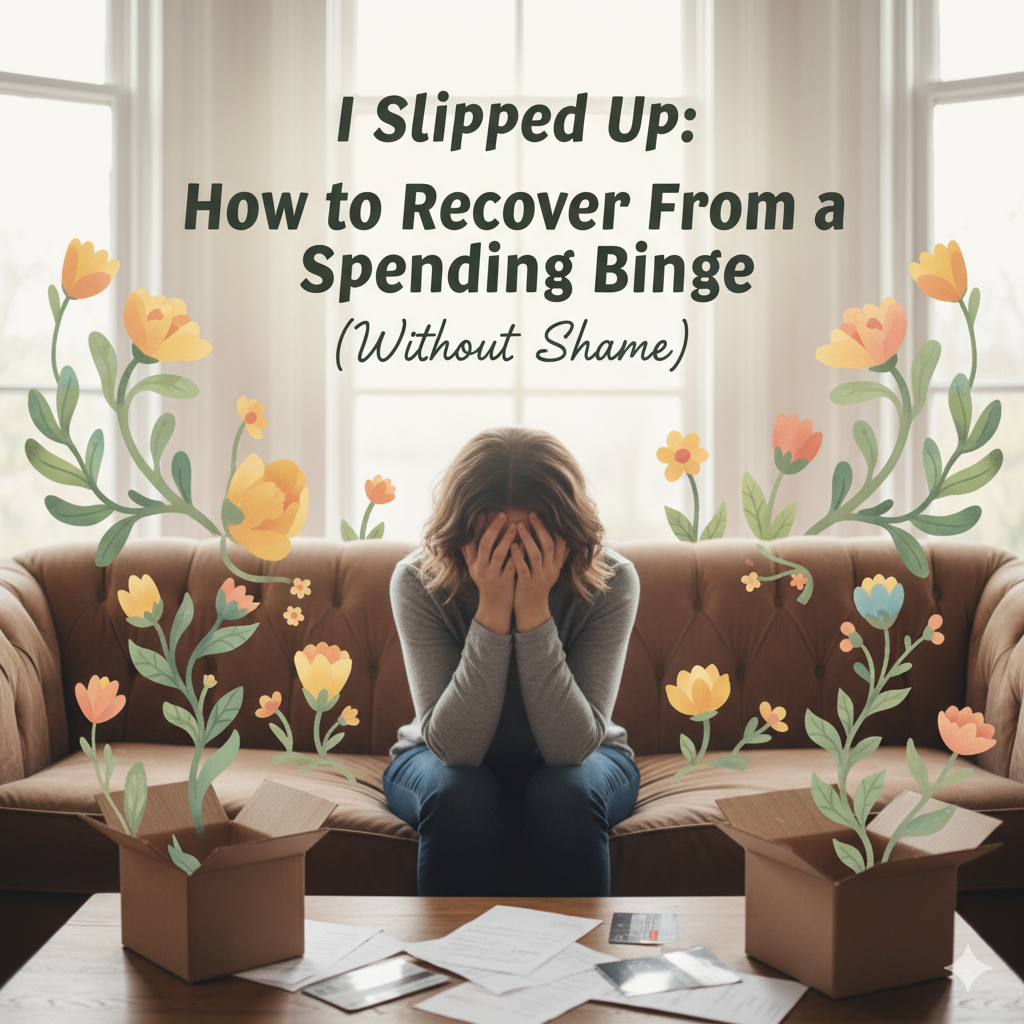
Phase 1: The Crash
The Scene: It was 2:00 PM on a Saturday. Alex stood in the center of the living room, surrounded by three bright yellow shopping bags and an open laptop displaying an order confirmation screen. The total on the screen was $450. The receipt in the bag was another $200.
For the last two hours, Alex had felt amazing. There was a rush, a buzzing energy that made the stress of a terrible work week vanish. But now, as the silence of the apartment settled in, that energy—the dopamine high—evaporated. In its place, a cold, heavy stone settled in Alex’s stomach.
The Science: Alex wasn’t just “irresponsible”; he was experiencing a specific neurochemical event. Research shows that the brain’s reward circuitry releases dopamine primarily during the anticipation of a purchase, often triggering more neural activity than the actual ownership of the item.1 The “thrill of the hunt” acts as a temporary mood repair for stress or boredom.2 But because this relief is chemical and fleeting, the crash is inevitable.
Then came the thought. The dangerous thought.
“Well,” Alex whispered, looking at the bags. “I’ve already blown the budget. I was supposed to save this month, and I ruined it. Since I’m already a failure, I might as well order that takeout I wanted. It doesn’t matter anymore.”
This is the “What-the-Hell Effect”. It is a cycle where a minor indulgence (buying a shirt) triggers a cognitive distortion that rationalizes total abandonment of the goal (spending the rest of the paycheck).4 It is driven by the Abstinence Violation Effect (AVE). Alex didn’t just see a mistake; he saw a character flaw. He attributed the slip-up to internal, permanent failure (“I am bad at money”) rather than a temporary lapse (“I was stressed”).6
Phase 2: The Ostrich Maneuver
The Scene: By Sunday night, Alex had entered full avoidance mode. He threw the receipts in the trash without looking at them. He refused to open his banking app. When his partner asked if he wanted to go over finances, he snapped, “Not right now,” and hid the yellow bags in the back of the closet.
The Science: Alex was drowning in Shame, not Guilt.
- Guilt focuses on behavior: “I did something bad.” This is adaptive; it prompts us to fix the error.
- Shame focuses on the self: “I am bad.” This is toxic. It leads to paralysis.8
Shame triggers the “Ostrich Effect”—the instinct to bury one’s head in the sand to avoid negative information. Research confirms that shame leads to avoidance behaviors, such as ignoring bank balances, which prevents the practical steps needed to stop the financial bleeding.5
Phase 3: Triage and Pattern Interruption
The Scene: Monday morning. The anxiety was now a physical weight. Alex knew he couldn’t hide forever. He remembered a strategy he read about: “Stop the Bleeding.”
He didn’t try to fix his whole life. He just did two things:
- He opened his banking app and hit “Freeze Card.”
- He deleted his credit card info from his favorite browser autofill.
The Science: This is Pattern Interruption. In the acute phase of a binge, willpower is unreliable because the prefrontal cortex (logic) is overwhelmed by the limbic system (impulse). By introducing physical friction—freezing cards and removing digital convenience—Alex bought himself time. He implemented the 24-Hour Rule, forcing a mandatory cooling-off period for any new desires, allowing his neurochemistry to stabilize.11
Phase 4: The Walk of Shame (Rewritten)
The Scene: Tuesday. The yellow bags were still in the closet. The shirt inside didn’t even fit right, but the thought of walking back into the store, facing the clerk, and saying “I made a mistake” felt impossible. They’ll judge me, Alex thought. They’ll know I’m broke.
Then, he tried a mental trick: The Personal Assistant Roleplay.
I am not Alex, he told himself. I am Alex’s personal assistant. My boss, Alex, decided this shirt isn’t required. It is my job to return it. The clerk doesn’t care about the assistant.
He walked into the store. He handed over the bag. The clerk, chewing gum, didn’t even look up. “Receipt in the bag?” she asked. “Yep.” Beep. “Refund to the card?” “Yes.”
It was over in 30 seconds. The shame evaporated.
The Science: The fear of judgment is a projection of our own internal critic. Retail staff are rarely invested in a customer’s narrative.14 By using cognitive distancing (playing the role of an assistant), individuals can bypass the ego’s shame response and reclaim their liquidity.16
Phase 5: The “No-Spend” Trap vs. Rolling with the Punches
The Scene: Wednesday night. Budget night. Alex sat down with his spreadsheet. The “Clothing” category was $200 over budget (even after the return).
His first instinct was punishment. “Okay,” he wrote in his journal. “Next month is a No-Spend Month. I will spend $0 on anything but rent and beans. I have to suffer to make this up.”
He paused. He knew how that story ended. He would last four days, get miserable, and binge again.
Instead, he tried “Rolling with the Punches.”
He looked at his “Vacation Fund.” It had $500. He sighed, and moved $200 from “Vacation” to “Clothing.”
The red ink on the spreadsheet turned zero.
He hadn’t cheated; he had prioritized. He accepted the reality that the money was gone, but he kept his budget accurate.
The Science: Rigid goals, like “No-Spend Months” used as punishment, are brittle. They set the stage for the “What-the-Hell Effect” to return at the slightest failure.17 The “Rolling with the Punches” method (popularized by YNAB) treats the budget as a flexible plan, not a moral decree. By covering overspending with funds from other categories, the user retains agency and control, preventing the psychological collapse that leads to quitting.19
Phase 6: Future-Proofing the Brain
The Scene: Two weeks later. Alex had a terrible meeting at work. He walked past an electronics store. He saw headphones in the window. The urge hit him like a wave—tight chest, racing heart. I deserve these, he thought.
He didn’t fight it. He didn’t scream “NO” inside his head. He just stood there and watched the feeling.
“Okay,” he thought. “I am feeling an urge. My chest is tight. I want the dopamine.”
He waited. One minute. Two minutes.
The wave peaked, broke, and receded. He didn’t buy the headphones.
The Science: Alex practiced Urge Surfing. Instead of fighting the impulse (which often strengthens it), he observed the physical sensations without judgment until they passed.1 He also utilized Future Self Continuity, briefly imagining “Future Alex” next week—would that guy be happy with headphones, or stressed about the credit card bill?1
Epilogue: Antifragility
Alex didn’t become perfect. He slipped up again three months later. But the second time, he didn’t spiral. He didn’t hide the bags. He didn’t hate himself.
He said, “I forgive myself for this mistake. I am human.” 22
Then he returned the item, adjusted the budget, and moved on.
The Lesson: Recovery isn’t about never falling; it’s about shortening the time it takes to get back up. By replacing shame with strategy and rigidity with resilience, the spending binge transforms from a catastrophe into a manageable data point.
Summary of Alex’s Recovery Toolkit
| Challenge | Alex’s Strategy | The Research Principle |
| The Urge | Waited 24 hours; Froze cards | Pattern Interruption & 24-Hour Rule 12 |
| The Shame | “I am an assistant returning this.” | Cognitive Distancing / Roleplay 16 |
| The Budget | Moved money from Vacation to cover debt | Rolling with the Punches (Plasticity) 20 |
| The Mindset | “I slipped, I’m not broken.” | RAP Technique (Realistic, Adaptive, Positive) 6 |
Works cited
- CBT for impulse control – impause, accessed November 19, 2025, https://impause.com/blog/cbt-for-impulse-control
- Money and Mood: How Emotional Spending Affects Your Mental Health, accessed November 19, 2025, https://homewoodhealthcentre.com/articles/money-and-mood/
- Retail therapy – Wikipedia, accessed November 19, 2025, https://en.wikipedia.org/wiki/Retail_therapy
- What-The-Hell Effect | Behavioral Principles, accessed November 19, 2025, https://finsights.advanced-hindsight.com/concepts/what-the-hell-effect/
- How The What-The-Hell Effect Impacts Your Willpower | Psychology …, accessed November 19, 2025, https://www.psychologytoday.com/us/blog/pressure-proof/201701/how-the-what-the-hell-effect-impacts-your-willpower
- The Abstinence Violation Effect and Overcoming It | Psychology Today, accessed November 19, 2025, https://www.psychologytoday.com/us/blog/stigma-addiction-and-mental-health/202309/the-abstinence-violation-effect-and-overcoming-it
- [Box], DEALING WITH THE ABSTINENCE VIOLATION EFFECT – Counseling Approaches To Promote Recovery From Problematic Substance Use and Related Issues – NCBI, accessed November 19, 2025, https://www.ncbi.nlm.nih.gov/books/NBK601490/box/ch3.b36/?report=objectonly
- Breaking Down And Releasing Financial Shame – Brainz Magazine, accessed November 19, 2025, https://www.brainzmagazine.com/post/breaking-down-and-releasing-financial-shame
- Why Some People Shop When They’re Stressed – Psychology Today, accessed November 19, 2025, https://www.psychologytoday.com/us/blog/consumption-and-lifestyles/202410/the-roots-of-retail-therapy
- What Does Shame Have to Do With My Financial Well-being? – Healthy Love and Money, accessed November 19, 2025, https://www.healthyloveandmoney.com/blog/shame-and-my-financial-wellbeing
- Addressing Shame Through Self Compassion – PMC – PubMed Central – NIH, accessed November 19, 2025, https://pmc.ncbi.nlm.nih.gov/articles/PMC11556665/
- 6 Ways To Recover Financially After A Spending Spree – Consumer Credit, accessed November 19, 2025, https://www.consumercredit.com/about-us/news-press-releases/2015/6-ways-to-recover-financially-after-a-spending-spree/
- Stop Impulse Buying with These Simple Techniques – Best Egg, accessed November 19, 2025, https://www.bestegg.com/blog/impulse-buying/
- How to Stop Emotional Spending + Practice Mindful Shopping – YouTube, accessed November 19, 2025, https://www.youtube.com/watch?v=X7GjigNiDtY
- Best Return Stories : r/retail – Reddit, accessed November 19, 2025, https://www.reddit.com/r/retail/comments/ejpqp8/best_return_stories/
- Overcoming the Fear of Returns. How to Learn That It’s Okay to Take… | by Michelle Richardson | Medium, accessed November 19, 2025, https://medium.com/@michellerichardson_11188/overcoming-the-fear-of-returns-5865921da8a3
- The “What the Hell” Effect & How to Conquer Its Vicious Cycle | Brainscape Academy, accessed November 19, 2025, https://www.brainscape.com/academy/what-the-hell-effect/
- https://www.truist.com/money-mindset/principles/budgeting-by-values/no-spend-challenge
- The Psychology of Emotional Spending, accessed November 19, 2025, https://www.psychologytoday.com/us/blog/mental-wealth/202305/the-psychology-of-emotional-spending
- Learn YNAB’s Rule Three: Roll With the Punches, accessed November 19, 2025, https://www.ynab.com/blog/the-beauty-of-rolling-with-the-punches
- Noob Question… How is rolling with the punches budgeting? : r/ynab – Reddit, accessed November 19, 2025, https://www.reddit.com/r/ynab/comments/11jikwh/noob_question_how_is_rolling_with_the_punches/
- 10 Self-Forgiveness Affirmations to Help You Heal, accessed November 19, 2025, https://www.affirmations.online/10-self-forgiveness-affirmations-to-help-you-heal/
- Fostering Self-Forgiveness: 25 Powerful Techniques and Books – Positive Psychology, accessed November 19, 2025, https://positivepsychology.com/self-forgiveness/