
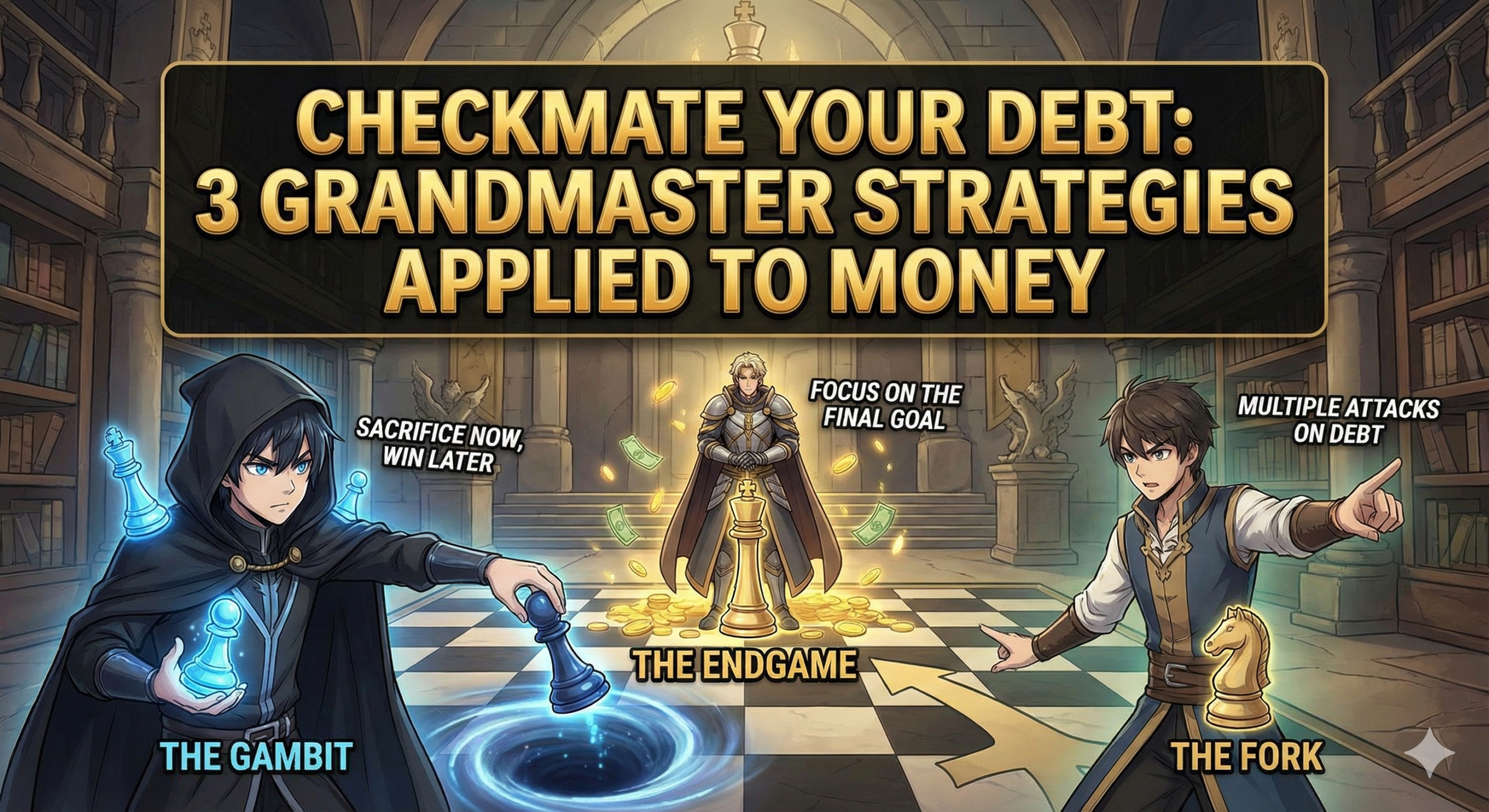
Prologue: The Zugzwang of Daily Life
The rain in the city did not wash things clean; it merely made the grime slicker, reflecting the neon signs of payday lenders and pawn shops like distorted hallucinations. For Elena, the dampness seeped through the soles of her worn boots, a cold reminder of the choices she couldn’t afford to make. She stood outside the glass window of a café she used to frequent, watching people inside laugh over steaming mugs. In her pocket, her phone buzzed—a haptic sting against her thigh. She didn’t need to look to know what it was. It was the bank. Or the credit card company. Or the student loan servicer. The notifications had become a rhythmic background noise to her life, a drumbeat marching her toward a cliff.
She turned away from the window and walked toward the park. It was an odd place for an epiphany, a concrete square dominated by stone tables where old men gathered to play chess regardless of the weather. They sat under the shelter of a large oak, their murmurs blending with the sound of rain on leaves. One man, in particular, caught her eye. He was older than the rest, with a face that looked like a crumpled map of a difficult terrain. He sat alone, a chessboard set up in front of him, staring at a position that seemed hopelessly deadlocked.
Elena paused. She knew nothing of chess, but she knew the look on the old man’s face. It was the same look she saw in the mirror every morning.
“White to move,” the old man said, without looking up. His voice was gravel and dust. “But every move loses.”
Elena stepped closer, drawn by a gravity she couldn’t name. “Why don’t they just stop playing?”
The old man finally looked up. His eyes were startlingly clear, a piercing blue that seemed to see right through her coat to the maxed-out credit cards in her wallet. “Because, my dear, you cannot stop time. In chess, as in life, you are compelled to move. It is called Zugzwang.”
“Zugzwang?” Elena tested the word. It felt heavy on her tongue.
“German,” he said. “It means ‘compulsion to move.’ It is a position where a player is not under direct attack, but any move they make will weaken their position. If they could pass their turn, they would be safe. But the rules forbid it. You must move. And to move is to die.”.1
Elena sat down on the wet stone bench opposite him. “That’s my life,” she whispered. “If I pay the rent, I can’t fix the car. If I don’t fix the car, I lose my job. If I lose my job, I lose the apartment. I’m just… waiting to be checkmated.”
The old man smiled, a slow, sad shifting of wrinkles. “Checkmate is a mercy. It ends the game. Zugzwang is torture. It prolongs the suffering.” He began to reset the pieces, his gnarled fingers moving with surprising grace. “But there is a way out. Always. You are playing the board as you see it now. You are reacting. To win, you must stop thinking like a pawn and start thinking like a Grandmaster.”
He placed a white pawn in the center of the board.
“My name is Viktor,” he said. “And I am going to teach you the three strategies that topple empires. We will learn the Gambit, the art of losing to win. We will learn Simplification, the art of clarity. And we will learn the Endgame, where the smallest pieces become Queens. Are you ready to play?”
Elena looked at the board. For the first time in months, the buzzing in her pocket seemed to fade. “I’m ready,” she said.
Viktor nodded. “Then let us begin with the most important lesson. You cannot win if you do not know the board.”
Part I: Board Vision – The Anatomy of a Financial Battlefield
The novice looks at a chessboard and sees thirty-two wooden carvings. The Grandmaster looks at the same board and sees lines of force, territories of control, and potential futures. This is called Board Vision. In the realm of personal finance, the lack of board vision is the primary cause of defeat. Most individuals navigating the complex global economy operate in a “fog of war.” They have a vague sense of their income and a terrifyingly opaque understanding of their liabilities. They play blindly, hoping their opponent—Debt—will make a mistake.
But Debt is a relentless opponent. It does not sleep, it does not pity, and it compounds with mathematical precision. To defeat it, one must first illuminate the board.
The Center: The Heart of the Conflict
In chess theory, the board is divided into sectors, but none are more critical than the Center—specifically the four squares d4, d5, e4, and e5. Control of the center allows a player to mobilize their pieces to any flank rapidly. A player who controls the center dictates the flow of the game. A player who cedes the center is cramped, reactive, and eventually crushed.4
In your financial life, the Center is your Cash Flow.
Cash flow is not merely your salary; it is the liquidity available to you after the absolute necessities of survival are met. It is the mobility of your money.
- A Cramped Position: When your fixed expenses (rent/mortgage, minimum debt payments, utilities) consume 90% or more of your income, you have lost control of the center. You cannot maneuver. An unexpected bill (an attack on the flank) results in immediate crisis because you have no pieces (dollars) to move to that sector.6
- A Central Stronghold: When you live on 70% of your income, you possess a 30% strategic reserve. You control the center. You can attack debt, invest in opportunities, or defend against emergencies.
The “Octopus” Knight Analogy
Viktor picked up a Knight and placed it on the square e5, right in the middle of the board.
“Look at this Knight,” he told Elena. “From here, it controls eight squares. It can jump to the King’s side, the Queen’s side, the back ranks. It is a monster. We call it an ‘Octopus’ because its tentacles reach everywhere.”.8
He then moved the Knight to the corner square, h1.
“Now look. It controls only two squares. It is the same piece, with the same potential, but its placement makes it useless. It is ‘dim’.”
“Your dollar is the Knight,” Viktor explained. “A dollar spent on interest payments is a Knight in the corner. It does nothing for you. It defends nothing. It attacks nothing. It merely exists until it is captured. A dollar in your control, however—a dollar used to pay down principal or sit in a savings account—is an Octopus. It has power.”
To checkmate your debt, you must relentlessly move your pieces from the corners (waste, interest, fees) to the center (principal payments, savings, investments).
Identifying the Enemy Pieces
Before engaging in strategy, one must accurately assess the opponent’s material. In a financial audit, this means listing every debt not just by balance, but by character. In chess, a Queen is worth nine points, a Rook five, a Bishop or Knight three, and a Pawn one. Debts have similar power rankings based on their interest rates and psychological weight.
Table 1: The Valuation of Enemy Pieces (Financial Debt)
| Chess Piece | Financial Equivalent | Threat Level | Strategic Characteristic |
| The Queen | High-Interest Credit Card Debt | Critical (9+ Points) | The most dangerous piece. It moves fast (compounds daily/monthly) and attacks from all angles (fees, credit score damage). It must be neutralized first. |
| The Rooks | Private Student Loans / Payday Loans | High (5 Points) | Heavy hitters. They move in straight lines (fixed payments) but occupy huge amounts of the board (cash flow). Hard to remove. |
| The Bishops | Car Loans | Moderate (3 Points) | Often disguised as necessary. They can be “good” or “bad” depending on the interest rate. They attack diagonally (depreciation of the asset vs. cost of the loan). |
| The Knights | Personal Loans | Moderate (3 Points) | Tricky. Often used to consolidate other debts. Can be useful tools or dangerous traps if the behavior doesn’t change. |
| The Pawns | Buy-Now-Pay-Later / Subscriptions | Low (1 Point each) | Individually weak, but dangerous in numbers. A “pawn storm” of small payments can overwhelm a King (your budget) by restricting movement. |
| The King | The Mortgage | Ultimate Value | The game typically doesn’t end until this is resolved, but it is often the piece you protect rather than attack early on. |
Most people fear the King (the large mortgage balance) while being checkmated by the Queen (the credit cards). Board vision requires understanding that the $50,000 student loan at 3% interest is less dangerous than the $5,000 credit card at 25% interest. The Queen must be taken off the board.
Part II: The Psychology of the Opening – Fear and “Time Trouble”
“The hardest move,” Viktor said, watching the rain drip from the oak leaves, “is the first one. Because until you move, you exist in a state of possibility. Once you move, you commit to a reality.”
In chess, the clock is as much an enemy as the opponent. Competitive chess is played with time controls. If your flag falls (time runs out), you lose, regardless of how superior your position is. This creates a psychological state known as Time Trouble. When a player is low on time, their heart rate spikes, their cortisol levels rise, and their cognitive functions degrade. They develop tunnel vision. They miss simple solutions. They make blunders.9
Financial stress places the debtor in a state of permanent Time Trouble.
- The Biological Reality: Research shows that chronic financial scarcity lowers a person’s effective IQ by up to 13 points. It occupies “mental bandwidth.” When you are worried about how to pay the electric bill, your brain literally has less processing power available to plan long-term strategies. You are playing a blitz game against an opponent playing a correspondence game.
- The Paralysis: This stress leads to avoidance. Elena admitted to Viktor that she hadn’t opened her mail in three weeks. “If I don’t see the move,” she reasoned, “maybe it hasn’t happened.”
- The Cure: In chess, the cure for time trouble is simplification (which we will cover in Strategy II) and preparation. You must automate the opening moves.
Developing Your Pieces
In the Opening phase (moves 1-10), the goal is Development. You must get your pieces off the back rank and into the game.
In finance, “Development” is the establishment of the systems that will fight the war for you.
- The Budget (The Grid): You cannot play on a board without squares. A budget is simply the grid that defines where pieces can move. Whether you use the 50/30/20 rule or Zero-Based Budgeting, the goal is to define the boundaries of the center.6
- The Audit (The Notation): Chess players write down every move. 1. e4 e5. This allows them to analyze mistakes later. You must track every penny. A coffee is Nf3. A late fee is Blunder??.
“You are afraid of the Opening,” Viktor told Elena. “Because you fear it will reveal you are already losing. But the game does not begin until you engage. Now, let us look at the first Grandmaster Strategy. It is a dangerous one. It requires courage. It is the Gambit.”
Part III: Grandmaster Strategy #1 – The Gambit (Sacrifice)
“The Queen’s Gambit is White’s chess opening that sacrifices the c-pawn… in exchange for a dominant position in the center of the chess board.” 11
History is filled with players who tried to hold onto everything and lost. And it is illuminated by the brilliance of those who knew what to throw away. The most famous example in the history of the game is the Immortal Game of 1851, played between Adolf Anderssen and Lionel Kieseritzky.
In this game, Anderssen did the unthinkable. He was not playing for material wealth; he was playing for checkmate.
- Move 11: He sacrificed a Bishop.
- Move 18: He sacrificed a Rook.
- Move 19: He sacrificed his other Rook.
- Move 22: He sacrificed his Queen.
To a novice spectator, Anderssen was being slaughtered. He had given away all his most valuable pieces. But Anderssen saw what they didn’t: by sacrificing material, he had opened lines of attack that were unstoppable. He delivered checkmate with three minor pieces, while his opponent still had a full board of wealth.12
The Philosophy of the Financial Gambit
In the world of debt, the Gambit is the strategic sacrifice of Lifestyle (Material) to gain Momentum (Tempo) and Position.
Most debtors try to play a defensive game. They try to pay off debt while maintaining their current standard of living. They keep the expensive car, the large apartment, the streaming services, and the weekly dinners out, while making minimum payments on their cards. They are trying to defend every pawn. This leads to a slow, suffocating defeat.
The Grandmaster plays a Gambit. They voluntarily accept a temporary reduction in “wealth” (lifestyle) to secure a winning position.
Executing the “Asset Gambit”
The most powerful move on the financial board for a middle-class debtor is the Asset Gambit.
The Scenario: You own a car worth $25,000. You owe $20,000 on it. The monthly payment is $550, and the insurance is $150. You are “winning” in material (you have a nice car), but you are losing in position (you have -$700 cash flow).
The Move: You sell the car. You take the $5,000 equity and buy a high-mileage, reliable “beater” for cash.
The Sacrifice:
- Status: You are no longer driving a symbol of success.
- Comfort: The new car might not have heated seats or Bluetooth.
- Reliability Risk: You accept a slight increase in the risk of repairs (though this is often overstated).
The Advantage:
- You have instantly reclaimed $700/month of the Center (Cash Flow).
- You have removed a Bishop (the loan) from the enemy’s ranks.
- That $700, when redirected to your “Queen” (the credit card debt), changes the math of the game entirely.
Case Study: The “Scorched Earth” Protocol
Research into extreme debt repayment highlights the efficacy of the “Scorched Earth” Gambit. This is akin to the King’s Gambit, an aggressive, romantic opening that throws caution to the wind.14
Consider the case of “Matt,” a filmmaker from California mentioned in debt consolidation reports.15 He faced over $27,000 in debt and was paying $1,000 monthly just in interest. He was in a losing position.
His Gambit involved a radical restructuring. He entered a debt consolidation program—a move that often hurts one’s credit score temporarily (The Sacrifice). He accepted the “damage” to his credit reputation to stop the bleeding of interest. He cut his expenses to the bone.
- The Result: By sacrificing his credit score in the short term and his lifestyle, he eliminated the debt in under two years. He is now traveling to Europe. He sacrificed the appearance of solvency for actual freedom.
Another couple, facing $200,000 in debt, moved in with parents for two years.16
- The Sacrifice: Privacy, autonomy, “adult” status.
- The Gain: Rent-free living. They redirected 100% of their housing budget to the debt. They cleared the board in record time.
The Psychology of Sacrifice: “Loss Aversion”
Why do so few people play the Gambit? Behavioral economics points to Loss Aversion. The human brain feels the pain of losing a possession twice as intensely as the pleasure of gaining a dollar. Selling the car feels like losing. Moving to a smaller apartment feels like failure.
“You must override your biology,” Viktor told Elena. “Anderssen did not weep for his Rooks. He knew they were the price of the King. Is your car the King? Is your Netflix subscription the King? Or is your Freedom the King?”
Grandmaster Insight: Mikhail Tal, the “Magician from Riga,” once said, “There are two types of sacrifices: correct ones, and mine.”.17 Tal played intuitive, chaotic sacrifices that terrified opponents. You do not need to be Tal. You need to be a calculator. If the sacrifice (selling the car) mathematically clears the debt 2 years faster, it is the correct sacrifice.
Part IV: Grandmaster Strategy #2 – Simplification (The Capablanca Method)
“He [Capablanca] was a master of simplification, often exchanging pieces to simplify the position and create favorable endgames.” 18
If Anderssen was the master of chaos, José Raúl Capablanca (World Champion 1921-1927) was the master of clarity. Capablanca possessed a “crystal clear” style.19 He did not like messy boards. If a position was complicated, with pieces tangled in a knot, Capablanca would find a way to trade them off. He would trade a Knight for a Knight, a Bishop for a Bishop, simplifying the equation until only the essential elements remained. He understood that complexity breeds error.
Complexity is the ally of Debt.
When you have five credit cards, two personal loans, a car note, and a student loan, you are playing a “Simul” (Simultaneous Exhibition) against eight opponents.
- You have eight due dates.
- You have eight different interest rates.
- You have eight login passwords.
- You have eight chances every month to miss a payment and trigger a fee.
This complexity creates Decision Fatigue. It drains your willpower. It forces you into blunders.
The Strategy of “The Exchange”
In chess, an “Exchange” is the trading of pieces of equal value. In finance, this is Consolidation.
The goal of consolidation is not always to lower the total amount owed (though that helps), but to Simplify the Position.20
Table 2: The Simplification Matrix
| Current Position (Chaos) | The Move (Simplification) | The Result (Clarity) |
| 5 Credit Cards @ 22% APR | Consolidation Loan @ 12% APR | 1 Payment. 1 Due Date. Lower Interest. “Time Trouble” reduced. |
| Mixed Federal/Private Student Loans | Refinancing (Private) or Consolidation (Federal) | Unified dashboard. Clear payoff timeline. Warning: Loss of federal protections is a “Gambit” risk. |
| Scattered Due Dates (1st, 5th, 17th, 24th) | Call Creditors to align dates | All bills due on the 1st. You pay all at once. The rest of the month is clear. |
The Debt Snowball vs. Avalanche: A Lesson in Simplification
Financial mathematicians often argue for the Debt Avalanche method: pay the debt with the highest interest rate first. This is mathematically optimal. It is the computer move (Stockfish would play the Avalanche).
However, the Debt Snowball (pay the smallest balance first, regardless of interest) is the Capablanca Move.
- The Scenario: You have a $500 medical bill and a $10,000 credit card.
- The Snowball: You pay off the $500 bill immediately.
- The Effect: You have removed a piece from the board. You now have one fewer enemy to track. You have simplified the game.
- The Psychology: Clearing the small debt provides a dopamine hit—a “quick win.” This builds momentum. In chess, removing the opponent’s pawns clears lines of sight. It makes the Endgame easier to visualize.20
Grandmaster Insight: “The winner of the game is the player who makes the next-to-last mistake.” — Savielly Tartakower.23
By simplifying the board (reducing the number of debts), you reduce the surface area for mistakes. It is harder to miss a payment when you have one debt than when you have ten.
Automation: The Cure for “Time Trouble”
We discussed Time Trouble in the opening. The ultimate Simplification is Automation.
Grandmasters memorize opening lines so they don’t have to think about them. You must automate your payments.
- The Move: Set every debt to auto-pay the minimum amount.
- The Result: You can never blunder a late fee. You have secured your King. Now, you can use your active mental energy to attack (making extra principal payments manually).
Part V: The Middle Game – The Grind and the “Exchange Variation”
“The Middle Game,” Viktor said, as the rain began to soften into a mist, “is where the romance dies. The Opening is full of hope. The Endgame is full of precision. The Middle Game is just… struggle.”
In debt repayment, the Middle Game is the long stretch between the initial excitement of the plan and the final payment. This is months 6 through 36. This is where most players resign.
- The Problem: You are making sacrifices (The Gambit), but the balance is still high. You are bored. The “shiny object syndrome” kicks in. You want to buy things again.
- The Strategy: You must play Prophylaxis.
Prophylaxis: Preventing the Counter-Attack
Prophylaxis is a chess strategy popularized by Aron Nimzowitsch. It involves making moves that prevent the opponent’s plan before it happens.19 It is the art of asking, “What does my opponent want to do?” and stopping it.
What does your opponent (Life/Debt) want to do in the Middle Game?
- Car Breakdown: It wants to force you to borrow money for repairs.
- Medical Emergency: It wants to hit you with a deductible.
- Job Loss: It wants to put you in checkmate.
If you have no defense, these events put you back in Zugzwang. You are forced to use the credit card you just paid off. The game resets, but your morale is broken.
The Prophylactic Move: The Emergency Fund
Before you attack the high-interest debt aggressively, you must build a fortress.
- The Fortress: A savings account with $1,000 to $5,000 (or 3-6 months of expenses, depending on risk tolerance).
- The Function: This money is not for spending. It is a blockade. When the car breaks down, you use the fund, not the credit card. You defend the position without losing material (taking on new debt).
Research in healthcare economics uses “prophylaxis” to describe expensive treatments that prevent catastrophic bleeds in hemophilia patients.25 The cost of the prophylaxis is high, but the cost of the catastrophe is higher. Your emergency fund is expensive (it earns little interest), but it prevents the catastrophe of compounding debt.
Dealing with “Tilt”
In competitive gaming and chess, Tilt is a state of emotional frustration where a player, after suffering a setback, begins to play aggressively and irrationally.
- Financial Tilt: You blow your budget on a Friday night. You feel guilty. You think, “I’ve ruined the plan.” So on Saturday, you go shopping. You spiral.
- The Grandmaster Mindset: “No game was ever won by resigning.” — Savielly Tartakower.27
- Grandmasters blunder. Magnus Carlsen blunders. But they have short memories. They assess the new position and play the best move from there.
- If you blow the budget, do not resign. Reset the board. The game continues.
Part VI: Grandmaster Strategy #3 – The Endgame (Promotion)
The board in the park was nearly empty now. Viktor had traded off the pieces. Elena watched as he pushed a single white pawn up the board. Step by step. Unopposed.
It reached the final square—the eighth rank.
Viktor replaced the tiny pawn with a towering Queen.
“This,” he said, “is the Promotion.”
In chess, the Pawn is the weakest piece. But if it survives the war, if it navigates the dangers of the Middle Game and reaches the other side, it transforms into the most powerful piece on the board.
In the financial Endgame, your debt payments are the Pawns.
The Principle of the Passed Pawn
A Passed Pawn is one with no enemy pawns ahead of it to stop its march. It is a deadly threat.
The Scenario: You have spent 3 years paying $500 a month to a student loan.
The Victory: You make the final payment. The debt is dead.
The Trap: Most people, upon winning the game, retire. They take that $500 and absorb it back into their “Lifestyle.” They eat out more. They lease a better car. The Pawn disappears.
The Grandmaster Move: You Promote the payment.
- You take that $500, which you are already used to living without, and you immediately redirect it to an Investment Account (Index Funds, Retirement).
- The Transformation: The $500 was a soldier fighting a defensive war (paying for the past). Now, it is a Queen fighting an offensive war (building the future). It earns compound interest. It attacks the board.
Calculating the Endgame
The difference between “Debt Free” and “Wealthy” is the Promotion.
Let’s look at the math of the Promotion using the concept of Compound Interest (The Queen’s Power).
Table 3: The Power of Promotion (The $500 Pawn)
| Strategy | Action | Result after 20 Years |
| The Amateur | Pays off debt. Spends the $500/mo on lifestyle. | $0 Wealth. (Temporary pleasure, no asset growth). |
| The Grandmaster | Pays off debt. Invests the $500/mo @ 7% return. | ~$260,000 Wealth. (The Pawn becomes a Queen). |
“You must not just play to not lose,” Viktor said. “You must play to win. The goal is not $0. The goal is Freedom.”
The King’s Safety: Estate Planning and Insurance
In the Endgame, the Kings come out to fight. But a sudden checkmate can still happen.
- Life Insurance: This is castling. It protects your family (The King) from the sudden removal of your income.
- Wills and Trusts: This is the score sheet. It ensures that if the game ends abruptly, your pieces go where you want them to go.
Part VII: Grandmaster Psychology – The Player, Not the Pieces
Viktor began to pack the pieces away into a wooden box. The rain had stopped, leaving the air smelling of ozone and wet earth.
“There is one final lesson,” he said. “Magnus Carlsen, the greatest player of the modern era, once said: ‘I have always believed in what I do on the chessboard, even when I had no objective reason to. It is better to overestimate your prospects than underestimate them.’”.28
Confidence and the Self-Fulfilling Prophecy
Debt destroys confidence. It tells you that you are bad with money. It tells you that you are destined to struggle. This is a losing mindset.
- The Carlsen Mindset: You must believe you are a player capable of winning. Even if the computer evaluation says you are down -3.00 (you have negative net worth), you play for the win. You complicate the position. You look for tactical shots.
The “Sunk Cost” of Identity
You must let go of the identity of “The Debtor.”
In chess, if you start a game badly, you cannot ask to restart. You play the position on the board.
- Don’t say: “I was stupid to buy that car.” (Looking at the past).
- Say: “White to move. What is the best move now?” (Looking at the future).
“You are not your debt, Elena,” Viktor said, snapping the latch of the box shut. “The debt is just the position of the pieces. You are the player. The pieces can be terrible, but if the player is strong, the game can be saved.”
Epilogue: The Next Move
Elena watched Viktor walk away, his silhouette fading into the greyscale of the city evening. She sat alone at the stone table for a long time. The board was empty, but in her mind, she could see the squares lighting up.
She reached into her pocket and pulled out her phone. The buzzing had stopped. The screen glowed with the familiar, terrifying notification of her banking app.
- Credit Card Balance: $4,352.18
- Checking Account: $214.50
It was a bad position. A terrible position. She was in Zugzwang.
But for the first time, she didn’t just see the red numbers. She saw the board.
She saw the “Octopus” she could create if she stopped buying lunch.
She saw the “Gambit” she could play if she sold her designer handbag online—a small sacrifice of material for a gain in tempo.
She saw the “Snowball” she could roll.
Elena opened her calendar. She typed in a date, two years from today: Checkmate.
Then, she opened the transfer screen. She moved $50 from her checking to her credit card.
It wasn’t a lot. It was just a pawn move. 1. e4.
But it was a move. And in the game of chess, as long as you can move, you are still alive.
The game had begun.
Technical Appendix: Implementation Guide
For the reader ready to apply the Grandmaster System, the following technical breakdown provides the specific “opening lines” for your financial game.
Appendix A: The Notation of Debt (The Audit)
You cannot play without notation. Create a spreadsheet (The Score Sheet) with the following columns. Rank them by “Threat Level” (Interest Rate).
| Debt Name (Piece) | Balance (Material) | Interest Rate (Threat) | Minimum Payment (Movement) | Strategy (Snowball vs Avalanche) |
| Credit Card A | $2,000 | 24.99% | $60 | TARGET (High Interest + Low Balance) |
| Car Loan | $15,000 | 6.00% | $350 | Maintenance (Auto-pay) |
| Student Loan | $30,000 | 4.50% | $200 | Maintenance (Auto-pay) |
Appendix B: Advanced Tactics
1. The “Balance Transfer” Maneuver (The Exchange Variation)
- Concept: Moving high-interest debt to a 0% APR card.
- Chess Equivalent: Trading a dangerous attacking Queen for a passive, blocked Bishop.
- The Trap: If you do not pay off the balance before the 0% period ends (usually 12-18 months), the Queen returns to the board with retroactive interest (Checkmate).
- Execution: Only play this move if you have the cash flow (The Center) to pay off the balance within the time limit.30
2. The “Side Hustle” Attack (Pawn Storm)
- Concept: Increasing income through secondary work.
- Chess Equivalent: A “Pawn Storm.” Advancing multiple pawns to break open the opponent’s defenses.
- Execution: Use the extra income only for the debt. Do not absorb it into lifestyle. This is pure attacking material.
3. The “Covenant Waiver” (Negotiation)
- Concept: Calling creditors to ask for lower rates or hardship plans.
- Chess Equivalent: Offering a draw or navigating a complex position to find a loophole.
- Reality: Creditors often prefer to get some money rather than no money (bankruptcy). You can often negotiate “The Exchange” of terms.31
Appendix C: Global Applicability
While the currency symbols here are generic, the principles are universal.
- Inflationary Economies (e.g., Argentina, Turkey): The “Gambit” of holding debt can sometimes be beneficial if the debt is fixed-rate and inflation erodes its value. However, high interest rates usually accompany inflation, negating this. The “Asset Gambit” (holding hard assets) becomes more important.
- Deflationary/Stable Economies (e.g., Japan, Eurozone): Cash is King. Debt is more expensive in real terms. The “Snowball” and aggressive payoff are critical.
Final Directive:
The board is set. The clock is ticking. You have the strategies.
Move.
Works cited
- The Impact of Global Capital Flows and Foreign Financing on U.S. Mortgage and Treasury Interest Rates, accessed November 27, 2025, https://www.mba.org/docs/default-source/research—riha-reports/57160_7282_riha.pdf?sfvrsn=cbed9417_1
- Ferguson’s Law: Debt Service, Military Spending, and the Fiscal Limits of Power – Hoover Institution, accessed November 27, 2025, https://www.hoover.org/sites/default/files/research/docs/HAHWGWorkingPaper-212502-Ferguson%27s%20Law-Final.pdf
- Full article: Democratizing the monetary provisioning system to enable social-ecological transformation – Taylor & Francis Online, accessed November 27, 2025, https://www.tandfonline.com/doi/full/10.1080/15487733.2024.2344305
- Chess Strategy – about.openlibhums.org, accessed November 27, 2025, https://about.openlibhums.org/Download_PDFS/textbooks/ABvTqe/Chess-Strategy.pdf
- How chess and entrepreneurship are the same – rbucks.com, accessed November 27, 2025, https://rbucks.com/2019/11/28/how-chess-and-entrepreneurship-are-the-same/
- All The Right Moves: 6 Money Lessons From the Game of Chess – Juno, accessed November 27, 2025, https://juno.finance/blog/all-the-right-moves-6-money-lessons-from-the-game-of-chess
- How Business Leaders Can Apply Chess Strategy To Decision-Making – Forbes, accessed November 27, 2025, https://www.forbes.com/councils/forbesbusinesscouncil/2024/12/18/how-business-leaders-can-apply-chess-strategy-to-decision-making/
- Beginner Chess Strategy: 5 Must-Know Tips – by GM Noël Studer, accessed November 27, 2025, https://nextlevelchess.com/beginner-chess-strategy/
- The Mental Game: Why Chess Players Need Sport Psychology – ChessBase, accessed November 27, 2025, https://en.chessbase.com/post/the-mental-game-why-chess-players-need-sport-psychology
- Differences Between High vs. Low Performance Chess Players in Heart Rate Variability During Chess Problems – PMC – PubMed Central, accessed November 27, 2025, https://pmc.ncbi.nlm.nih.gov/articles/PMC6400145/
- 2 Key Traits Smart Investors Share with Great Chess Players | Kiplinger, accessed November 27, 2025, https://www.kiplinger.com/investing/601920/2-key-traits-smart-investors-share-with-great-chess-players
- Immortal Game – Wikipedia, accessed November 27, 2025, https://en.wikipedia.org/wiki/Immortal_Game
- The Immortal Chess Game – Every Move Explained – Anderssen vs. Kieseritzky, 1851, accessed November 27, 2025, https://www.chess.com/blog/SamCopeland/the-immortal-chess-game-every-move-explained-anderssen-vs-kieseritzky-1851
- The Immortal Game — Adolf Anderssen vs Lionel Kieseritzky – Lichess.org, accessed November 27, 2025, https://lichess.org/study/MwalNAcW/Hx7RurEp
- 5 Debt Success Stories: How Real People Paid-Off Thousands in Debt Through Debt Consolidation – Top Dollar, accessed November 27, 2025, https://www.accrediteddebtrelief.com/blog/5-debt-success-stories-how-real-people-paid-off-thousands-in-debt-through-debt-consolidation/
- Our Debt Story: How We Paid Off $200k – Happily Ever After, accessed November 27, 2025, https://happilyeverafter.org/our-debt-story-how-we-paid-off-200k/
- Chess Quotes You May Not Have Heard Before, accessed November 27, 2025, https://www.chess.com/article/view/chess-quotes
- Jose Raul Capablanca – Chess Champion Extraordinaire, accessed November 27, 2025, https://www.henrychesssets.com/jose-raul-capablanca-chess-champion-extraordinaire/
- What Can We Learn From the “Crystal Clear” Chess Style of Capablanca. – Medium, accessed November 27, 2025, https://medium.com/@musson_fraser/what-can-we-learn-from-the-crystal-clear-chess-style-of-capablanca-6b778cc8cff5
- Debt Consolidation vs. Debt Snowball – Legacy Life Planning Lance, accessed November 27, 2025, https://legacylifeplanninglance.com/debt-consolidation-vs-debt-snowball/
- Breaking Down the Math: When Consolidation Saves You the Most | BHG Financial, accessed November 27, 2025, https://bhgfinancial.com/personal-loans/debt-consolidation/when-consolidation-saves-you-the-most
- Snowball vs. Avalanche Method for Paying Down Debt | Navy Federal Credit Union, accessed November 27, 2025, https://www.navyfederal.org/makingcents/credit-debt/snowball-vs-avalanche-for-paying-down-debt.html
- The quotes of chess grandmaster Saviely Tartakower fit League of Legends to a surprisingly high degree. : r/leagueoflegends – Reddit, accessed November 27, 2025, https://www.reddit.com/r/leagueoflegends/comments/38hcp1/the_quotes_of_chess_grandmaster_saviely/
- Quotes by Savielly Tartakower (Author of 500 Master Games of Chess) – Goodreads, accessed November 27, 2025, https://www.goodreads.com/author/quotes/363694.Savielly_Tartakower
- Health care resource utilization and costs among adult patients with hemophilia A on factor VIII prophylaxis: an administrative claims analysis – NIH, accessed November 27, 2025, https://pmc.ncbi.nlm.nih.gov/articles/PMC10391018/
- The cost of severe haemophilia in Europe: the CHESS study – ResearchGate, accessed November 27, 2025, https://www.researchgate.net/publication/317351941_The_cost_of_severe_haemophilia_in_Europe_the_CHESS_study
- The Tartakoverisms of Savielly Tartakower – Chess.com, accessed November 27, 2025, https://www.chess.com/blog/ThummimS/the-tartakoverisms-of-savielly-tartakower
- Magnus Carlsen quotes: His most instructive advice about chess – Chessable, accessed November 27, 2025, https://www.chessable.com/blog/magnus-carlsen-quotes-chess/
- Quotes by Magnus Carlsen (Author of Grind Like a Grandmaster) – Goodreads, accessed November 27, 2025, https://www.goodreads.com/author/quotes/6880208.Magnus_Carlsen
- Does anyone have a good ‘climbing out of a mountain of debt’ story? : r/UKPersonalFinance, accessed November 27, 2025, https://www.reddit.com/r/UKPersonalFinance/comments/splocz/does_anyone_have_a_good_climbing_out_of_a/
- Corporate Restructuring Primer | Reorganization Strategy – Wall Street Prep, accessed November 27, 2025, https://www.wallstreetprep.com/knowledge/restructuring/